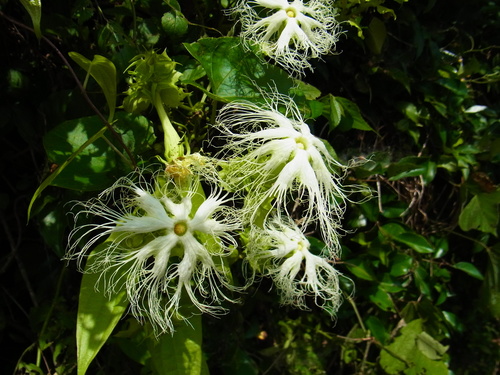
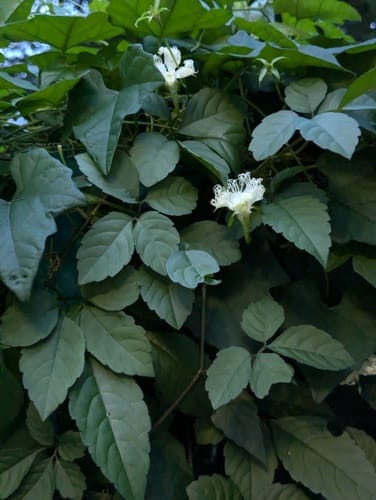
Coccinia abyssinica
(Lam.) Cogn.
Anchote
iNaturalist· cc-by-sa
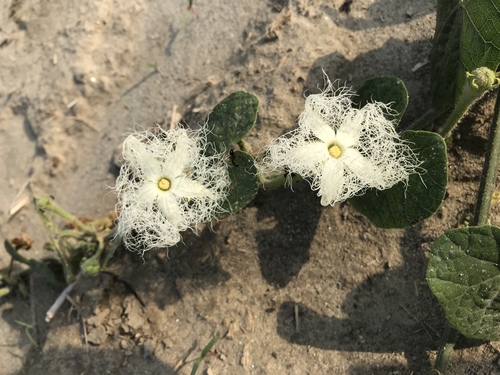
(c) Pharaoh han, some rights reserved (CC BY-SA)
iNaturalist· pd
anonymous, no known copyright restrictions (public domain)
iNaturalist· cc-by-nc
(c) T.H.Haileselasie, some rights reserved (CC BY-NC)
Summary
Source: WikipediaCoccinia abyssinica is an Ethiopian species of Coccinia which was first described by Jean-Baptiste Lamarck. The tuber is under its Oromo name anchote a well-known local crop, but also the leaves are eaten.
Description
A pumpkin family herb. It is a climbing vine plant. It has a tuber and puts out annual stems. The female flowers occur singly and the male flowers in groups. The fruit are oval shaped. They are reddish-yellow. They are about 4 cm long. They contain about 150 seeds. The seeds have a slimy covering.
Edible Uses
Coccinia abyssinica tubers are an important staple crop in the Ethiopian highlands. The tubers are rich in starch and are cooked. Also the young shoots and the leaves are cooked and eaten around Dembi Dolo, Oromia State. There are also beliefs about medical use, but none is scientifically verified so far. The relatively high content of calcium might be the reason for the local belief that eating C. abyssinica helps against fractured bones. The edibility of the fruits is disputed, eventually, there are different races.
Traditional Uses
The tubers are used as food. They are boiled and then often fried. The young shoots are cooked and eaten as a vegetable.
This uses section is brief — help expand it
Distribution
A tropical plant. It grows in areas with at least 950-1000 mm of rainfall and will grow in areas with 2400 mm rainfall. It grows at altitudes between 1,300-2,800 m. It can grow in arid places.
Where It Grows
Africa, East Africa, Ethiopia*, Ghana, West Africa,
Cultivation
It is grown from seed or tubers. It requires support for its climbing habit. The seeds are sown at the beginning of wet season. 2-3 seeds are sown 2-3 cm deep in prepared holes. They are spaced about 1 m apart. Seeds germinate best with a temperature between 20°-30°C. Seedlings can be transplanted.
Production
Tubers can weigh 5 kg after several years. Tubers are best eaten after 10-12 months. The tubers of cultivated plants are the ones that are used.
Other Information
It is a cultivated food plant. It is a high yielding root crop.
Notes
There are about 30 Coccinia species. They are mostly in Africa.
Synonyms
Also Known As
Aamola, Anchote, Hamola, Poteta-karata
References (13)
- Addis, G., Asfaw, Z & Woldu, Z., 2013, Ethnobotany of Wild and Semi-wild Edible Plants of Konso Ethnic Community, South Ethiopia. Ethnobotany Research and Applications. 11:121-141
- A. L. P. P. de Candolle & A. C. de Candolle, Monogr. phan. 3:536. 1881 (As (Lam.) Cogn.)
- Asfaw, Z. and Tadesse, M., 2001, Prospects for Sustainable Use and Development of Wild Food Plants in Ethiopia. Economic Botany, Vol. 55, No. 1, pp. 47-62
- Asfaw, Z., Conservation and use of traditional vegetables in Ethiopia. FAO
- Edwards. S., et al, (Eds), 1995, Flora of Ethiopia and Eritrea. Vol.2, Part 2 Canellaceae to Euphorbiaceae. Uppsala, Sweden. p 55
Show all 13 references Hide references
- Grubben, G. J. H. and Denton, O. A. (eds), 2004, Plant Resources of Tropical Africa 2. Vegetables. PROTA, Wageningen, Netherlands. p 203
- Lulekal, E., et al, 2011, Wild edible plants in Ethiopia: a review on their potential to combat food insecurity. Afrika Focus - Vol. 24, No 2. pp 71-121
- Mekbib, Y & Deressa, T., 2015, Exploration and collection of root and tuber crops in East Wollega and Ilu Ababora zones: Rescuing declining genetic resources. Indian Journal of Traditional Knowledge. Vol. 15(1), pp. 86-92
- Molla, A., Ethiopian Plant Names. http://www.ethiopic.com/aplants.htm
- Robinson, R.W., & Decker-Walters, D.S., Cucurbits. CAB International p
- Royal Botanic Gardens, Kew (1999). Survey of Economic Plants for Arid and Semi-Arid Lands (SEPASAL) database. Published on the Internet; http://www.rbgkew.org.uk/ceb/sepasal/internet [Accessed 15th April 2011]
- World Checklist of Useful Plant Species 2020. Royal Botanic Gardens, Kew
- Zeven, A. C. & de West, J. M. J., 1982, Dictionary of cultivated plants and their regions of diversity. Wageningen. p 124