Citrullus lanatus
(Thunb.) Matsum. & Nakai
Watermelon
iNaturalist· cc0
no rights reserved
iNaturalist· cc-by-nc-sa
(c) Ahmad Fuad Morad, some rights reserved (CC BY-NC-SA)
iNaturalist· cc-by-nc
(c) olgaaseeva, some rights reserved (CC BY-NC)
Summary
Source: WikipediaAn annual plant reaching 0.5 m tall by 2 m wide. Hardy to UK zone 9 and frost tender. Flowers from July to August. Monoecious with insect pollination and self-fertile. Grows in light sandy and medium loamy soils, preferring well-drained conditions. Suitable for mildly acid, neutral, and basic soils. Requires full sun and tolerates both dry and moist conditions with good drought tolerance. Fruit varies considerably by cultivar, reaching up to 1 meter long and 40 cm wide.
Description
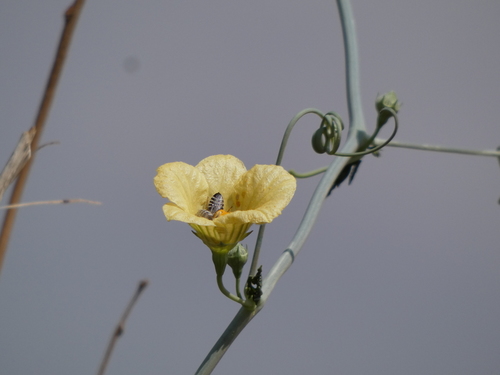
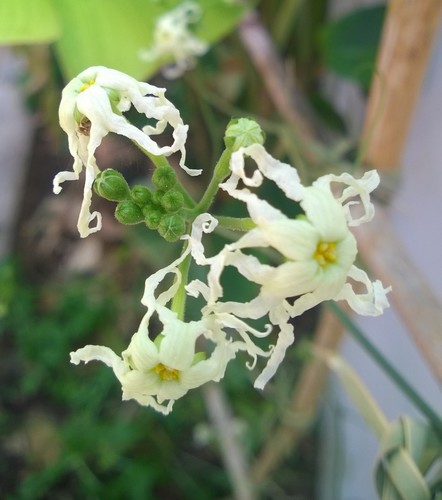
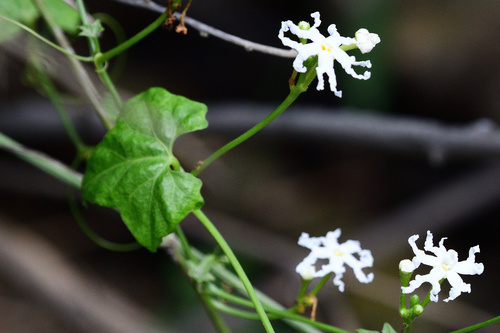
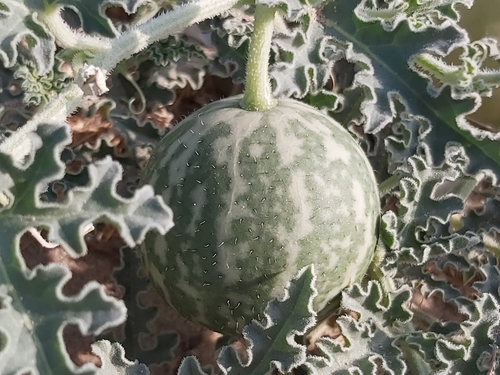
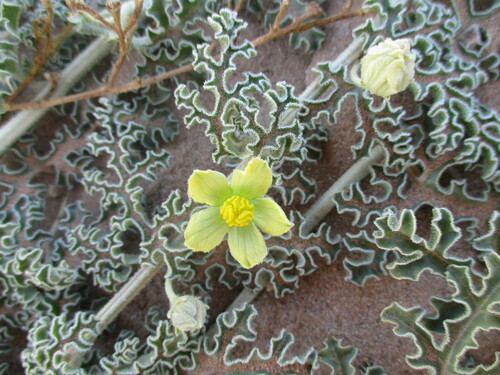
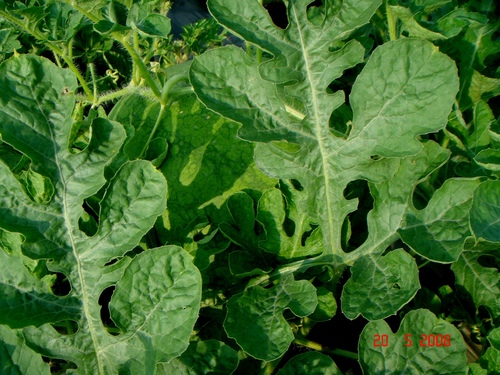
An annual climber with deeply divided leaves and tendrils along the vine. It trails over the ground and has hairy, angular stems. The leaves are on long leaf stalks. The leaves are deeply divided along their length. These lobe are rounded and can themselves be divided. The leaves are 5-20 cm long by 2-12 cm across. The tendrils are divided. The plant has separate male and female flowers on the same plant. The flowers are pale yellow and smaller than pumpkins. The flowers occur in the axils of leaves. The male flowers appear first. Fruit are large and round or oval. They can be 60 cm long. Fruit have a hard smooth skin. Several fruit colours and shapes occur. Often they have a dark green mottle. The fruit has reddish juicy flesh and black or red seeds. The seeds are oval shaped and smooth. The seed size and shape vary considerably.
Edible Uses
The fruit is eaten raw and is prized for its refreshing, delicately sweet flavour and extremely high water content — it is often consumed as a drink in itself. Unripe fruits can be added to soups, and a syrup can be made from the juice. The fruit is a rich source of pectin, useful for adding to low-pectin fruits when making jam; pectin is said to protect the body against radiation. Fruit size varies greatly by cultivar but can reach up to 1 metre long and 40cm wide. Leaves can be eaten cooked. Seeds are edible raw or cooked — roasted whole, or ground into a powder and mixed with cereal flours for breads and cakes, or added to soups and stews. The seed contains about 30% protein and 20–40% oil, from which an edible oil is extracted. Nutritional values per 100g (dry weight, 344 calories): Water 0%, Protein 7.8g, Fat 1.6g, Carbohydrate 85.9g, Fibre 6.3g, Ash 4.7g; Calcium 125mg, Phosphorus 141mg, Iron 4.7mg, Potassium 1351mg; Vitamin A 4300mg, Thiamine (B1) 0.5mg, Riboflavin (B2) 0.6mg.
Traditional Uses
The fruit is eaten raw when ripe. Small unripe fruit can be cooked as a vegetable. Seeds are also eaten. They are dried, soaked in salt water then roasted. Oil is extracted from the seeds. The seeds are ground and made into bread. Occasionally very young leaves are eaten. The skin is sometimes candied in vinegar then eaten with fish. The syrup from the fruit can be used in jams and cakes.
Medicinal Uses
The seed is demulcent, diuretic, pectoral and tonic, and is used to treat conditions of the urinary passages and bed wetting. It is also an effective vermifuge: a fatty oil in the seed, as well as aqueous or alcoholic extracts, paralyze tapeworms and roundworms. The seed also has a hypotensive action. The fully ripe fruit — or even fruit that is almost putrid — is used as a febrifuge, and is also diuretic, being effective in treating dropsy and renal stones. The fruit contains lycopine (also found in tomato skins), which has been shown to protect against heart attacks and is more effective when cooked. The fruit rind is prescribed for alcoholic poisoning and diabetes. The root is purgative and in large doses is said to be a certain emetic.
Known Hazards
The sprouting seed produces a toxic substance in its embryo.
Distribution
A tropical plant. They grow best on the coast in the tropics but will grow up to about 1,700 m altitude. They will not stand water-logging and do well on sandy soils. Plants are frost sensitive. Seed will not germinate below 21°C. Temperatures between 24-30°C are suitable. It can grow in arid places. Fruit are sweeter in arid warm areas. It suits hardiness zones 10-12.
Where It Grows
Africa, Amazon, Angola, Argentina, Aruba, Asia, Australia, Austria, Azerbaijan, Balkans, Bangladesh, Benin, Bolivia, Botswana, Bougainville, Brazil, Burkina Faso, Burundi, Cabinda, Cambodia, Cameroon, Cape Verde, Caucasus, Central Africa, Central African Republic, CAR, Central America, Central Asia, Chad, China, Colombia, Congo DR, Cook Islands, Costa Rica, Côte d'Ivoire, Cuba, Dominican Republic, East Africa, East Timor, Easter Island, Ecuador, Egypt, Equatorial-Guinea, Eritrea, Eswatini, Ethiopia, Europe, Fiji, FSM, Gabon, Gambia, Georgia, Ghana, Greece, Grenada, Guam, Guiana, Guianas, Guinea, Guinée, Guinea-Bissau, Guyana, Haiti, Hawaii, Himalayas, India, Indochina, Indonesia, Iran, Iraq, Italy, Ivory Coast, Jamaica, Japan, Kenya, Kiribati, Korea, Kyrgyzstan, Laos, Lesotho, Liberia, Libya, Macedonia, Madagascar, Malawi, Malaysia, Maldives, Mali, Malta, Marquesas, Mauritania, Mauritius, Mediterranean, Mexico, Middle East, Mozambique, Myanmar, Namibia, Nauru, Nepal, New Zealand, Nicaragua, Niger, Nigeria, Niue, North Africa, North America, Northeastern India, Pacific, Pakistan, Papua New Guinea, PNG, Paraguay, Peru, Philippines, Pohnpei, Puerto Rico, Rotuma, Russia, Sahel, Samoa, Sao Tome and Principe, Saudi Arabia, SE Asia, Senegal, Serbia, Seychelles, Sierra Leone, Solomon Islands, Somalia, South Africa, Southern Africa, South America, South Sudan, Spain, Sri Lanka, St. Vincent and Grenadines, Sudan, Suriname, Swaziland, Switzerland, Syria, Tajikistan, Tanzania, Thailand, Timor-Leste, Togo, Tokelau, Tonga, Tunisia, Turkey, Türkiye, Tuvalu, Uganda, Ukraine, USA, Uzbekistan, Vanuatu, Venezuela, Vietnam, West Africa, West Indies, Yugoslavia, Zambia, Zimbabwe,
Cultivation
Plants are grown from seed. They are suitable mainly for the dry season. A spacing of 1.5 to 2 m is suitable. They grow easily from seed. They do best when fully exposed to the sun. Seed can be dried and stored. If too much vegetative growth occurs picking out the tip to produce side branches with more fruit.
Propagation
Sow seed in spring in rich compost in a greenhouse. Either put 2–3 seeds per pot and thin to the strongest plant, or prick out seedlings into individual pots of rich soil as soon as they are large enough to handle. Grow on quickly and, if planting outside, do so after the last expected frosts. Provide protection such as a cloche or frame at least until the plants are growing away vigorously.
Other Uses
The seed contains 20–40% oil, which is used both as an edible oil and for making soap and for lighting. Face masks made from the fruit are used as a cosmetic on delicate skin.
Production
Plants grow quickly. Harvesting commences after 4-5 months. The main fruit season is November to January. The ripeness can be picked by tapping the fruit to get a dull sound, the part of the fruit on the ground changes from green to light yellow and the tendril near the base of the fruit becomes dry. Fruit yield can be 45-60 tons per hectare. There can be 4-6 fruit on each plant.
Other Information
It is a commercially cultivated vegetable. The seeds are a popular food in China. Common and popular in lowland areas of Papua New Guinea.
Notes
There are 3 Citrullus species. The fruit are mostly water with little food value or taste. Some kinds are being selected for seeds for oil. The seed oil is nutritious.
Nutrition
| Part | Moisture | kJ | kcal | Protein | Vit A | Vit C | Iron | Zinc |
|---|---|---|---|---|---|---|---|---|
| Seeds | 10 | 2107 | 514 | 40 | — | — | 5.6 | — |
| Fruit | 90 | 148 | 36 | 0.6 | — | — | 0.2 | — |
Synonyms
Also Known As
Agushi, Anowotere, Atsetsea, Bara, Battikh, Beteka, Bittekh, Blass, Bostan, Bvani, Chimwamaji, Chimwela, Cimango, Dagita, Deri, Dole dodosine, Dua hau, Egusi, Goussi-gaga, Guna, Habu, Ibece, Ibotolo, Ihele, Intshabotyi, Itikitiki, Kalambojo, Kamandiki, Kankana, Karaa, Kemikaii, Kgengwe, Khakha, Komadu, Labu ayer, Lehapu, Lerotse, Litichiti, Majoda, Makakabane, Makatendry, Mak po, Matao, Mbika ntetu, Melancia, Meleni, Melon de agua, Mendikai, Mereni, Mubvembe, muShamba, Munwiwa, Mutshatsha, muVise, Narracuene, Nendikai, Ogili, Oru, 'Owllok, Pakwan, Patilla, Peni-komadu, Pitcha, Raiapisa, Rayapisa, Samangka, Sandia, Sandiya, Sania, Semongka, Sihka, Tarabuja, Tarbuj, Tarbuz, Tarmuj, Te meren, Tembikai, Temikai, Thaisim hagong, Thoomo, Tinacanti, Tjoto, Voasavy, Vwende, Watesan, Watre, Wedamelon, Werewere
References (142)
- Achigan-Dako, E, et al (Eds), 2009, Catalogue of Traditional Vegetables in Benin. International Foundation for Science.
- Addis, G., Asfaw, Z & Woldu, Z., 2013, Ethnobotany of Wild and Semi-wild Edible Plants of Konso Ethnic Community, South Ethiopia. Ethnobotany Research and Applications. 11:121-141
- Ambasta, S.P. (Ed.), 2000, The Useful Plants of India. CSIR India. p 127 (As Citrullus vulgaris)
- Anderson, E. F., 1993, Plants and people of the Golden Triangle. Dioscorides Press. p 206
- Arnold, T.H., Wells, M.J. & Wehmeyer, A.S., Khoisan food plants: taxa with potential for future economic exploitation, in Wickens, G.E., Goodin, J.R., and Field, D.V.,(Eds.) 1985, Plants for Arid Lands. Unwin Hyman, London, p 73
Show all 142 references Hide references
- Baa-Poku, F. & Asante, I. K., 2020, Use of Neglected and Underutilized Crop Species (NUCS) in some farming communities in the Upper Afram and Upper Dayi River Basins in Ghana. International Journal of Technology and Management Research 5 (2): 48-63
- Barrau, J., 1976, Subsistence Agriculture in Melanesia. Bernice P. Bishop Museu, Bulletin 219 Honolulu Hawaii. Kraus reprint. p 53 (As Citrullus vulgaris)
- BHANDARI,
- Beckstrom-Sternberg, Stephen M., and James A. Duke. "The Foodplant Database." http://probe.nalusda.gov:8300/cgi-bin/browse/foodplantdb.(ACEDB version 4.0 - data version July 1994)
- Bennett, B. C., 1990, Useful Plants of Amazonian Ecuador. US Agency for International Development. Fifth Progress Report. New York Botanical Gardens. p 40
- Bianchini, F., Corbetta, F., and Pistoia, M., 1975, Fruits of the Earth. Cassell. p 138
- Brouk, B., 1975, Plants Consumed by Man. Academic Press, London. p 203
- Burkill, H. M., 1985, The useful plants of west tropical Africa, Vol. 1. Kew.
- Burkill, I.H., 1966, A Dictionary of the Economic Products of the Malay Peninsula. Ministry of Agriculture and Cooperatives, Kuala Lumpur, Malaysia. Vol 1 (A-H) p 567 (As Citrullus vulgaris)
- Bussman, R. W., et al, 2016, A comparative ethnobotany of Khevsureti, Samtskhe-Javakheti, Tusheti, Svaneti, and Racha-Lechkhumi, Republic of Georgia (Sakartvelo), Caucasus. Journal of Ethnobiology and Ethnomedicine (2016) 12:4
- Bussman, R. W. et al, 2017, Ethnobotany of Samtskhe-Javakheti, Sakartvelo (Republic of Georgia), Caucasus. Indian Journal of Traditional Knowledge Vol. 16(1) pp 7-24
- Bussman, R. W., et al, 2021, Unity in diversity—food plants and fungi of Sakartvelo (Republic of Georgia), Caucasus. Journal of Ethnobiology and Ethnomedicine (2021) 17:72 p 8
- Cat. sem. spor. hort. bot. Univ. Imp. Tokyo 30, no. 854. 1916 (l.c. 38. 1920)
- Cheifetz, A., (ed), 1999, 500 popular vegetables, herbs, fruits and nuts for Australian Gardeners. Random House p 179
- Chin, H.F., & Yong, H.S., 1996, Malaysian Fruits in Colour. Tropical press, Kuala Lumpur p 24
- Cobley, L.S. (rev. Steele, W.M.) 2nd Ed., 1976, An Introduction to the Botany of Tropical Crops. Longmans. p 139
- Coe, F. G. & Anderson, G. J., 1997, Ethnobotany of the Miskitu of Eastern Nicaragua. Journal of Ethnobiology 17(2): 171-214
- CRÉAC'H, (As Citrullus vulgaris)
- Cundall, P., (ed.), 2004, Gardening Australia: flora: the gardener's bible. ABC Books. p 382
- D'Ambrosio, U., & Puri, R. K., 2016, Foodways in transition: food plants, diet and local perceptions of change in a Costa Rican Ngäbe community. Journal of Ethnobiology and Ethnomedicine (2016) 12:3 p 22
- Dansi, A., et al, 2008, Traditional leafy vegetables and their use in the Benin Republic. Genet Resour Crop Evol (2008) 55:1239–1256
- Dansi, A., et al, 2012, Diversity of the Neglected and Underutilized Crop Species of Importance in Benin. The Scientific World Journal. Volume 2012, Article ID 932947, 19 pages
- Diarra, N. et al, 2016, Etude ethnobotanique des plantes alimentaires utilisées en période de soudure dans les régions Sud du Mali. Int. J. Biol. Chem. Sci. 10(1): 184-197
- Duarte, M. C., et al, 2022, Diversity of Useful Plants in Cabo Verde Islands: A Biogeographic and Conservation Perspective. Plants 2022, 11, 1313 p 10
- Edwards. S., et al, (Eds), 1995, Flora of Ethiopia and Eritrea. Vol.2, Part 2 Canellaceae to Euphorbiaceae. Uppsala, Sweden. p 48
- Ekman Herbarium records Haiti (As Citrullus vulgaris)
- Epenhuijsen C.W. van., 1974, Growing Native vegetables in Nigeria. FAO Rome, p 53
- Facciola, S., 1998, Cornucopia 2: a Source Book of Edible Plants. Kampong Publications, p 84
- FAO, 1988, Traditional Food Plants, FAO Food and Nutrition Paper 42. FAO Rome p 186
- Farooq, S., et al, 2012, Ethnobotanical Studies of the Flora of Tehsil Birmal in South Waziristan Agency, Pakistan. Pak. J. Weed Sci. Res. 18(3): 277-291 (As Citrullus vulgaris)
- Flora of Australia, Volume 8, Lecythidales to Batales, Australian Government Publishing Service, Canberra (1982) p 173
- Flowerdew, B., 2000, Complete Fruit Book. Kyle Cathie Ltd., London. p 120
- Fowler, D. G., 2007, Zambian Plants: Their Vernacular Names and Uses. Kew. p 22
- Fox, F. W. & Young, M. E. N., 1982, Food from the Veld. Delta Books. p 165
- French, B.R., 1986, Food Plants of Papua New Guinea, A Compendium. Asia Pacific Science Foundation p 209
- French, B.R., 2010, Food Plants of Solomon Islands. A Compendium. Food Plants International Inc. p 208
- Furusawa, T., et al, 2014, Interaction between forest biodiversity and people's used of forest resources in Roviana, Solomon Islands: implications for biocultural conservation under socioeconomic changes. Journal of Ethnobiology and Ethnomedicine, 10:10
- Grubben, G. J. H. and Denton, O. A. (eds), 2004, Plant Resources of Tropical Africa 2. Vegetables. PROTA, Wageningen, Netherlands. p 185
- GUPTA & KANODIA,
- Hadfield, J., 2001, The A-Z of Vegetable Gardening in South Africa. Struik p 132
- Harris, F. M. A. and Mohammed, S., 2003, Relying on Nature: Wild Foods in Northern Nigeria. Ambio Vol. 32 No. 1. p 25-30
- Hedrick, U.P., 1919, (Ed.), Sturtevant's edible plants of the world. p 195
- Hunter, J.T., 2017, Is there a relationship between contemporary high Aboriginal plant resource locations and mapped vegetation communities? Cunninghamia 17:27-34. The Royal Botanic Garden Sydney. ISSN 2200 - 405X
- Hussey, B.M.J., Keighery, G.J., Cousens, R.D., Dodd, J., Lloyd, S.G., 1997, Western Weeds. A guide to the weeds of Western Australia. Plant Protection Society of Western Australia. p 140
- Hu, Shiu-ying, 2005, Food Plants of China. The Chinese University Press. p 694 (As Citrullus battich)
- INFOODS:FAO/INFOODS Databases
- John, L., & Stevenson, V., 1979, The Complete Book of Fruit. Angus & Robertson p 278
- Jardin, C., 1970, List of Foods Used In Africa, FAO Nutrition Information Document Series No 2.p 41, 67, 128
- Kays, S. J., and Dias, J. C. S., 1995, Common Names of Commercially Cultivated Vegetables of the World in 15 languages. Economic Botany, Vol. 49, No. 2, pp. 115-152
- Kenneally, K.E., Edinger, D. C., and Willing T., 1996, Broome and Beyond, Plants and People of the Dampier Peninsula, Kimberley, Western Australia. Department of Conservation and Land Management. p 95
- Khan, D. & Shaukat, S.S., 2006, The Fruits of Pakistan: Diversity, Distribution, Trends of Production and Use. Int. J. Biol. Biotech., 3(3):463-499
- Kiple, K.F. & Ornelas, K.C., (eds), 2000, The Cambridge World History of Food. CUP p 1877
- Latham, P., 2004, Useful Plants of Bas-Congo province. Salvation Army & DFID p 78
- Lazarides, M. & Hince, B., 1993, Handbook of Economic Plants of Australia, CSIRO. p 60 (Also as Citrullus lanatus var. lanatus)
- Leger, S., 1997, A Description of Today's Use of Plants in West Bushmanland (Namibia). German Development Service. PO Box 220035, 14061 Berlin, Germany. http://www.sigridleger.de/book/
- Lembaga Biologi Nasional, 1977, Buah-Buahan, Balai Pustaka, Jakarta. p 120
- Long, C., 2005, Swaziland's Flora - siSwati names and Uses http://www.sntc.org.sz/flora/
- Lorenzi, H., Bacher, L., Lacerda, M. & Sartori, S., 2006, Brazilian Fruits & Cultivated Exotics. Sao Paulo, Instituto Plantarum de Estuados da Flora Ltda. p 382
- Lulekal, E., et al, 2011, Wild edible plants in Ethiopia: a review on their potential to combat food insecurity. Afrika Focus - Vol. 24, No 2. pp 71-121
- Lyle, S., 2006, Discovering fruit and nuts. Land Links. p 125
- Macmillan, H.F. (Revised Barlow, H.S., et al) 1991, Tropical Planting and Gardening. Sixth edition. Malayan Nature Society. Kuala Lumpur. p 273
- Magwede, K., van Wyk, B.-E., & van Wyk, A. E., 2019, An inventory of Vhavenḓa useful plants. South African Journal of Botany 122 (2019) 57–89
- Manandhar, N.P., 2002, Plants and People of Nepal. Timber Press. Portland, Oregon. p 155
- Martin, M.A., 1971, Introduction L'Ethnobotanique du Cambodge. Centre National de la Recherche Scientifique. Paris.
- Martin, F.W. & Ruberte, R.M., 1979, Edible Leaves of the Tropics. Antillian College Press, Mayaguez, Puerto Rico. p 189 (As Citrullus vulgaris)
- Maundu, P. et al, 1999, Traditional Food Plants of Kenya. National Museum of Kenya. 288p
- McKerney, M. & White, H., 2011, Bush Tucker, Boomerangs & Bandages. Border River-Gwyder Catchment Management Authority p 195
- Medhi, P. & Borthakur, S. K., 2012, Phytoresources from North Cachur Hills of Assam -3: Edible plants sold at Hflong market. Indian Journal or Natural Products and Resources. 3(1) pp 84-109
- Menninger, E.A., 1977, Edible Nuts of the World. Horticultural Books. Florida p 105
- Morley, B.D., & Toelken, H.R., (Eds), 1983, Flowering Plants in Australia. Rigby. p 101
- Mutie, F. G., 2020, Conservation of Wild Food Plants and Their Potential for Combatting Food Insecurity in Kenya as Exemplified by the Drylands of Kitui County. Plants 2020, 9, 1017
- Mutie, F. M., et al, 2023, Important Medicinal and Food Taxa (Orders and Families) in Kenya, Based on Three Quantitative Approaches. Plants 2023, 12, 1145
- Ngugi, G., 2000, Case Study from Kenya on Indigenous Wild Vegetables. Paper 4 Workshop in Kenya 1999. p 33
- Norrington, L., & Campbell, C., 2001, Tropical Food Gardens. Bloomings Books. p 49
- Ochse, J.J. et al, 1931, Vegetables of the Dutch East Indies. Asher reprint. p 185 (As Citrullus vulgaris)
- Omawale, 1973, Guyana's edible plants. Guyana University, Georgetown p 53 (As Citrullus vulgaris)
- Owen, S., 1993, Indonesian Food and Cookery, INDIRA reprints. p 83
- Paczkowska, G. & Chapman, A.R., 2000, The Western Australian Flora. A Descriptive Catalogue. Western Australian Herbarium. p 220
- Parham, B. E. V., 1972, Plants of Samoa. New Zealand Department of Scientific and Industrial Research. Information Series. No. 85 p 81
- Paz, F. S., et al, 2021, Edible Fruit Plant Species in the Amazon Forest Rely Mostly on Bees and Beetles as Pollinators. Journal of Economic Entomology, XX(XX), 2021, 1–13
- Peters, C. R., O'Brien, E. M., and Drummond, R.B., 1992, Edible Wild plants of Sub-saharan Africa. Kew. p 98
- Pham-Hoang Ho, 1999, An Illustrated Flora of Vietnam. Nha Xuat Ban Tre. p 569
- Phon, P., 2000, Plants used in Cambodia. © Pauline Dy Phon, Phnom Penh, Cambodia. p 157
- Pieroni, A. et al, 2013, One century later: the folk botanical knowledge of the last remaining Albanians of the upper Reka Valley, Mount Korab, Western Macedonia. Journal of Ethnobiology and Ethnomedicine. 9:22
- Plants for a Future database, The Field, Penpol, Lostwithiel, Cornwall, PL22 0NG, UK. http://www.scs.leeds.ac.uk/pfaf/
- Plants of Haiti Smithsonian Institute http://botany.si.edu/antilles/West Indies
- Purseglove, J.W., 1968, Tropical Crops Dicotyledons, Longmans. p 102
- Rajapaksha, U., 1998, Traditional Food Plants in Sri Lanka. HARTI, Sri Lanka. p 139 (As Colocynthis citrullus)
- Razanameharizaka, J., et al, 2022, Catalogue Legumes Traditionnels de Madagascar. Université d’Antananarivo, Antananarivo (101), Madagascar. Vol. 1. p 36 (As Citrullus vulgaris)
- Recher, P, 2001, Fruit Spirit Botanical Gardens Plant Index. www.nrg.com.au/~recher/ seedlist.html p 1
- Rashid, H. E., 1977, Geography of Bangladesh. Westview. p 346 (As Citrullus vulgaris)
- Roa, J. A. G. & Boada, D. S. G., 2018, Fundación para el Fortalecimiento de la Fruticultura y Plantas Alimenticias no Convencionales en Colombia.
- Royal Botanic Gardens, Kew (1999). Survey of Economic Plants for Arid and Semi-Arid Lands (SEPASAL) database. Published on the Internet; http://www.rbgkew.org.uk/ceb/sepasal/internet [Accessed 15th April 2011]
- Ruiters-Welcome, A. K., 2019, Food plants of southern Africa. Ph.D. thesis. Univ. of Johannesburg p 48
- SAXENA,
- Segnon, A. C. and Achigan-Dako, E. G., 2014, Comparative analysis of diversity and utilization of edible plants in arid and semi-arid areas in Benin. Journal of Ethnobiology and Ethnomedicine. 10:80 (As Citrullus mucusospermus)
- Segura, S., et al, 2018, The edible fruit species in Mexico. Genet Resour Crop Evol (2018) 65:1767–1793
- SHANKARNARAYAN & SAXENA,
- Sharma, B.B., 2005, Growing fruits and vegetables. Publications Division. Ministry of Information and broadcasting. India. p 185
- Shava, S., et al, 2009, Traditional food crops as a source of community resilience in Zimbabwe. International Journal of the African Renaissance 4(1)
- Siemonsma, J. S. and Piluek, K. (Eds), 1994, Plant Resources of South-East Asia No. 8 Vegetables. Prosea Foundation, Bogor, Indonesia, p 144
- Stanley, T. D. & Ross, E. M., 1986, Flora of south-eastern Queensland Volume 2. Queensland Government p 113
- Staples, G.W. and Herbst, D.R., 2005, A tropical Garden Flora. Bishop Museum Press, Honolulu, Hawaii. p 264
- Sujanapal, P., & Sankaran, K. V., 2016, Common Plants of Maldives. FAO & Kerala FRI, p 80
- Tate, D., 1999, Tropical Fruit. Archipelago Press. Singapore. p 44
- Termote, C., et al, 2014, Assessing the potential of wild foods to reduce the cost of a nutritionally adequate diet: An example from eastern Baringo District, Kenya. Food and Nutrition Bulletin, vol. 35, no. 4
- Thaman, R.R., 1976, The Tongan Agricultural System, University of the South Pacific, Suva, Fiji. p 388 (As Citrullus vulgaris)
- Thaman, R. R., 1987, Plants of Kiribati: A listing and analysis of vernacular names. Atoll Research Bulletin No. 296
- Thaman, R. R, 2016, The flora of Tuvalu. Atoll Research Bulletin No. 611. Smithsonian Institute p 80
- Tindall, H.D., & Williams, J.T., 1977, Tropical Vegetables and their Genetic Resources, International Board for Plant Genetic Resources, Rome, p 40
- Tindall, H.D., 1983, Vegetables in the tropics. Macmillan p. 150
- Torre, de la, L., et al, 2008, Enciclopedia de las Plantas Útiles del Ecuador. Herbario QCA. Pontificia Universidad Católica del Ecuador. p 297
- Tredgold, M.H., 1986, Food Plants of Zimbabwe. Mambo Press. p 3
- USDA, ARS, National Genetic Resources Program. Germplasm Resources Information Network - (GRIN). [Online Database] National Germplasm Resources Laboratory, Beltsville, Maryland. Available: www.ars-grin.gov/cgi-bin/npgs/html/econ.pl (10 April 2000) (As Citrullus lanatus var. lanatus)
- Vael, L., 2015, Ethnobotanical study of the plant use in the natural landscape of two mestizo communities in the Ucayali region of the Peruvian Amazon. Universiteit Gent.
- Valder, P., 1999, The Garden Plants of China. Florilegium. p 188
- van der Vossen, H.A.M. & Denton, O.A. & El Tahir, I.M., 2004. Citrullus lanatus (Thunb.) Matsum. & Nakai. [Internet] Record from Protabase. Grubben, G.J.H. & Denton, O.A. (Editors). PROTA (Plant Resources of Tropical Africa), Wageningen, Netherlands. < http://database.prota.org/search.htm>. Accessed 14 October 2009.
- van Wyk, B., 2005, Food Plants of the World. An illustrated guide. Timber press. p 136
- van Wyk, B-E., 2011, The potential of South African plants in the development of new food and beverage products. South African Journal of Botany 77 (2011) 857–868
- Vasquez, R. and Gentry, A. H., 1989, Use and Misuse of Forest-harvested Fruits in the Iquitos Area. Conservation Biology 3(4): 350f
- Walters, T. W., 1989, Historical Overview on Domesticated Plants in China with Special Emphasis on the Cucurbitaceae. Economic Botany 43(3): 297-313
- Walter, A. & Lebot, V., 2007, Gardens of Oceania. ACIAR Monograph No. 122. p 183
- WEBB,
- Wechter, W. P., et al, 2008, Gene expression in developing watermelon fruit. BMC Genomics 9:275
- Wehmeyer, A. S, 1986, Edible Wild Plants of Southern Africa. Data on the Nutrient Contents of over 300 species
- Welcome, A. K. & Van Wyk, B.-E., 2019, An inventory and analysis of the food plants of southern Africa. South African Journal of Botany 122 (2019) 136–179
- Wheeler, J.R.(ed.), 1992, Flora of the Kimberley Region. CALM, Western Australian Herbarium, p 247 (As Citrullus lanatus var. lanatus)
- Whitaker, T.W., & Bemis, W.P., 1979, Cucurbits, in Simmonds N.W.,(ed), Crop Plant Evolution. Longmans. London. p 64
- Wickens, G.E., 1995, Edible Nuts. FAO Non-wood forest products. FAO, Rome. p 119
- Wiersema, J. H. & Leon, B., 2013, World Economic Plants. A Standard Reference CRC Press. 2nd Ed. p 178
- Wild edible plants of Himachal Pradesh
- Williamson, J., 2005, Useful Plants of Malawi. 3rd. Edition. Mdadzi Book Trust. p 65
- World Checklist of Useful Plant Species 2020. Royal Botanic Gardens, Kew
- www.zimbabweflora.co.zw 2011
- Zambrana, P, et al, 2017, Traditional knowledge hiding in plain sight – twenty-first century ethnobotany of the Chácobo in Beni, Bolivia. Journal of Ethnobiology and Ethnomedicine (2017) 13:57
- Zeven, A. C. & de West, J. M. J., 1982, Dictionary of cultivated plants and their regions of diversity. Wageningen. p 72, 124
- Zizka, G., 1991, Flowering Plants of Easter Island. Palmarum Hortus Francofurtensis