Torreya nucifera
(L.) Siebold & Zucc.
Japanese Torreya, Japanese nutmeg
iNaturalist· cc-by
(c) Lek Khauv, some rights reserved (CC BY), uploaded by Lek Khauv
iNaturalist· cc-by-nc-sa
(c) Tim, some rights reserved (CC BY-NC-SA)
Summary
Source: WikipediaTorreya nucifera is a slow-growing, coniferous tree native to southern Japan and to South Korea's Jeju Island. It is also called kaya (榧) Japanese torreya or Japanese nutmeg-yew.
Description
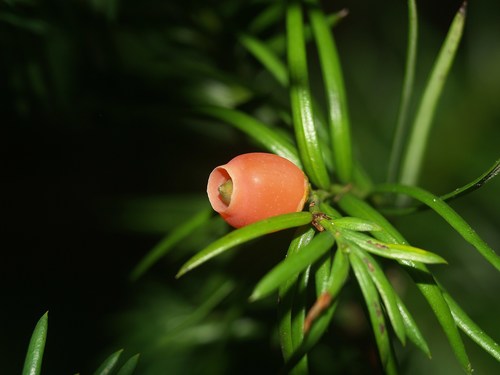
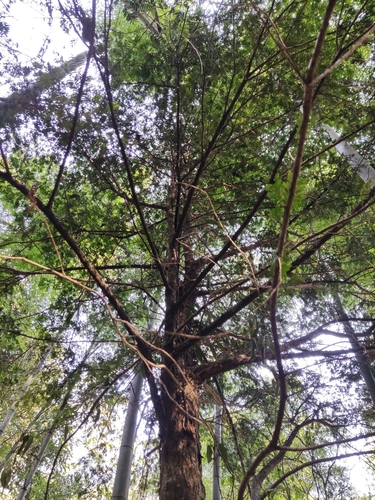
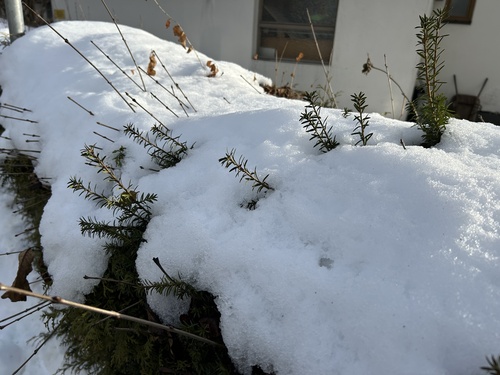
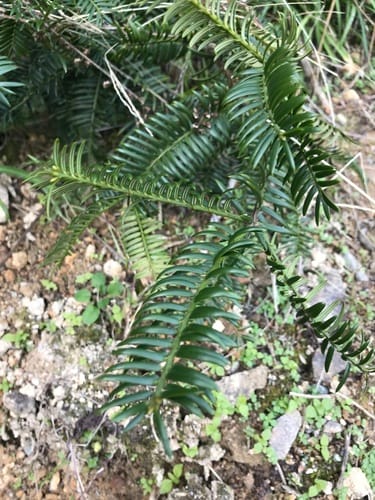
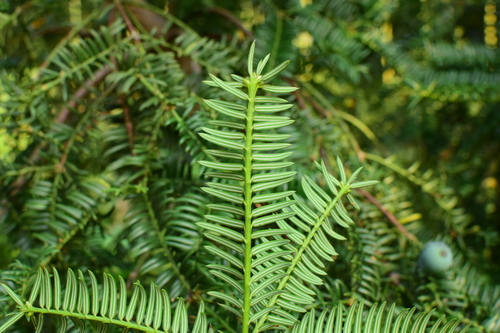
A shrub or tree. It can grow 25 m tall. The branches are spreading. The small branches are reddish-brown. The leaves are dark and glossy green above and with blue white bands underneath. The leaves have a scent when crushed. The female cones are olive green. The kernel is edible.
Edible Uses
Seeds can be eaten raw, cooked, or used in confectionery. They have an agreeable, sweet, slightly resinous and aromatic flavour and are much relished, though they are reported to be laxative if eaten in excess. An edible oil extracted from the seed is used in cooking.
Traditional Uses
The kernels of the nuts are eaten. They are eaten raw or roasted and used in confectionery. An oil can be extracted from the kernels and eaten in cooking.
Medicinal Uses
The seeds are anthelmintic and are used in the treatment of several parasitic conditions including hookworm, tapeworms, pinworms, and roundworms. The plant is also anodyne, carminative, digestive, laxative, and pectoral.
Distribution
It is a temperate plant. It suits hardiness zones 7-10.
Where It Grows
Asia, Australia, Britain, China, Europe, Japan*, Korea, North America, USA,
Propagation
Seed is best sown as soon as it is ripe in a cold frame. Some seed should germinate the following spring, though much may take a further 12 months. Stored seed requires cold stratification and can take 18 months or more to germinate. Prick seedlings into individual pots as soon as growth appears and grow on in light shade in the greenhouse for at least the next two winters, potting on as needed. Plant out into permanent positions in early summer when plants are at least 20cm tall. Half-ripe shoot cuttings can be taken in late summer, though rooting success is poor. Layering is also an option.
Other Uses
None known.
Other Information
It is a cultivated food plant.
Notes
Also put in the family Cephalotaxaceae.
Nutrition
| Part | Moisture | kJ | kcal | Protein | Vit A | Vit C | Iron | Zinc |
|---|---|---|---|---|---|---|---|---|
| Seeds dried | 6.5 | 2433 | 582 | 11.1 | — | — | 3.6 | — |
Synonyms
Also Known As
Binjanamu, Kaya
References (18)
- Abh. Math.-Phys. Cl. Koenigl. Bayer. Akad. Wiss. 4(3):234; Fl. Japan Fam. Nat. 2:108. 1846
- Bodkin, F., 1991, Encyclopedia Botanica. Cornstalk publishing, p 988
- Brickell, C. (Ed.), 1999, The Royal Horticultural Society A-Z Encyclopedia of Garden Plants. Convent Garden Books. p 1017
- Chen, B. & Qiu, Z., Consumer's Attitudes towards Edible Wild Plants, Ishikawa Prefecture, Japan. p 26 www.hindawi.com/journals/ijfr/aip/872413.pdf
- Ciesla, W.M., 1998, Non-wood forest products from conifers. Non-wood forest products 12, FAO, Rome, p 81
Show all 18 references Hide references
- Cundall, P., (ed.), 2004, Gardening Australia: flora: the gardener's bible. ABC Books. p 1424
- Facciola, S., 1998, Cornucopia 2: a Source Book of Edible Plants. Kampong Publications, p 240
- Food Composition Tables for use in East Asia FAO http://www.fao.org/infoods/directory No. 344
- Hedrick, U.P., 1919, (Ed.), Sturtevant's edible plants of the world. p 651
- Hu, Shiu-ying, 2005, Food Plants of China. The Chinese University Press. p 277
- Lord, E.E., & Willis, J.H., 1999, Shrubs and Trees for Australian gardens. Lothian. p 90
- Menninger, E.A., 1977, Edible Nuts of the World. Horticultural Books. Florida p 159
- Phillips, R. & Rix, M., 2002, The Botanical Garden Vol. 1. Trees and Shrubs. MacMillan. p 53
- Plants for a Future database, The Field, Penpol, Lostwithiel, Cornwall, PL22 0NG, UK. http://www.scs.leeds.ac.uk/pfaf/
- Song, M., et al, 2013, Traditional knowledge of wild edible plants in Jeju Island, Korea. Indian Journal of Traditional Knowledge. 12(2) pp 177-194
- Wickens, G.E., 1995, Edible Nuts. FAO Non-wood forest products. FAO, Rome. p179
- Wiersema, J. H. & Leon, B., 2013, World Economic Plants. A Standard Reference CRC Press. 2nd Ed. p 689
- World Checklist of Useful Plant Species 2020. Royal Botanic Gardens, Kew