Taxus wallichiana
Zucc.
Barmi, Thuna
iNaturalist· cc-by-nc
(c) MP Zhou, some rights reserved (CC BY-NC)
iNaturalist· cc-by-nc
(c) MP Zhou, some rights reserved (CC BY-NC)
iNaturalist· cc-by-nc
(c) MP Zhou, some rights reserved (CC BY-NC)
Summary
Source: WikipediaTaxus wallichiana, the Himalayan yew, is a species of yew, native to the Himalaya and parts of south-east Asia. The species has a variety of uses in traditional medicine. It is currently classified as endangered by the IUCN.
Description
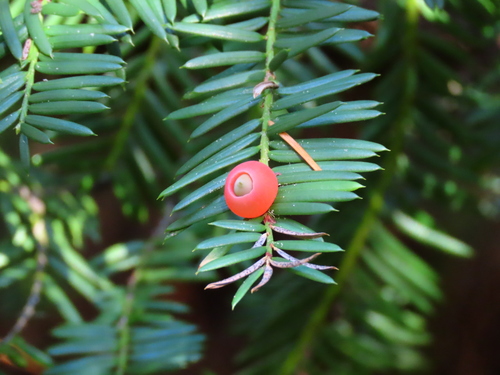
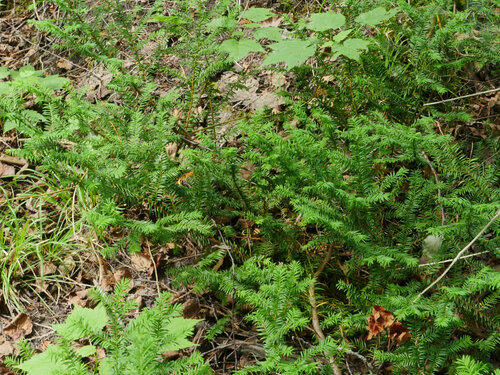
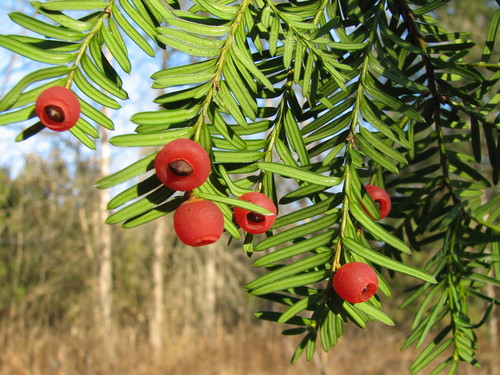
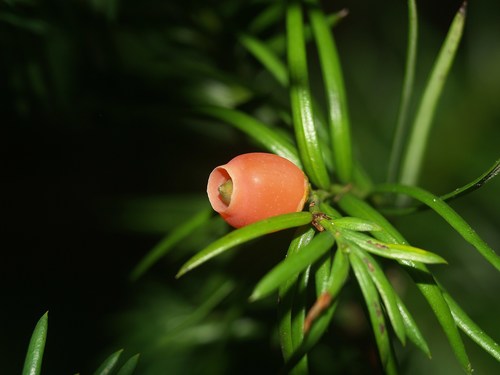
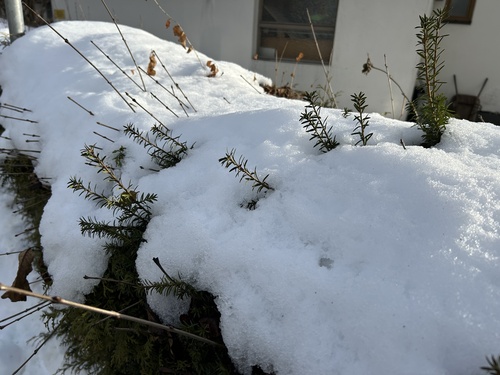
A tree. It grows 6-18 m tall. The branches are spreading. The bark is reddish-brown and scaly. The leaves are narrow and almost in spirals. They are 2-4 cm long. The female flowers are green and occur singly in the axils of leaves. The seed are olive green and surrounded by a red fleshy aril.
Edible Uses
The leaves are brewed as tea, the flowers are eaten raw, the fruit are eaten, and bark is used for flavouring tea.
Traditional Uses
The leaves are boiled in water for tea. CAUTION: The seeds are poisonous and tea from the leaves is poisonous. The flowers are eaten raw. The fruit are eaten.
Medicinal Uses
The tree has medicinal use in Ayurveda and Tibetan medicine. Taxus wallichiana is also a source of the chemical precursors to the anticancer drug paclitaxel (taxol). Taxus wallichiana is used for making tea by the Bhotiya tribal community in the Garhwal Himalaya. The stem bark of this species, which is locally known as thuner, is collected for this purpose. This species is also used as fuelwood by the local communities. In Himachal it is known to be medicine for some types of cancer. A high-quality phased genome of T. wallichiana has been sequenced, and collinearity analysis between it and other closely related species to gymnosperms has helped provide evidence explaining why Taxus species are the only plants providing a large-scale source of paclitaxel. Helping identify and annotate several CYP450 genes involved in the paclitaxel biosynthetic pathway.
Known Hazards
All parts of the plant, except the flesh of the fruit (actually an aril), are potentially highly poisonous. They contain the alkaloid taxine and , if ingested, can cause nervousness, trembling, slow pulse, pupil dilation, difficult breathing, abdominal pain, vomiting, diarrhoea, weakness and convulsions - in larger doses it can be fatal, having a paralyzing affect on the heart.
Distribution
It is a temperate plant. In Northeastern India it grows between 2,400-3,200 m above sea level. Garhwal Himalayas. Arboretum Tasmania.
Where It Grows
Afghanistan, Asia, Australia, Himalayas, India, Indonesia, Myanmar, Nepal, Northeastern India, Pakistan, Philippines, SE Asia, Tasmania,
Cultivation
Plants are very shade tolerant, though they can also succeed in full sun. They thrive in almost any soil, acid or alkaline, as long as it is well-drained. The plant grows in the wild on acidic to neutral soils that are mostly derived from silicate-bearing rocks. Succeeds in dry soils. Plants grow best in a position sheltered from cold, dry winds. Since the exploitation of Himalayan yew for its foliage containing taxanes has proved to be unsustainable, cultivation efforts are being undertaken in the Himalayan foothills and elsewhere in India; this involves both species Taxus contorta and Taxus wallichiana. Because of its similarity with the European Yew (Taxus baccata), this species is rarely found in cultivation in Europe, but is used as an ornamental elsewhere, as in Baguio, Philippines. The tree has a very long life-span and can be coppiced. It may resprout even from very old stumps. A dioecious species, both male and female forms must be grown if fruit and seed are required.
Propagation
Seed - can be very slow to germinate, often taking 2 or more years. It is best sown as soon as it is ripe when it should germinate 18 months later. Stored seed may take 2 years or more to germinate. 4 months warm followed by 4 months cold stratification may help reduce the germination time. Harvesting the seed 'green' (when fully developed but before it has dried on the plant) and then sowing it immediately has not been found to reduce the germination time because the inhibiting factors develop too early. Prick out the seedlings into individual pots once they are large enough to handle and grow them on in pots. The seedlings are very slow-growing and will probably require at least 2 years of pot cultivation before being large enough to plant out. Cuttings of half-ripe terminal shoots, 5 - 8cm long in a shaded frame. They should root within 8 weeks. High percentage. Cuttings of ripe terminal shoots, in a shaded frame. Layering
Other Uses
The bark of most, if not all species of taxus is a moderate source of tannins. The inner bark produces a red dye, often used in religious ceremonies by Brahmins of Nepal. The wood is burnt as incense in Nepal and parts of Tibet. The wood is durable and strong. It is used for door frames, cabinet work and wood turning and wood inlaying, also for candlesticks, knife handles etc. Less refined products are gates and fences, poles, struts and 'wattle and daub' in walls of rural buildings. The wood is used as fuel.
Notes
There are about 6 Taxus species.
Synonyms
Also Known As
Kyauk-tinyu, Lauth salla, Lawaita, Nemdal, Rakhal, Sangcha, Sipehu, Tae-sheng, Thoon, Thuna, Thune, Thuner
References (14)
- Abh. Math.-Phys. Cl. Koenigl. Bayer. Akad. Wiss. 3:805, t. 5. 1843
- Agarwal, R. & Chandra, V., 2019, Diversity of wild edible plants in the Mandal-Chopta forest, Uttarakhand. Journal of Medicinal Plants Studies 2019; 7(1): 89-92
- Amin, M., et al, 2023, Edible wild plant species used by different linguistic groups of Kohistan Upper Khyber Pakhtunkhwa (KP), Pakistan. Journal of Ethnobiology and Ethnomedicine 19:6 p 13
- Chase, P. & Singh, O. P., 2016, Bioresources of Nagaland: A Case of Wild 4 Edible Fruits in Khonoma Village Forest. in J. Purkayastha (ed.), Bioprospecting of Indigenous Bioresources of North-East India. p 51
- Flora of Pakistan. www.eFloras.org
Show all 14 references Hide references
- GUPTA
- Jabeen, A., et al, 2009, Indigenous uses of economically important flora of Margallah Hills National Park, Islamabad, Pakistan. African Journal of Biotechnology Vol. 8 (5), pp. 763-784 (As Taxus baccata subsp. wallichiana)
- Masoodi, H. U. R. & Sundriyal, R. C., 2020, Richness of non-timber forest products in Himalayan communities—diversity, distribution, use pattern and conservation status. Journal of Ethnobiology and Ethnomedicine 16:56
- Negi, P. S. & Subramani, S. P., 2015, Wild Edible Plant Genetic Resources for Sustainable Food Security and Livelihood of Kinnaur District, Himachal Pradesh, India, International Journal of Conservation Science. 6 (4): 657-668
- Rana, D., et al, 2019, Ethnobotanical knowledge among the semi-pastoral Gujjar tribe in the high altitude (Adhwari’s) of Churah subdivision, district Chamba, Western Himalaya. Journal of Ethnobiology and Ethnomedicine (2019) 15:10
- Thakur, D., et al, 2017, Why they eat, what they eat: patterns of wild edible plants consumption in a tribal area of Western Himalaya. Journal of Ethnobiology and Ethnomedicine (2017) 13:70 (As Taxus baccata subsp. wallichiana)
- Tsering, J., et al, 2017, Ethnobotanical appraisal on wild edible plants used by the Monpa community of Arunchal Pradesh. Indian Journal of Traditional Knowledge. Vol 16(4), October 2017, pp 626-637
- Upreti, K., et al, 2010, Diversity and Distribution of Wild Edible Fruit Plants of Uttarakhand. Bioversity Potentials of the Himalaya. p 188 (As Taxus baccata subsp. wallichiana)
- Wild edible plants of Himachal Pradesh