Torreya grandis
Fortune
Chinese nutmeg-yew, Chinese torreya, Torreya nut
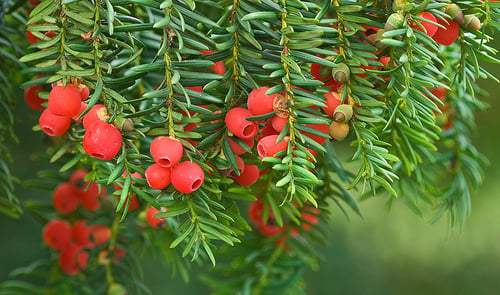
iNaturalist· cc-by-nc
(c) My Gu, some rights reserved (CC BY-NC)
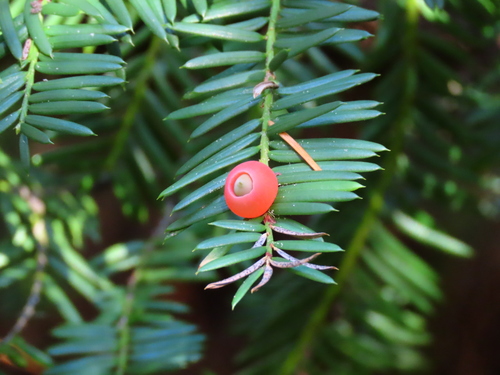
iNaturalist· cc-by-nc
(c) 江国彬, some rights reserved (CC BY-NC), uploaded by 江国彬
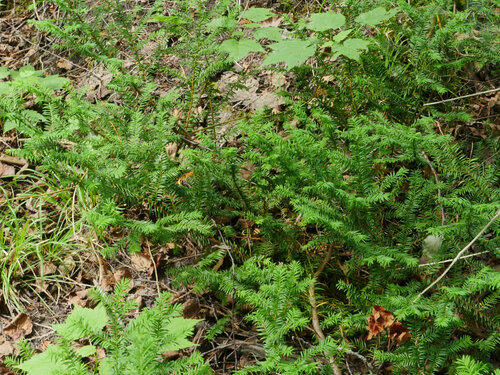
iNaturalist· cc-by-nc
(c) squirrelzz, some rights reserved (CC BY-NC)
Summary
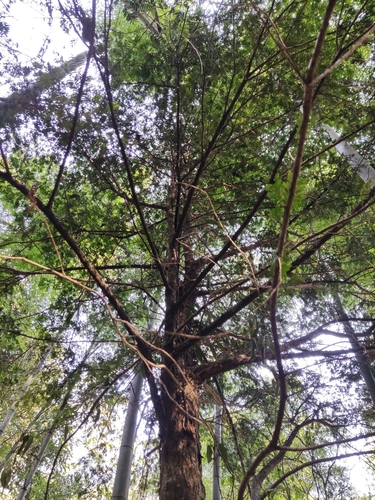
Source: WikipediaTorreya grandis (Chinese: 香榧; pinyin: xiāngfěi; lit. 'fragrant nutmeg yew') is a species of conifer in either the family Taxaceae, or Cephalotaxaceae. Common names include Chinese Torreya and Chinese nutmeg yew, which refers to its edible seeds that resemble nutmeg and to its yew-like foliage, although it is not related to either nutmeg nor to the true yews belonging to the genus Taxus. Originating in the Jurassic period, about 170 million years ago, it is known as a "living fossil". T. grandis is a large tree that can attain height of 25 metres (82 ft), and possibly as high as 39 metres (128 ft). T. grandis is endemic to eastern and south-eastern China; it is found in the coastal provinces Fujian, Zhejiang, and Jiangsu, as well as in Anhui, Guizhou, Hunan, and Jiangxi inland. Its natural habitat are mountains and open valleys, often by streams, between 200 and 1,400 metres (660 and 4,590 ft) ASL. T. grandis is a precious tree species with multiple values. According to survey data, its economic life is more than a thousand years. Torreya grandis cv. Merrillii is a cultivar with a history going back to the Tang dynasty. It is believed to originate from the mountains of northeast Zhejiang.
Description
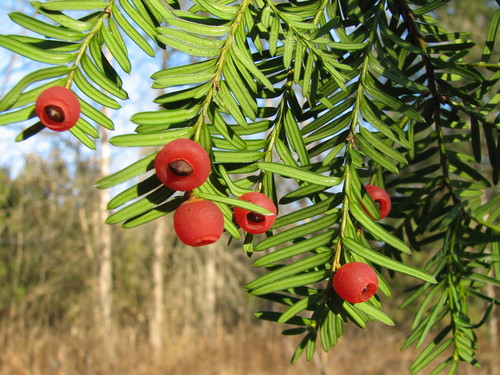
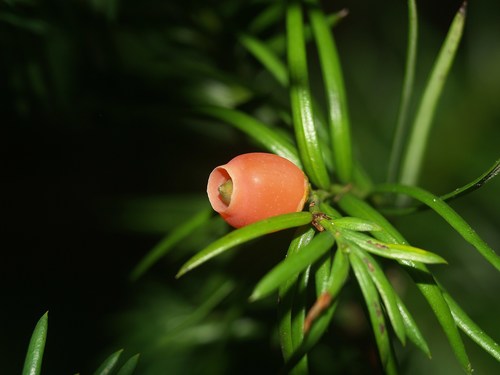
A tree which grows up to 25 m tall. Several different cultivated varieties occur. The trunks are 55 cm across. The leaves are arranged in spirals. They appear to be in 2 layers The are narrow and rigid. They are 1-2.5 cm long and 2-4 mm wide. The end in a sharp point. The flowers are of one sex and plants are separately male and female. The seed is oval and 2-4.5 cm long by 1.5-2.5 cm wide. There is a thin fleshy outer coat and a woody inner coat.
Edible Uses
The seeds are eaten roasted. An edible oil is also extracted from the seed.
Traditional Uses
The seeds are eaten.
This uses section is brief — help expand it
Medicinal Uses
The flowers are anthelmintic and carminative. The seed is anthelmintic, antitussive, laxative, and peptic.
Distribution
It is a temperate plant. It suits hardiness zone 6.
Where It Grows
Asia, Britain, China*, Europe,
Cultivation
Succeeds in ordinary garden soil, tolerating some lime. Requires a sheltered position and either high humidity or a moist riverside soil. Dislikes wind exposure. Tolerates woodland shade very well. Requires hot, very humid summers for best growth. This species is not very hardy in Britain, it only succeeds outdoors in the milder areas of the country. It succeeds outdoors at Kew, a tree was 8 metres tall in 1970. The seed takes two summers to mature. The edible seed of this very ornamental evergreen tree is often sold in local markets in China. Closely related to T. nucifera. Plants are dioecious so both male and female plants are required if seed is to be produced. Occasional trees are monoecious with dioecious branches.
Propagation
Seed is best sown as soon as it is ripe in a cold frame. Some seed should germinate the following spring, though much may take a further 12 months. Stored seed requires cold stratification and can take 18 months or more to germinate. Prick seedlings into individual pots as soon as growth appears and grow on in light shade in the greenhouse for at least the next two winters, potting on as needed. Plant out into permanent positions in early summer when plants are at least 20cm tall. Half-ripe shoot cuttings can be taken in late summer, though rooting success is poor. Layering is also an option.
Other Uses
An essential oil is extracted from the aril (fruit). The wood is used in constructing buildings, bridges, and furniture.
Other Information
The nuts are sold and marketed roasted and salted. It is cultivated.
Notes
Also put in the family Cephalotaxaceae.
Synonyms
Also Known As
Feishu, Xiangfei
References (10)
- Ciesla, W.M., 1998, Non-wood forest products from conifers. Non-wood forest products 12, FAO, Rome, p 81
- Cope, E. A., 1998, Taxaceae: The Genera and Cultivated Species. Botanical Review, Vol. 64, No. 4, pp. 291-322
- Gard. Chron. 1857:788. 1857
- Hu, Shiu-ying, 2005, Food Plants of China. The Chinese University Press. p 276
- Menninger, E.A., 1977, Edible Nuts of the World. Horticultural Books. Florida p 160
Show all 10 references Hide references
- Plants for a Future database, The Field, Penpol, Lostwithiel, Cornwall, PL22 0NG, UK. http://www.scs.leeds.ac.uk/pfaf/
- Valder, P., 1999, The Garden Plants of China. Florilegium. p 87
- Wickens, G.E., 1995, Edible Nuts. FAO Non-wood forest products. FAO, Rome. p179
- Wiersema, J. H. & Leon, B., 2013, World Economic Plants. A Standard Reference CRC Press. 2nd Ed. p 689
- World Checklist of Useful Plant Species 2020. Royal Botanic Gardens, Kew