Taxus globosa
Schltdl.
Mexican yew
iNaturalist· cc-by-nc
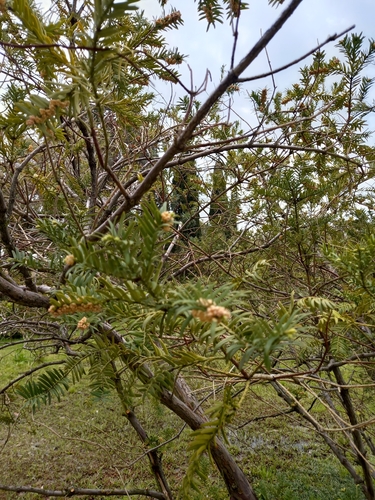
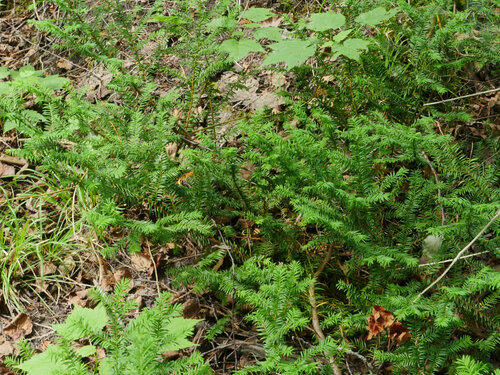
(c) CARLOS VELAZCO, some rights reserved (CC BY-NC), uploaded by CARLOS VELAZCO
iNaturalist· cc-by-nc
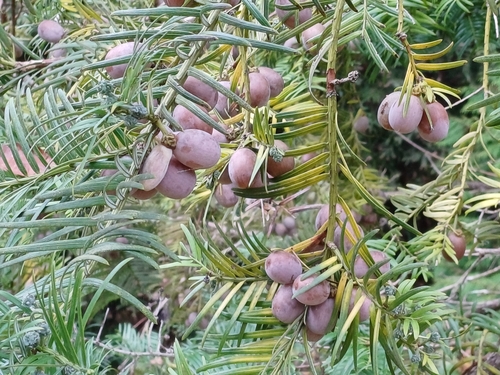
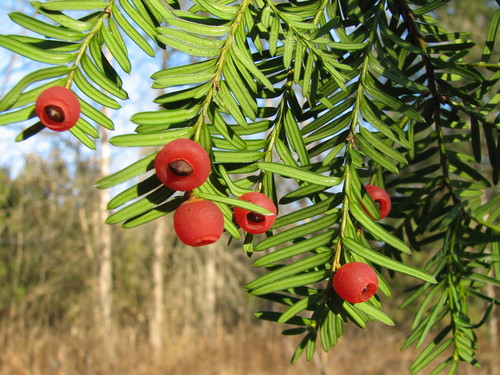
(c) Joey Santore, some rights reserved (CC BY-NC)
iNaturalist· cc-by-nc
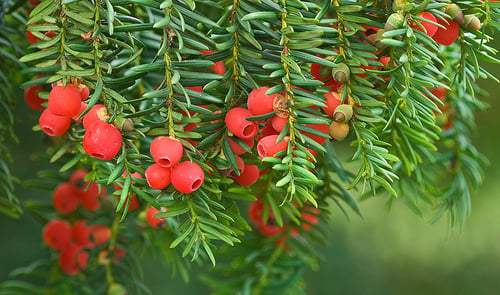
(c) Joey Santore, some rights reserved (CC BY-NC)
Summary
Source: WikipediaTaxus globosa, the Mexican yew, is an evergreen shrub and one of the eight species of yew. The Mexican yew is a rare species, only known to be found in a small number of locations in eastern Mexico, Guatemala, El Salvador and Honduras, and is listed as an endangered species. The Mexican yew is a shrub that grows to an average height of 4.6m. It has large, sharp light green needles growing in ranks on either side of its branches. There are several projects in order to produce Paclitaxel (an anti-tumor agent) around the world, but Mexican yew has not been as well studied because its low production of Taxol (Bringi et al., 1995) by in vitro plant cell cultures. Few researchers focus their work on this species, the team leader on Taxus globosa S. is perhaps that of Barradas at Veracruz Institute of Technology (Instituto Tecnológico de Veracruz).
Description
A shrub. It grows 4-5 m tall. It can be 15 m tall. The branches have sharp needles. The leaves are in 2 ranks. They are 2-3 cm long by 2 cm wide. The edges can curve inwards.
Edible Uses
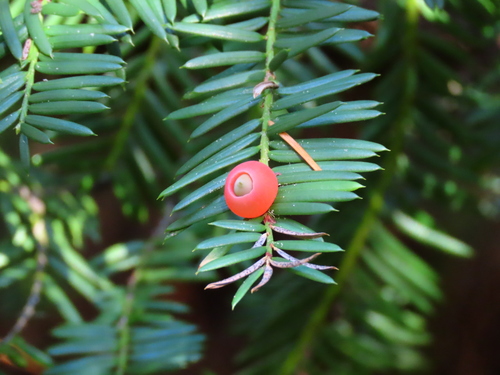
We have no specific information for this species, but the fruit (a fleshy aril) of all members of the genus should be edible. The following is a general description. Fruit - raw. Very sweet and gelatinous, most people find it delicious though some find it sickly. A number of people who like the flavour do not like the texture which is often described as being 'snotty' All other parts of this plant, including the seed, are highly poisonous. When eating the fruit you should spit out the large seed found in the fruit's centre. Should you swallow the whole seed it will just pass straight through you without harm. If it is bitten into, however, you will notice a very bitter flavour and the seed should immediately be spat out or it could cause some problems. The fruit is a fleshy berry about 10mm in diameter and containing a single seed.
Medicinal Uses
As with most other Taxus species, Taxus globosa is a potential source of anti-cancer drugs.
Known Hazards
All parts of the plant, except the flesh of the fruit (actually an aril), are potentially highly poisonous. They contain the alkaloid taxine and , if ingested, can cause nervousness, trembling, slow pulse, pupil dilation, difficult breathing, abdominal pain, vomiting, diarrhoea, weakness and convulsions - in larger doses it can be fatal, having a paralyzing affect on the heart.
Distribution
It is a tropical plant.
Where It Grows
Central America, El Salvador, Guatemala, Honduras, Mexico,
Cultivation
Taxus globosa is moderately cold hardy, tolerating occasional, short-lived temperatures falling to between -12.1°c and -6.7°c. Plants are very shade tolerant, though they can also succeed in full sun. They thrive in almost any soil, acid or alkaline, as long as it is well-drained. Succeeds in dry soils. Plants grow best in a position sheltered from cold, dry winds. This species produces the largest fruits (arils) in the genus. As with most other Taxus species, Taxus globosa is a potential source of anti-cancer drugs. However, its subpopulations are likely to be too small and scattered to make harvesting of wild plants commercially viable. Plantation cultivation would be the only viable and sustainable option A dioecious species, both male and female forms must be grown if fruit and seed are required.
Propagation
Seed - can be very slow to germinate, often taking 2 or more years. It is best sown as soon as it is ripe when it should germinate 18 months later. Stored seed may take 2 years or more to germinate. 4 months warm followed by 4 months cold stratification may help reduce the germination time. Harvesting the seed 'green' (when fully developed but before it has dried on the plant) and then sowing it immediately has not been found to reduce the germination time because the inhibiting factors develop too early. Prick out the seedlings into individual pots once they are large enough to handle and grow them on in pots. The seedlings are very slow-growing and will probably require at least 2 years of pot cultivation before being large enough to plant out. Cuttings of half-ripe terminal shoots, 5 - 8cm long in a shaded frame. They should root within 8 weeks. High percentage. Cuttings of ripe terminal shoots, in a shaded frame. Layering
Other Uses
The bark is said to be rich in tannin. The heartwood is bright orange to brown, the thin band of sapwood is white. The texture is very fine and uniform; the grain straight or variable; lustre is rather high; it is free of an distinctive odour or taste. The wood is hard, moderately heavy, stiff, and elastic. It has long been used in Europe for making bows. Locally used for fence posts.
Synonyms
References (2)
- Conifer society
- Wikipedia