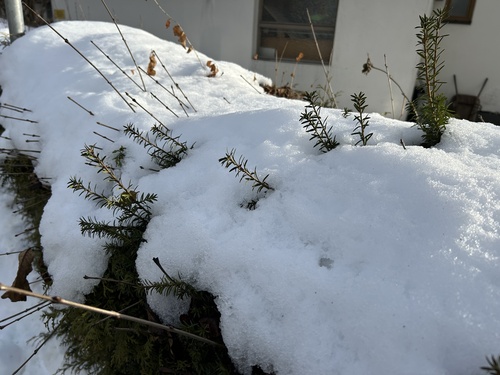
Torreya californica
Torr.
California Nutmeg Tree
iNaturalist· cc-by-nc
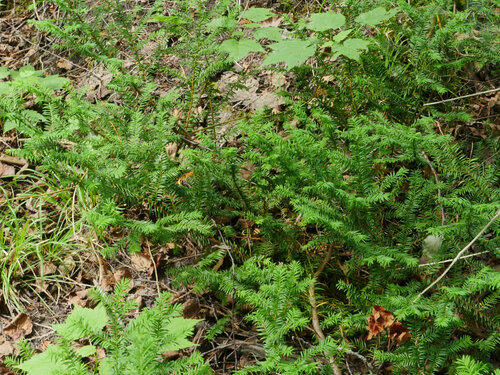
(c) Jennifer Chandler, some rights reserved (CC BY-NC)
iNaturalist· cc-by-nc
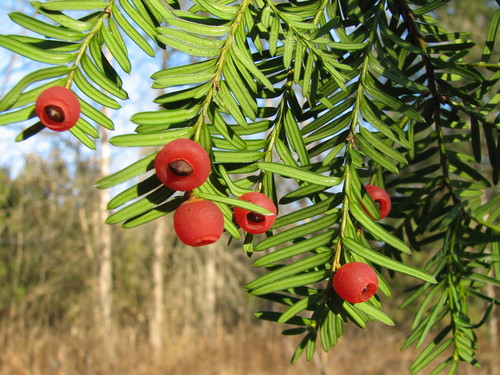
(c) Jennifer Chandler, some rights reserved (CC BY-NC)
iNaturalist· cc-by
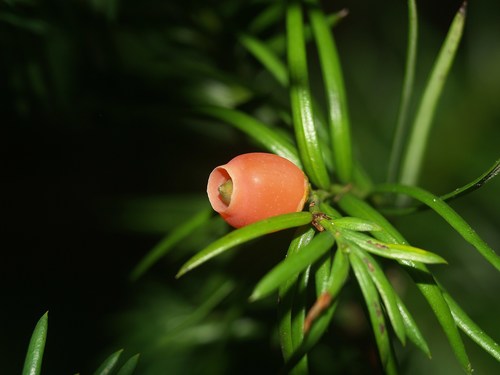
(c) Ken-ichi Ueda, some rights reserved (CC BY)
Summary
Source: WikipediaTorreya californica is a species of conifer endemic to California, occurring in the Pacific Coast Ranges and the foothills of the Sierra Nevada. It is commonly known as California torreya or California nutmeg tree (although not closely related to true nutmeg). It is one of only two species of genus Torreya that are native to North America. A slow-growing (but long-lived) subcanopy tree, it is listed as "vulnerable" in the IUCN Red List.
Description
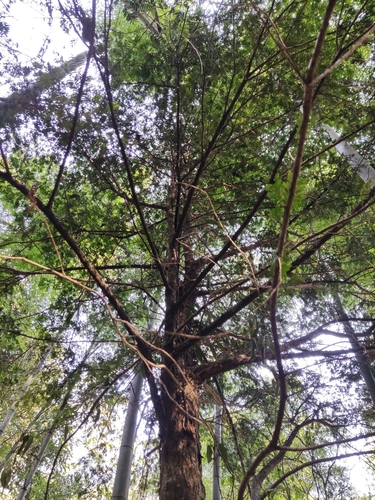
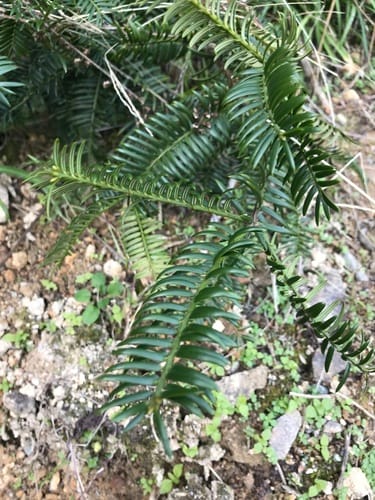
A pointed cone shaped tree. It grows up to 20-30 m high. The bark is grey-brown with vertical ridges. The leaves are long and narrow. They are 6 cm long. They are flattened and have long sharp points. They are shiny green on top. The flowers are of one sex. The female flowers form a single ovule with a scaly base. The kernel is contained in a fleshy purple fruit. The fruit is green at first but turns purple later. The fruit is about 4 cm long.
Edible Uses
The ovoid seeds, up to 2cm long, can be eaten raw or cooked, and are commonly roasted. They are rich in oil, which can also be extracted and used on its own.
Traditional Uses
The kernel of the nut is eaten roasted. The nut also yields an edible oil.
This uses section is brief — help expand it
Medicinal Uses
The nuts have been chewed to treat indigestion. A decoction of the nuts has been used in the treatment of tuberculosis. Crushed seeds have been rubbed on the temples to relieve headaches, and rubbed on the body to induce sweating in the treatment of chills and fevers.
Distribution
It is a Mediterranean climate plant. It grows naturally in California in the United States. It grows in valley bottoms at 900-2,000 m altitude. It can grow in on chalky soils. It likes plenty of moisture. It can grow in shade. Young plants cannot stand frost. Mature plants can only tolerate slight frost. It suits hardiness zones 7-10.
Where It Grows
Australia, Britain, Europe, North America, USA,
Cultivation
Succeeds in ordinary garden soil, tolerating some lime. Undemanding as to the soil pH. Dislikes wind exposure. Requires a sheltered position and either high humidity or a moist riverside soil. Tolerates woodland shade very well. One report says that trees are only hardy in the milder parts of Britain, whilst another says that trees are hardy in Britain at least as far north as Edinburgh. This species is the only member of the genus that is fully adapted to cool maritime sites. It can actually grow faster in such a position than it does in the wild. Trees in general grow better in the wetter western part of Britain. Usually slow growing, though trees occasionally increase by 60cm in a year. The bruised leaves release a powerful resinous smell. The fruits are also aromatic. The seed takes two summers to mature. Trees often crop well at Kew, but there were no seeds formed in 1994. A tree in fairly deep shade at Kew was carrying a good crop of seeds in the summer of 1996. Plants are usually dioecious, but isolated female plants have been known to bear fruit in the absence of a pollinating male. Plants are sometimes monoecious with dioecious branches. Male and female plants must usually be grown if seed is required.
Propagation
Seed is best sown as soon as it is ripe in a cold frame. Some seed should germinate the following spring, though much may take a further 12 months. Stored seed requires cold stratification and can take 18 months or more to germinate. Prick seedlings into individual pots as soon as growth appears and grow on in light shade in the greenhouse for at least the next two winters, potting on as needed. Plant out into permanent positions in early summer when plants are at least 20cm tall. Half-ripe shoot cuttings can be taken in late summer, though rooting success is poor. Layering is also an option.
Other Uses
The roots have been used as splints in basketry. The wood is straight-grained, strong, light, soft, and easily worked, though it has no commercial value and is only occasionally used for fence posts.
Notes
There are 7 Torreya species. Also put in the family Cephalotaxaceae.
Synonyms
References (16)
- Beckstrom-Sternberg, Stephen M., and James A. Duke. "The Foodplant Database." http://probe.nalusda.gov:8300/cgi-bin/browse/foodplantdb.(ACEDB version 4.0 - data version July 1994) (As Tumion californicum)
- Brickell, C. (Ed.), 1999, The Royal Horticultural Society A-Z Encyclopedia of Garden Plants. Convent Garden Books. p 1017
- Coombes, A.J., 2000, Trees. Dorling Kindersley Handbooks. p 79
- Cundall, P., (ed.), 2004, Gardening Australia: flora: the gardener's bible. ABC Books. p 1424
- Facciola, S., 1998, Cornucopia 2: a Source Book of Edible Plants. Kampong Publications, p 240
Show all 16 references Hide references
- Harris, E & J., 1983, Field Guide to the Trees and Shrubs of Britain. Reader's Digest. p 226
- Kermath, B. M., et al, 2014, Food Plants in the Americas: A survey of the domesticated, cultivated and wild plants used for Human food in North, Central and South America and the Caribbean. On line draft. p 870
- Marinelli, J. (Ed), 2004, Plant. DK. p 157
- Menninger, E.A., 1977, Edible Nuts of the World. Horticultural Books. Florida p 160
- Moerman, D. F., 2010, Native American Ethnobotany. Timber Press. p 563
- New York J. Pharm. 3:49, 51. 1854
- Pittonia 2:195. 1891 (As Tumion californicum)
- Plants for a Future database, The Field, Penpol, Lostwithiel, Cornwall, PL22 0NG, UK. http://www.scs.leeds.ac.uk/pfaf/
- Schuler, S., (Ed.), 1977, Simon & Schuster's Guide to Trees. Simon & Schuster. No. 45
- Tanaka,
- World Checklist of Useful Plant Species 2020. Royal Botanic Gardens, Kew