Sterculia africana
(Lour.) Fiori
African star-chestnut
iNaturalist· cc-by-nc
(c) jambobwana, some rights reserved (CC BY-NC)
iNaturalist· cc-by-nc
(c) JP, some rights reserved (CC BY-NC)
Summary
Source: WikipediaSterculia africana is a species of flowering plant in the family Malvaceae (previously the Sterculiaceae, now relegated to a subfamily). This deciduous tree is sometimes referred to by the common names African star-chestnut and mopopaja tree. It is distributed throughout Northeast Africa to Arabia.
Description
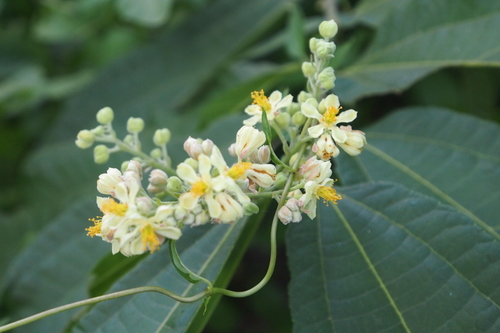
A medium to tall tree. It can be 15 m tall. It has a thick trunk. It can be 2.5 m across. The leaves are light green and crowded at the ends of branches. They are 5-15 cm long and 4-13 cm wide. They can be broadly egg shaped or 3-5 lobed. The lobes are pointed and the base indented. The flowers are in sprays at the ends of twigs. They are 1.9 cm across and with 5-6 petal like lobes. They are yellow with red stripes. The flowers are male and female. The fruit have 1-5 follicles or lobes. These are thick, hard, oblong pods. They have a tail like point. They open wide to reveal stinging hairs. There are blue-black seeds inside. These are edible. The seeds are rich in oil.
Edible Uses
The blue-black seeds are edible and can be roasted, eaten raw, or pounded and sieved into flour to cook with vegetables. The bark is also listed as an edible portion.
Traditional Uses
The seeds are roasted and eaten. They can be eaten raw. The seeds are also pounded and sieved and the flour cooked with vegetables.
This uses section is brief — help expand it
Medicinal Uses
Resin was traditionally used as a washing agent in Arabia. The hardened resin was mixed with water or spittle and then rubbed over the body. It was also a treatment to treat head lice. It is an important fodder and the wood was used to make fishing platforms.
Known Hazards
There are some irritating hairs upon the fruits.
Distribution
A tropical plant. It often grows on hot, dry areas on rocky hills. In East Africa it grows from sea level to 1,000 m altitude. It can grow in semi desert. It can grow in arid places. In Brisbane Botanical Gardens.
Where It Grows
Africa, Angola, Australia, Botswana, Djibouti, East Africa, Eritrea, Eswatini, Ethiopia, Kenya, Malawi, Middle East, Mozambique, Namibia, Oman, Socotra, Somalia, South Africa, Southern Africa, Sudan, Swaziland, Tanzania, Zambia, Zimbabwe,
Cultivation
Plants can be grown from seeds.
Propagation
A physical dormancy caused by the hard seed coat of the mature seeds of many species in this genus can be overcome by scarifying the seed. This is carried out by cutting away or abrading some of the seed coat to allow the ingress of water, though great care must be taken not to damage the embryo. The aril surrounding the seed should also be removed - this is easiest when it has been softened through soaking in water. The seeds germinate optimally at temperatures between 20 - 30°c. They can be sown in a nursery seedbed or in containers. A germination rate of about 95%, occurring within about 2 weeks can be expected if the seed has been properly treated.
Other Uses
A strong fibre obtained from the bark is used to make ropes and mats.
Production
Seeds are collected during the dry season.
Notes
Also put in the family Sterculiaceae.
Nutrition
| Part | Moisture | kJ | kcal | Protein | Vit A | Vit C | Iron | Zinc |
|---|---|---|---|---|---|---|---|---|
| Seeds | 4.3 | — | — | 24.9 | — | 5.1 | 13.3 | 5.8 |
Synonyms
Also Known As
Chitondo, Geed-jini, Ikuayva, Kautsee, Kereri, M'gosa, Marapeixo, Mfune, Mhozya, Mluze, Mopopoja tree, Moza, Mtumbwi, Muhozya, Mujuria, Muluze, Muusya, Muyamba, Ngoza, Olkarasha, Ourae, Qararu, Qawrenta, Qawreta, Qawureta, Qereri, Rapeixo, Tick tree
References (31)
- Addis, G., Asfaw, Z & Woldu, Z., 2013, Ethnobotany of Wild and Semi-wild Edible Plants of Konso Ethnic Community, South Ethiopia. Ethnobotany Research and Applications. 11:121-141
- Addis, G., et al, 2013, The Role of Wild and Semi-wild Edible Plants in Household Food Sovereignty in Hamer and Konso Communities, South Ethiopia. Ethnobotany Research & Applications. 11:251-271
- Agric. Colon. 5(Suppl.):37. 1912
- Ashagre, M., et al, 2016, Ethnobotanical study of wild edible plants in Burji District, Segan Area Zone of Southern Nations, Nationalities and Peoples Region (SNNPR), Ethiopia. Journal of Ethnobiology and Ethnomedicine (2016) 12:32
- Bahru, T., et al, 2013, Wild Edible Plants: Sustainable Use and Management by Indigenous Communities in and the Buffer Area of Awah National Park, Ethiopia. Ethiop. J. Sci., 36(2): 93-108
Show all 31 references Hide references
- Balemie, K., & Kebebew, F., 2006, Ethnobotanical study of wild edible plants in Derashe and Kucha Districts, South Ethiopia. Journal of Ethnobiology and Ethnomedicine. 2:53
- Dharani, N., 2002, Field Guide to common Trees & Shrubs of East Africa. Struik. p 164
- Emire, A., et al, 2021, Ethnobotanical Study of Wild Edible Fruit Tree and Shrub Species in Adola Rede and Odo Shakiso Midland Districts of Guji Zone, Southern Ethiopia. Int. J. Adv. Res. Biol. Sci. (2021). 8(12): 96-109
- Emmanuel, T. V., 2011, Nutritive and Anti-nutritive Qualities of mostly preferred edible woody species in selected drylands of Iringa District, Tanzania. Pakistan Journal of Nutrition. 10(8): 786-791
- Ethiopia: Famine Food Field Guide. http://www.africa.upenn.edu/faminefood/category1.htm
- Feyssa, D. H., et al, 2011, Seasonal availability an consumption of wild edible plants in semiarid Ethiopia; Implications to food security and climate change adaptation. Journal of Horticulture and Forestry 3(5): 138-149
- Fowler, D. G., 2007, Zambian Plants: Their Vernacular Names and Uses. Kew. p 46
- Guinand, Y., & Lemessa, D., 2000, Wild-food Plants in Southern Ethiopia. University of Pennsylvania - African Studies Center. UN-EUE Addis Ababa.
- Kidane, B., et al, 2014, Ethnobotany of Wild and Semi-wild Edible Fruit Species used by Maale and Ari Ethnic Communities in South Ethiopia. Ethnobotany Research and Applications. Vol. 12, 1546-3465-12-455
- Kuhnlein, H. V., et al, 2009, Indigenous Peoples' food systems. FAO Rome p 239
- Lulekal, E., et al, 2011, Wild edible plants in Ethiopia: a review on their potential to combat food insecurity. Afrika Focus - Vol. 24, No 2. pp 71-121
- Mannheimer, C. A. & Curtis. B.A. (eds), 2009, Le Roux and Muller's Field Guide to the Trees and Shrubs of Namibia. Windhoek: Macmillan Education Namibia. p 338
- Mbuya, L.P., Msanga, H.P., Ruffo, C.K., Birnie, A & Tengnas, B., 1994, Useful Trees and Shrubs for Tanzania. Regional Soil Conservation Unit. Technical Handbook No 6. p 446
- Miller, A. G., Morris, M. & Stuart-Smith, S., 1988, Plants of Dhofar. The Southern Region of Oman, Traditional, Economic and Medicinal Uses. Sultanate of Oman. p 280
- Mutie, F. M., et al, 2023, Important Medicinal and Food Taxa (Orders and Families) in Kenya, Based on Three Quantitative Approaches. Plants 2023, 12, 1145
- Palgrave, K.C., 1996, Trees of Southern Africa. Struik Publishers. p 595
- Palmer, E and Pitman, N., 1972, Trees of Southern Africa. Vol. 2. A.A. Balkema, Cape Town p 1487
- Peters, C. R., O'Brien, E. M., and Drummond, R.B., 1992, Edible Wild plants of Sub-saharan Africa. Kew. p 188
- Royal Botanic Gardens, Kew (1999). Survey of Economic Plants for Arid and Semi-Arid Lands (SEPASAL) database. Published on the Internet; http://www.rbgkew.org.uk/ceb/sepasal/internet [Accessed 11th June 2011]
- Ruffo, C. K., Birnie, A. & Tengnas, B., 2002, Edible Wild Plants of Tanzania. RELMA p 624
- Ruiters-Welcome, A. K., 2019, Food plants of southern Africa. Ph.D. thesis. Univ. of Johannesburg p 77
- Shumsky, S., et al, 2014, Institutional factors affecting wild edible plant (WEP) harvest and consumption in semi-arid Kenya. Land Use Policy 38(2014) 48-69
- Swaziland's Flora Database http://www.sntc.org.sz/flora
- Welcome, A. K. & Van Wyk, B.-E., 2019, An inventory and analysis of the food plants of southern Africa. South African Journal of Botany 122 (2019) 136–179
- Williamson, J., 2005, Useful Plants of Malawi. 3rd. Edition. Mdadzi Book Trust. p 234
- World Checklist of Useful Plant Species 2020. Royal Botanic Gardens, Kew