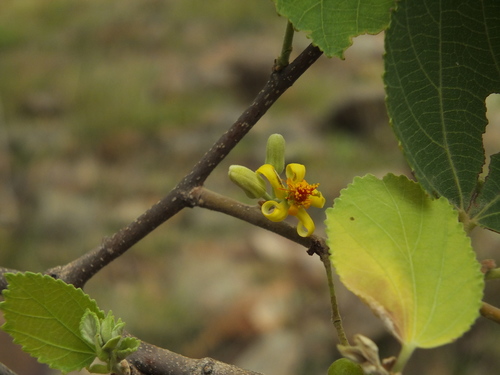
Brachychiton diversifolius
R. Br.
Northern kurrajong, Tropical kurrajong
iNaturalist· cc-by-nc
(c) Bailey Field, some rights reserved (CC BY-NC), uploaded by Bailey Field
iNaturalist· cc-by-nc
(c) Mike and Cathy Beamish, some rights reserved (CC BY-NC)
Summary
Source: WikipediaBrachychiton diversifolius, commonly known as the northern kurrajong, is a small tree of the genus Brachychiton found in northern Australia. It was originally classified in the family Sterculiaceae, which is now within Malvaceae.
Description
A deciduous tree. It often grows about 6 m high but can grow to 25 m high. It loses many of its leaves during the year. The leaves are oval to heart shaped. They are 4.5-15 cm long by 5-10.5 cm wide. They have a long pointed tip. Young leaves vary in shape. There are male and female flowers separately. They are bell shaped and greenish-yellow. The fruit are smooth and oval. They are woody and 5-9.5 cm long by 2.5-3.5 cm wide. They are dark grey to black and split open when ripe. They have prickly hairs inside. There are many prickly hairy yellow seeds. There can be 10-22 seeds in each follicle. The seeds are edible.
Edible Uses
The seeds, after having their hairs removed, can be eaten raw or cooked, roasted, or ground into flour for bread, pancakes, and muffins. The yam-like tuberous roots of young plants are eaten raw or cooked. The honey-colored sap is also consumed.
Traditional Uses
The hairs are removed from the seed and then the seed are eaten raw or cooked. They can be roasted and mae into bread, pancakes, muffins, and other baked goods. The yam like tuberous roots of young plants are eaten raw or cooked. The honey coloured sap is eaten.
Known Hazards
Although we have seen no specific information for this species, the seed capsule of most, if not all members of this genus contains irritant, glochid-like, hairs and should only be handled when wearing gloves.
Distribution
A tropical plant. It grows in open forest in northern Western Australia. It needs well-drained soil. It suits hot inland and tropical areas. It is very frost sensitive when young.
Where It Grows
Australia*,
Cultivation
Plants are grown from seed.
Other Uses
A strong fibre is obtained from the bark.
Production
It is slow growing.
Notes
There are about 30 Brachychiton species. Most are in Australia. Also put in the family Sterculiaceae.
Nutrition
| Part | Moisture | kJ | kcal | Protein | Vit A | Vit C | Iron | Zinc |
|---|---|---|---|---|---|---|---|---|
| Seed | 76.5 | 249 | 60 | 2.1 | — | — | 2.3 | 0.3 |
| Roots | — | — | — | — | — | — | — | — |
| Sap | — | — | — | — | — | — | — | — |
Synonyms
Also Known As
Airitja, Burdaga, Darlab, Djalad, Gorrgorr, Kawoorrkawoorr, Maradaja, Marlikirringa, Nanunguwa, Pirtpa
References (33)
- Barwick, M., 2004, Tropical and Subtropical Trees. A Worldwide Encyclopedic Guide. Thames and Hudson p 57
- J. J. Bennett & R. Brown, Pl. jav. rar. 234. 1844
- Bindon, P., 1996, Useful Bush Plants. Western Australian Museum. p 56
- Bodkin, F., 1991, Encyclopedia Botanica. Cornstalk publishing, p 164
- Brock, J., 1993, Native Plants of Northern Australia, Reed. p 100
Show all 33 references Hide references
- Cherikoff V. & Isaacs, J., The Bush Food Handbook. How to gather, grow, process and cook Australian Wild Foods. Ti Tree Press, Australia p 198
- Crawford, I. M., 1982, Traditional Aboriginal Plant Resources in the Kalumburu Area: Aspects in Ethno-economics. Records of the Western Australian Museum Supplement No. 15
- Doran, J.C., & Turnbull, J.W. (Eds), 1997, Australian Trees and Shrubs: species for land rehabilitation and farm plantings in the tropics. ACIAR Monograph No 24. p 254
- Elliot, W.R., & Jones, D.L., 1982, Encyclopedia of Australian Plants suitable for cultivation. Vol 2. Lothian. p 366
- Facciola, S., 1998, Cornucopia 2: a Source Book of Edible Plants. Kampong Publications, p 238 (As Brachychiton diversifolium)
- Hardwick, G., 2001, Economically Useful Plants for Northern Australia: Master Species List. Crusader eBooks.
- Hearne, D.A., & Rance, S.J., 1975, Trees for Darwin and Northern Australia. AGPS, Canberra p 34
- Hibbert, M., 2002, The Aussie Plant Finder 2002, Florilegium. p 45
- Kenneally, K.E., Edinger, D. C., and Willing T., 1996, Broome and Beyond, Plants and People of the Dampier Peninsula, Kimberley, Western Australia. Department of Conservation and Land Management. p 188
- Lands, M., 1987, Mayi: Some Bush fruits of Dampierland. Magabala Books, Broome West Australia. p 49
- Lazarides, M. & Hince, B., 1993, Handbook of Economic Plants of Australia, CSIRO. p 36
- Low, T., 1991, Wild Food Plants of Australia. Australian Nature FieldGuide, Angus & Robertson. p 183
- Paczkowska, G . & Chapman, A.R., 2000, The Western Australian Flora. A Descriptive Catalogue. Western Australian Herbarium. p 538
- Petheram, R. J. and Kok, B., 2003, Plants of the Kimberley Region of Western Australia. UWA Press p 383
- Recher, P, 2001, Fruit Spirit Botanical Gardens Plant Index. www.nrg.com.au/~recher/ seedlist.html p 4
- Smith, M & Kalotas, A. C., 1985, Bardi Plants: An Annotated List of Plants and Their Use by the Bardi Aborigines of Dampierland, in North-western Australia. Rec. West Aust. Mus. 1985, 12(3): 317-359
- Smith, N and Wightman, G.M., 1990, Ethnobotanical Notes from Belyuen Northern Territory Australia. Northern Territory Botanical Bulletin No 10. Parks and Wildlife Commission of the Northern Territory. p5, 6
- Smith, N. M., 1991, Ethnobotanical Field Notes from the Northern Territory, Australia, J. Adelaide Bot. Gard. 14(1): 1-65
- Smith, Nicholas et al. 1993, Ngarinyman Ethnobotany: Aboriginal Plant Use from the Victoria River Area Northern Australia. Northern Territory Botanical Bulletin No 16. Parks and Wildlife Commission of the Northern Territory. p 10, 11.
- Tiwi Plants and Animals. 2001, Aboriginal flora and fauna knowledge from Bathurst and Melville Islands, northern Australia. Northern Territory Botanical Bulletin; No. 24 p 22
- Townsend, K., 1994, Across the Top. Gardening with Australian Plants in the tropics. Society for Growing Australian Plants, Townsville Branch Inc. p 105
- Vigilante, T., et al, 2013, Island country: Aboriginal connections, values and knowledge of the Western Kimberley islands in the context of an island biological survey. Records of the Western Australian Museum Supplement 81: 145-182
- Wheeler, J.R.(ed.), 1992, Flora of the Kimberley Region. CALM, Western Australian Herbarium, p 183, 185, 187
- Wightman, Glenn et al. 1991.Alawa Ethnobotany: Aboriginal Plant Use from Minyerri, Northern Australia. Northern Territory Botanical Bulletin No 11. Parks and Wildlife Commission of the Northern Territory. p 6, 7.
- Wightman, Glenn et al. 1992. Mudburra Ethnobotany: Aboriginal Plant Use from Kulumindini (Elliott) Northern Australia. Northern Territory Botanical Bulletin No 14. Parks and Wildlife Commission of the Northern Territory. p 10, 9.
- Wightman, Glenn et al. 1992, Mangarrayi Ethnobotany: Aboriginal Plant Use from the Elsey Area Northern Australia. Northern Territory Botanical Bulletin No 15. Parks and Wildlife Commission of the Northern Territory. p 10, 11.
- Wightman, G. & Brown, J., 1994, Jawoyn Plant Identikit, Common Useful Plants in the Katherine Area of Northern Australia. Concervation Commission Northern Territory. p 15
- Yunupinu Banjgul, Laklak Yunupinu-Marika, et al. 1995, Rirratjinu Ethnobotany: Aboriginal Plant Use from Yirrkala, Arnhem Land, Australia. Northern Territory Botanical Bulletin No 21. Parks and Wildlife Commission of the Northern Territory. p 22.