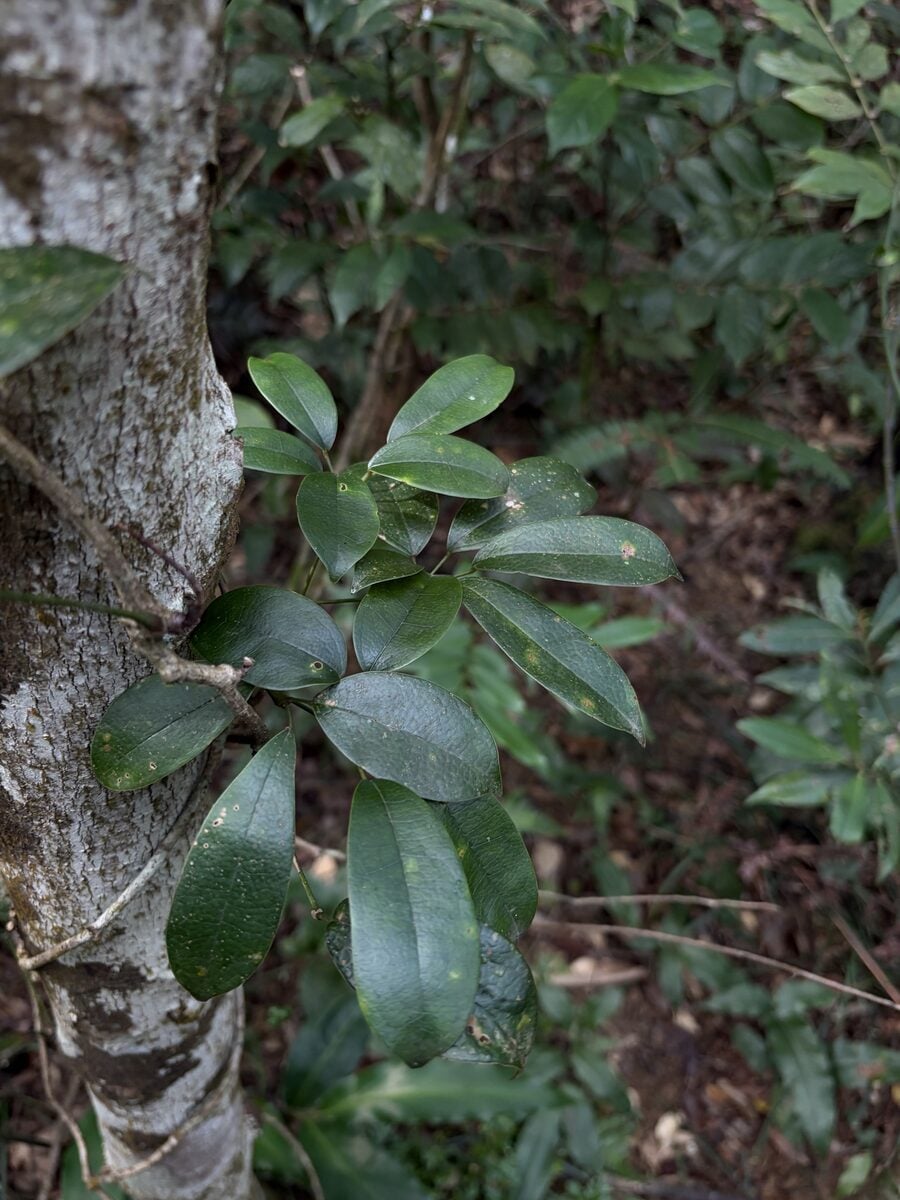
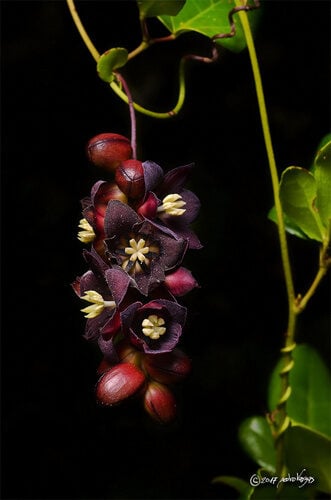
Stauntonia hexaphylla
(Thunberg) Decnaisne
Japanese Staunton vine, Staunton's climber
iNaturalist· cc-by-nc-sa
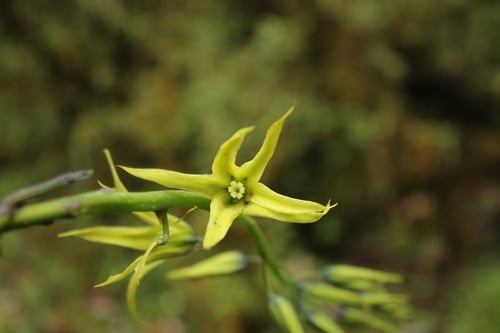
(c) Gregory Mihaich, some rights reserved (CC BY-NC-SA), uploaded by Gregory Mihaich
iNaturalist· cc-by-nc-sa
(c) Gregory Mihaich, some rights reserved (CC BY-NC-SA)
Summary
Source: WikipediaStauntonia hexaphylla or Stauntonia vine is a plant in the family Lardizabalaceae. In Japan, it is distributed in Honshu, Shikoku, Kyushu, and Okinawa. Outside Japan it is found in South Korea. It grows wild in mountains and hills in warm regions and near the coast. Outside of its natural distribution, it is sometimes planted in gardens as shade shelves. In Japanese it is called Mube (ムベ, or 郁子).
Description
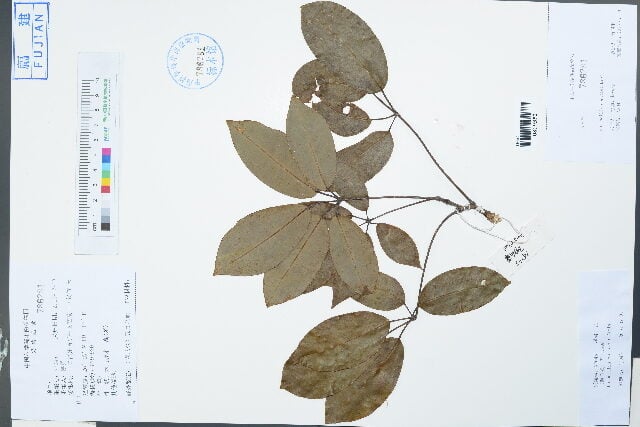
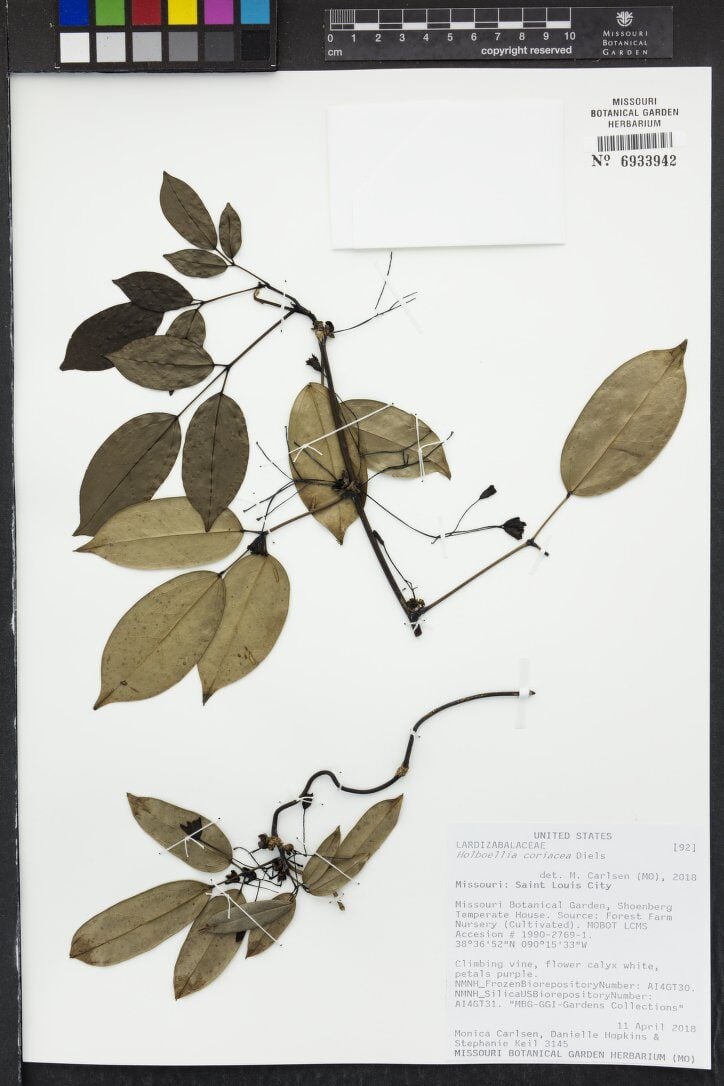
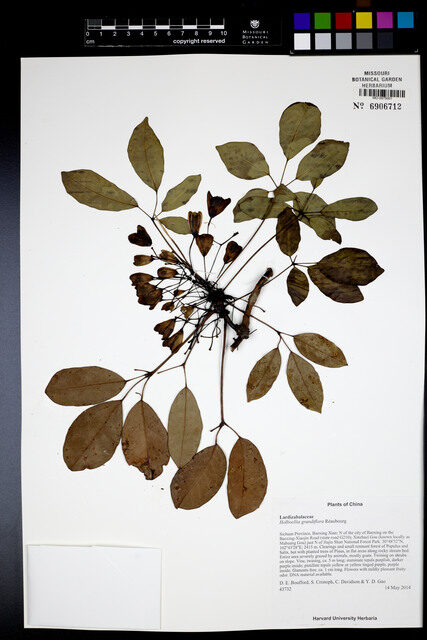
An evergreen twining climber. It can grow 10-13 m long. It spreads 3-5 m wide. The leaves occur alternately. They are compound leaves with 3-7 leaflets arranged like fingers on a hand. The leaflets are 10 cm long. The flowers are bell-shaped and 2 cm across. They are white with a mauve flush. Plants are separately male and female. The fruit are 5 cm long and oval reddish-purple berries. They have a juicy, sweet flavour.
Edible Uses
Fruit can be eaten raw or cooked. It is sweet and watery with a honey-like flavour, and is highly esteemed as a dessert fruit in Japan. The fruit grows up to 5cm long.
Traditional Uses
The ripe fruit can be eaten fresh. They can also be boiled to soften them.
This uses section is brief — help expand it
Medicinal Uses
The roots, stems, and fruits are antirheumatic and diuretic. The juice of the fruit is used in the treatment of ophthalmia.
Distribution
It is a tropical and subtropical plant. They do best with a long, hot summer. They need some shelter from wind and strong sun. They do best in a moist, well-drained humus rich soil. In Japan it grows on the edge of forests between 200-1,500 m above sea level. It suits hardiness zones 10-11.
Where It Grows
Asia, Australia, Britain, China, Europe, Indochina, Japan, Korea, Myanmar, SE Asia, Taiwan,
Cultivation
Plants can be grown from seed or cuttings. Cuttings should be of half-ripened wood. Seed can take a long time to germinate.
Propagation
Sow seed in early spring in a greenhouse; germination can take up to 18 months. Prick out seedlings into individual pots once large enough to handle and grow on under glass for at least their first winter. Plant out into permanent positions in early summer, with protection from cold considered advisable for the first winter or two outdoors. Can also be propagated by cuttings.
Other Uses
None known
Production
It is fast growing.
Other Information
It is cultivated for its fruit in Japan. The fruit are enjoyed.
Synonyms
Also Known As
Mube
References (19)
- Ann. Sci. Nat. Bot. ser. 2, 12:105. 1839
- Arora, R. K., 2014, Diversity in Underutilized Plant Species - An Asia-Pacific Perspective. Bioversity International. p 87
- Bodkin, F., 1991, Encyclopedia Botanica. Cornstalk publishing, p 948
- Brickell, C. (Ed.), 1999, The Royal Horticultural Society A-Z Encyclopedia of Garden Plants. Convent Garden Books. p 979
- Chen, B. & Qiu, Z., Consumer's Attitudes towards Edible Wild Plants, Ishikawa Prefecture, Japan. p 26 www.hindawi.com/journals/ijfr/aip/872413.pdf
Show all 19 references Hide references
- Christenhusz, M. J. M., 2012, An overview of Lardizabalaceae. Curtis Botanical magazine 2012 vol. 29(3): pp 235-276
- Crandall, C & Crandall, B., 1996, Flowering Fruiting and Foliage vines. Sterling. p 93
- Cundall, P., (ed.), 2004, Gardening Australia: flora: the gardener's bible. ABC Books. p 1369
- Facciola, S., 1998, Cornucopia 2: a Source Book of Edible Plants. Kampong Publications, p 138
- Hedrick, U.P., 1919, (Ed.), Sturtevant's edible plants of the world. p 634
- Hibbert, M., 2002, The Aussie Plant Finder 2002, Florilegium. p 294
- Hu, Shiu-ying, 2005, Food Plants of China. The Chinese University Press. p 394
- Hwang, H., et al, 2013, A Study on the Flora of 15 Islands in the Western Sea of Jeollanamdo Province, Korea. Journal of Asia-Pacific Biodiversity Vol. 6, No. 2 281-310
- Levy-Yamamori, R., & Taaffe, G., 2004, Garden Plants of Japan. Timber Press. p 284
- Lord, E.E., & Willis, J.H., 1999, Shrubs and Trees for Australian gardens. Lothian. p 338
- Plants for a Future database, The Field, Penpol, Lostwithiel, Cornwall, PL22 0NG, UK. http://www.scs.leeds.ac.uk/pfaf/
- READ,
- Ryan, S., 2008, Dicksonia. Rare Plants Manual. Hyland House. p 79
- Uphof,