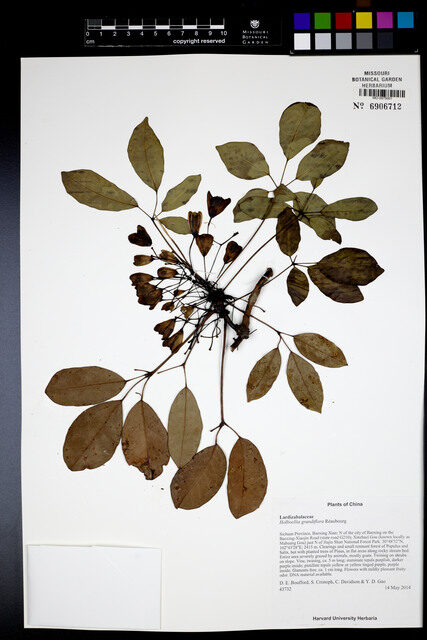
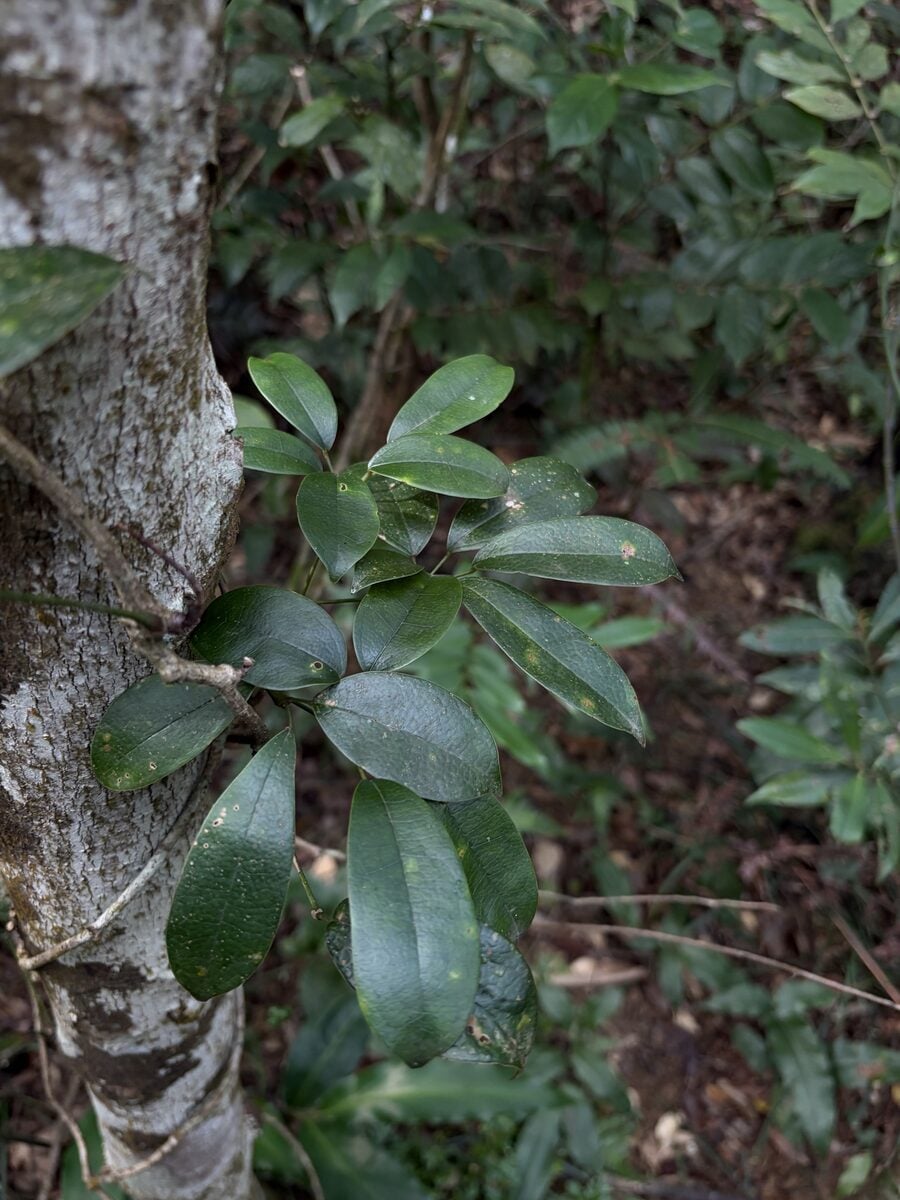
Decaisnea fargesii
Franchet
Blue bean shrub, Blue sausage fruit
iNaturalist· cc-by-sa
(c) Denis.prévôt, some rights reserved (CC BY-SA)
iNaturalist· cc-by-sa
(c) MPF, some rights reserved (CC BY-SA)
iNaturalist· cc-by-sa
(c) peganum, some rights reserved (CC BY-SA)
Summary
Source: WikipediaDecaisnea fargesii, the blue sausage fruit, blue bean shrub, or dead men's fingers, is a member of the family Lardizabalaceae, and is native to Nepal, Tibet and China. It is a deciduous shrub that grows to 4 m tall and broad, but may achieve 8 m (26 ft) eventually. It has divided leaves up to 90 cm (35 in) long, but its main attraction is the pendant bean-like pods, which appear in autumn, and are an unusual blue-grey colour. It is hardy to −20 °C (−4 °F) or lower and prefers a sheltered position. The species was first described in 1892 by French botanist Adrien René Franchet. Both the online Flora of China and Global Biodiversity Information Facility (GBIF) do not consider this a separate species from Decaisnea insignis, but Plants of the World Online does.
Description
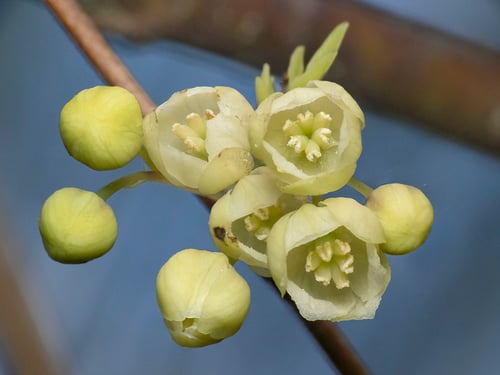
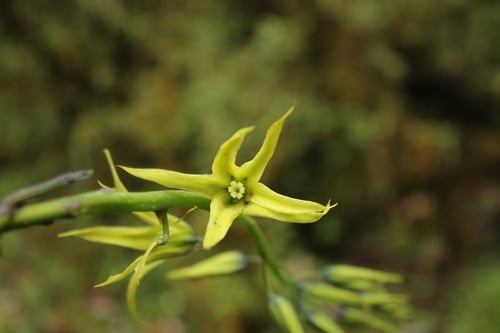
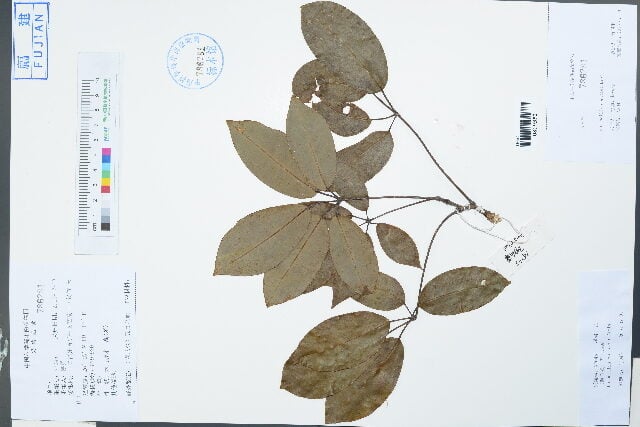
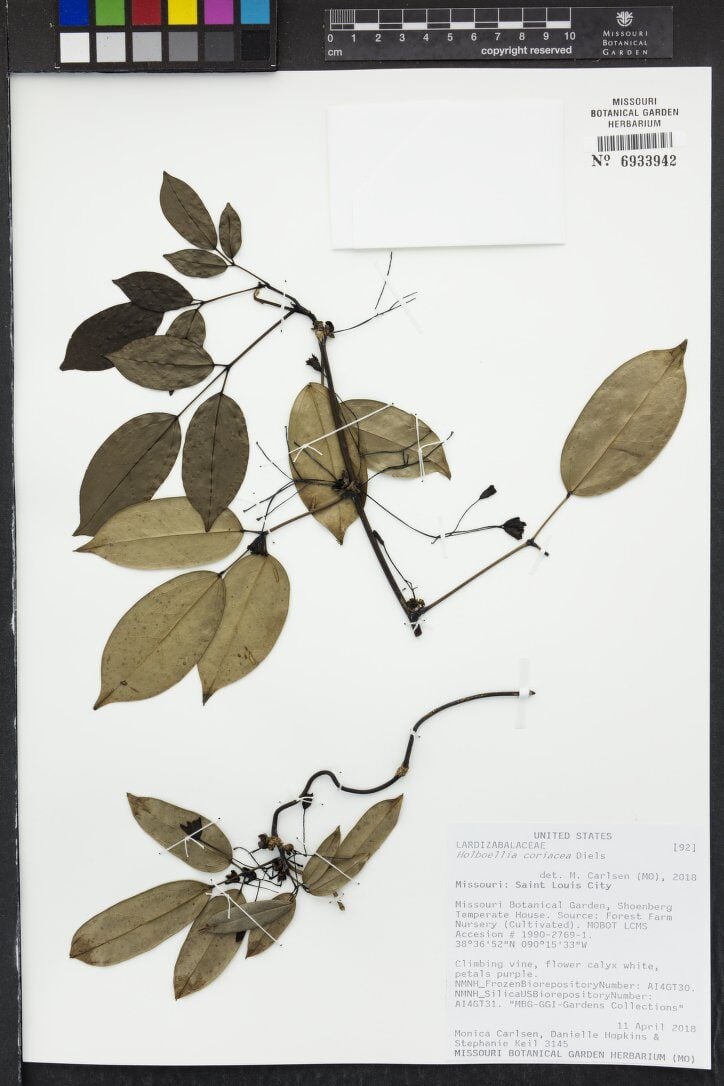
An upright deciduous shrub. It grows 3-6 m high and spreads 6 m wide. The leaves are 75 cm long. They are divided into leaflets along the stalk. There are up to 25 leaflets. The flowers are lime-green and bell shaped. They hang in long stalks. The fruit are pea pod shaped. The seeds are black and surrounded by white pulp.
Edible Uses
The fruit is eaten raw. Its flavour is sweet but rather insipid, though some find it quite delicate and pleasant. The fruit resembles a bright blue sausage or broad bean pod and grows up to 10cm long. The skin is peeled back in the same way as a broad bean pod, revealing a row of seeds running the full length of the fruit surrounded by a relatively thin layer of flesh.
Traditional Uses
The white pulp of the ripe fruit is eaten.
This uses section is brief — help expand it
Medicinal Uses
No medicinal uses are known for this plant.
Distribution
It is a temperate plant. It needs a moist, well-drained location. It needs a protected, sunny position. It grows in hardiness zones 5-9.
Where It Grows
Asia, Australia, Britain, Canada, China*, Europe, Himalayas, North America, Slovenia, USA,
Cultivation
An easily grown plant succeeding in most soils, but it prefers a rich moist loamy soil and a sunny position sheltered from cold winds. Succeeds in partial shade. Prefers partial shade, succeeding in full sun if the soil is reliably moist. Dislikes drought. A very cold-hardy plant when fully dormant, but the flowers and young growth in spring can be damaged by late frosts. Plants usually fruit well and regularly in Cornwall and a specimen has been seen on a number of occasions at Kew Botanical gardens laden down with fruit. The flowers are produced at the tips of the new upright growths in the spring. Plants take some years from seed to produce fruit. A very ornamental plant. It is fairly fast growing but it looks gaunt and open in the winter. Plants do not usually require pruning. In some new floras, this species is seen as no more than a synonym for D. insignis.
Propagation
Seed is best sown as soon as it is ripe in a cold frame, where it usually germinates freely in early spring. Stored seed sown in February in a greenhouse generally germinates well within 1–3 months at 18°C. Prick seedlings into individual pots as soon as they are large enough to handle and grow on under protection through their first winter. Plant out in late spring after the last expected frosts. Can also be propagated by cuttings.
Other Uses
No other uses are known for this plant.
Other Information
The fruit is popular. It is cultivated.
Notes
There are (1) 2 Decaisnea species.
Synonyms
Also Known As
Dekajzneja, Maoershi, Maoshigua, Wu-yueh-kua-t'eng, Yexiongjiao
References (22)
- Altschul, S.V.R., 1973, Drugs and Foods from Little-known Plants. Notes in Harvard University Herbaria. Harvard Univ. Press. Massachusetts. no. 979 (As Holboellia fargesii)
- Bodkin, F., 1991, Encyclopedia Botanica. Cornstalk publishing, p 329
- Brickell, C. (Ed.), 1999, The Royal Horticultural Society A-Z Encyclopedia of Garden Plants. Convent Garden Books. p 349
- Christenhusz, M. J. M., 2012, An overview of Lardizabalaceae. Curtis Botanical magazine 2012 vol. 29(3): pp 235-276
- Cundall, P., (ed.), 2004, Gardening Australia: flora: the gardener's bible. ABC Books. p 477 (As Decaisnea insignis)
Show all 22 references Hide references
- Etherington, K., & Imwold, D., (Eds), 2001, Botanica's Trees & Shrubs. The illustrated A-Z of over 8500 trees and shrubs. Random House, Australia. p 258
- Facciola, S., 1998, Cornucopia 2: a Source Book of Edible Plants. Kampong Publications, p 138 (As Holboellia fargesii)
- J. Bot. (Morot) 6:234. 1892
- Heywood, V.H., Brummitt, R.K., Culham, A., and Seberg, O. 2007, Flowering Plant Families of the World. Royal Botanical Gardens, Kew. p 182
- Hibbert, M., 2002, The Aussie Plant Finder 2002, Florilegium. p 84
- Hu, Shiu-ying, 2005, Food Plants of China. The Chinese University Press. p 392
- Jackes, D. A., Edible Forest Gardens
- Kang, Y., et al, 2012, Wild food plants and wild edible fungi in two valleys on the Qinling Mountains (Shaanxi, central China) Journal of Ethnobiology and Ethnomedicine; 9:26
- Lord, E.E., & Willis, J.H., 1999, Shrubs and Trees for Australian gardens. Lothian. p 223
- Marinelli, J. (Ed), 2004, Plant. DK. p 212 (As Holboellia fargesii)
- Plants for a Future database, The Field, Penpol, Lostwithiel, Cornwall, PL22 0NG, UK. http://www.scs.leeds.ac.uk/pfaf/ (As Holboellia fargesii)
- Plants for a Future database, The Field, Penpol, Lostwithiel, Cornwall, PL22 0NG, UK. http://www.scs.leeds.ac.uk/pfaf/
- Ritchie, F., 1999, Edible Landscape Plants and Trees. Book Three. The Incredible Edible Series. p 40
- Ryan, S., 2008, Dicksonia. Rare Plants Manual. Hyland House. p 22
- Tanaka, (As Holboellia fargesii)
- USDA, ARS, National Genetic Resources Program. Germplasm Resources Information Network - (GRIN). [Online Database] National Germplasm Resources Laboratory, Beltsville, Maryland. Available: www.ars-grin.gov/cgi-bin/npgs/html/econ.pl (10 April 2000)
- Wiersema, J. H. & Leon, B., 2013, World Economic Plants. A Standard Reference CRC Press. 2nd Ed. p 236