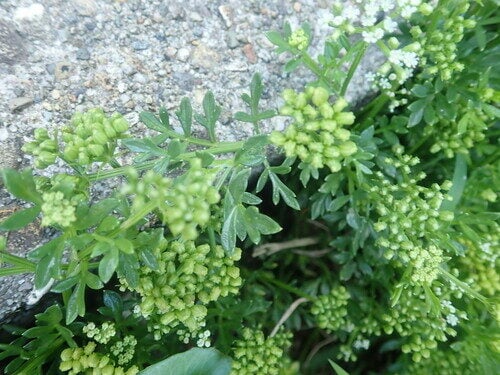
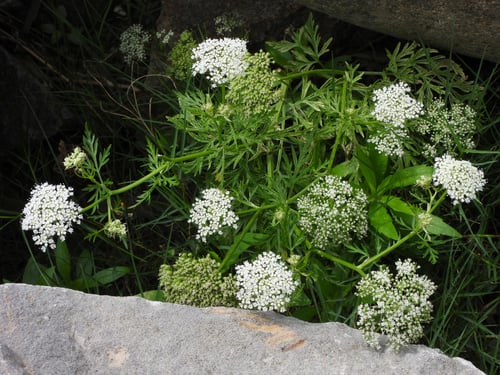
Smyrnium olusatrum
L.
Black lovage, Alexanders
iNaturalist· cc-by-nc
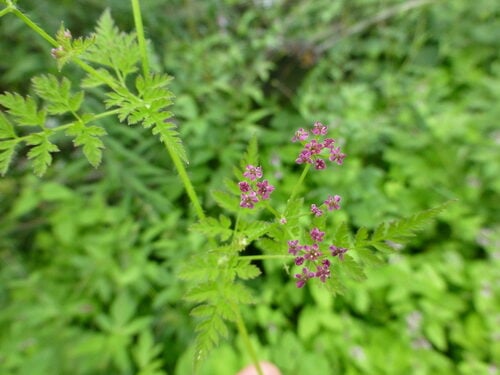
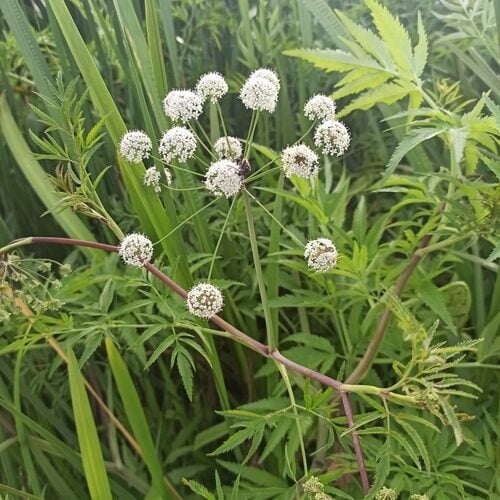
(c) moira_parker, some rights reserved (CC BY-NC)
iNaturalist· cc-by-nc
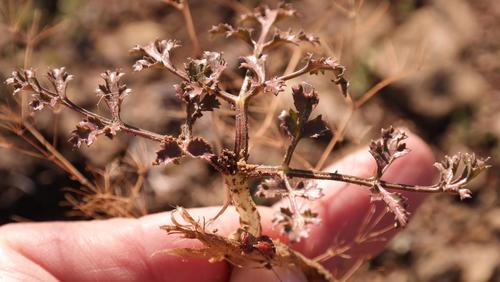
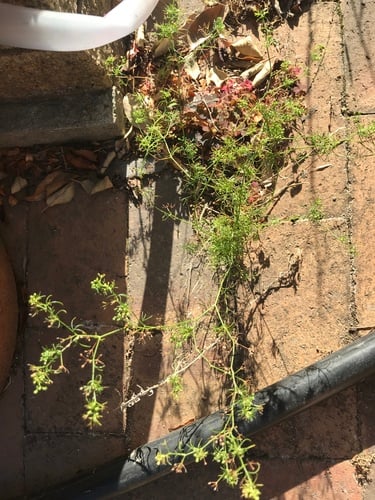
(c) tappynoma_cecily, some rights reserved (CC BY-NC)
Summary
Source: WikipediaSmyrnium olusatrum, common name alexanders (or alisander) is an edible flowering plant of the family Apiaceae (Umbelliferae), which grows on waste ground and in hedges around the Mediterranean and Atlantic coastal regions of Europe. It was formerly widely grown as a pot herb, but is now appreciated mostly by foragers.
Description
A herb. It grows over 2 years or keeps growing from year to year. The plant grows 0.9-1.5 m tall. It spreads 45-90 cm wide. It has bright glossy leaves and a furrowed stem. The leaves are roundish and in groups of three. The leaves are divided 1 or 2 times and there are teeth along the edge. The upper leaves are smaller than the lower leaves. The flowers are yellow-green. The fruit are 7-8 mm long. The large black seed follow.
Edible Uses
Leaves and young shoots can be eaten raw in salads or cooked in soups and stews. The plant comes into growth in autumn, and leaves are often available throughout winter. They have a strong celery-like flavour and are frequently blanched by excluding light from the growing plant before use. Leafy seedlings make a reasonable parsley substitute. The stem is eaten raw or cooked and has a pungent, celery-like taste; it is often blanched before use. Flower buds are eaten raw and added to salads, where they contribute a celery-like flavour. The spicy seeds are used as a pepper substitute. The root is cooked and boiled for use in soups, with a flavour somewhat like celery; it is said to be more tender if kept in a cool place throughout winter.
Medicinal Uses
The whole plant is bitter and digestive. It has been used historically to treat asthma, menstrual problems and wounds, but is generally considered obsolete as a medicinal plant.
Distribution
It is a temperate plant. It grows in damp places near roadsides and on the edges of woodland. It is often near the sea and on dunes and coastal cliffs. It suits hardiness zones 6-10.
Where It Grows
Africa, Asia, Australia, Balkans, Bosnia, Britain, Caucasus, Croatia, Cyprus, Europe, France, Germany, Greece, Isle of Man, Italy, Libya, Mediterranean, Morocco, North Africa, North America, Portugal, Sicily, Spain, Tasmania, Turkey, Türkiye, USA,
Cultivation
Succeeds in most soils but prefers an open sunny position in a well-drained moisture retentive soil. Hardy to about -15°c. At one time this plant was extensively grown for its edible leaves and stems but it has now fallen into virtual disuse, having been replaced by celery[1, 2, 27, 37, 61, 183]. The seeds are highly aromatic with a myrrh-like scent. A good bee plant. In garden design, as well as the above-ground architecture of a plant, root structure considerations help in choosing plants that work together for their optimal soil requirements including nutrients and water. Thick or swollen - fibrous or tap root.
Propagation
Seed - best sown in an outdoor seedbed in autumn and planted into its permanent position in late spring. Germination can be slow. Seed can also be sown in situ in spring.
Other Uses
A good wildlife plant with a scent, suitable for food forests and forest gardens.
Other Information
It is cultivated.
Also Known As
Alexander buds, Apio caballar, Baldiran, Cannela, Dag kerevizi, Elhiyyar, Gelendor, Goret, Horse parsley, Kokar baldiran, Lhyyar, Lisciannaru, Macerone, Vrati muz, Yabani kereviz
References (41)
- Biscotti, N. & Pieroni, A., 2015, The hidden Mediterranean diet: wild vegetables traditionally gathered and consumed in the Gargano area, Apulia, SE Italy. Acta Societatis Botanicorum Poloniae 84 (3): 327-338
- Biscotti, N. et al, 2018, The traditional food use of wild vegetables in Apulia (Italy) in the light of Italian ethnobotanical literature. Italian Botanist 5:1-24
- Blamey, M and Grey-Wilson, C., 2005, Wild flowers of the Mediterranean. A & C Black London. p 155
- Bodkin, F., 1991, Encyclopedia Botanica. Cornstalk publishing, p 933
- Bremness, L., 1994, Herbs. Collins Eyewitness Handbooks. Harper Collins. p 270
Show all 41 references Hide references
- Ciftcioglu, C. G., 2015, Sustainable wild-collection of medicinal and edible plants in Lefke region of North Cyprus. Agroforest Syst. Springer
- Cundall, P., (ed.), 2004, Gardening Australia: flora: the gardener's bible. ABC Books. p 1345
- Dogan, A., et al, 2014, A review of edible plants on the Turkish Apiaceae species. J. Fac. Pharm. Istanbul, 44(2) pp 251-262
- Dogan, Y., 2012, Traditionally used wild edible greens in the Aegean Region of Turkey. Acta Societatis Botanicorum Poloniae 81(4): 329-342
- Dogan, Y. et al, 2013, Wild Edible Plants sold in the Local Markets of Izmir, Turkey. Pak. J. Bot. 45(S1): 177-184
- Dolina, K. & Luczaj, L., 2014, Wild food plants used on the Dubrovnik coast (south-eastern Croatia) Acta Soc Bot Pol 83(3):175–181
- Ertug, F., 2004, Wild Edible Plants of the Bodrum Area. (Mugla, Turkey). Turk. J. Bot. 28 (2004): 161-174
- Ertug, F, Yenen Bitkiler. Resimli Türkiye Florası -I- Flora of Turkey - Ethnobotany supplement
- Esperanca, M. J., 1988. Surviving in the wild. A glance at the wild plants and their uses. Vol. 1. p 26
- Facciola, S., 1998, Cornucopia 2: a Source Book of Edible Plants. Kampong Publications, p 22
- Geraci, A., et al, 2018, The wild taxa utilized as vegetables in Sicily (Italy): a traditional component of the Mediterranean diet. Journal of Ethnobiology and Ethnomedicine (2018) 14:14
- Guzelsoy, N. A., et al, 2017, Nutritional Properties of some Wild Edible Plant Species in Turkey. ANADOLU, J. of AARI 27(2) 2017, 39-45
- Hammer, K. & Spahillari, M., 1999, Crops of European origin. in Report of a networking group on minor crops. IPGRI p 46
- Hedrick, U.P., 1919, (Ed.), Sturtevant's edible plants of the world. p 611
- Hermandez Bermejo, J.E., and Leon, J. (Eds.), 1994, Neglected Crops. 1492 from a different perspective. FAO Plant Production and Protection Series No 26. FAO, Rome. p 263, 319
- Hemphill, I, 2002, Spice Notes Macmillan. p 29, 235
- Hibbert, M., 2002, The Aussie Plant Finder 2002, Florilegium. p 291
- http://cypruswildflowers.com
- Jardin, C., 1970, List of Foods Used In Africa, FAO Nutrition Information Document Series No 2.p 101
- Kiple, K.F. & Ornelas, K.C., (eds), 2000, The Cambridge World History of Food. CUP p 432, 1716
- Lentini, F. and Venza, F., 2007, Wild food plants of popular use in Sicily. J Ethnobiol Ethnomedicine. 3: 15
- Lim, T. K., 2015, Edible Medicinal and Non Medicinal Plants. Volume 9, Modified Stems, Roots, Bulbs. Springer p 77
- Luczaj et al, 2013, Wild vegetable mixes sold in the markets of Dalmatia (southern Croatia). Journal of Ethnobiology and Ethnomedicine. 8:2
- Luczaj, L. et al, 2014, Wild Food Plants of Dalmatia (Croatia). in A. Pieroni, C. L. Quave (eds.), Ethnobotany and Biocultural Diversities in the Balkans, p 143
- Mabey, R., 1973, Food for Free. A Guide to the edible wild plants of Britain, Collins. p 110
- Mahklouf, M. H., 2019, Ethnobotanical Study of Edible Wild Plants in Libya. European Journal of Ecology. 5(2): 30-40
- Martin, F.W. & Ruberte, R.M., 1979, Edible Leaves of the Tropics. Antillian College Press, Mayaguez, Puerto Rico. p 222
- Michael, P., 2007, Edible Wild Plants and Herbs. Grub Street. London. p 13
- Mukemre, M., et al, 2016, Survey of wild food plants for human consumption in villages of Catak, (Van-Turkey), Indian Journal of Traditional Knowledge. Vol. 15(2) pp. 183-191
- Nassif, F., & Tanji, A., 2013, Gathered food plants in Morocco: The long forgotten species in Ethnobotanical Research. Life Science Leaflets 3:17-54
- Pasta, S., et al, 2020, An Updated Checklist of the Sicilian Native Edible Plants: Preserving the Traditional Ecological Knowledge of Century-Old Agro-Pastoral Landscapes. Frontiers in Plant Science. Volume 11|Article 388
- Plants for a Future database, The Field, Penpol, Lostwithiel, Cornwall, PL22 0NG, UK. http://www.scs.leeds.ac.uk/pfaf/
- Sp. pl. 1:262. 1753
- Tardio, J., et al, Ethnobotanical review of wild edible plants in Spain. Botanical J. Linnean Soc. 152 (2006), 27-71
- Tbatou, M, et al, 2016, Wild Edible Plants traditionally used in the countryside of El Jadida, Coastal Area in the Center of Morocco. Life Sciences Leaflets 75:28-48
- Zeven, A. C. & de West, J. M. J., 1982, Dictionary of cultivated plants and their regions of diversity. Wageningen. p 119