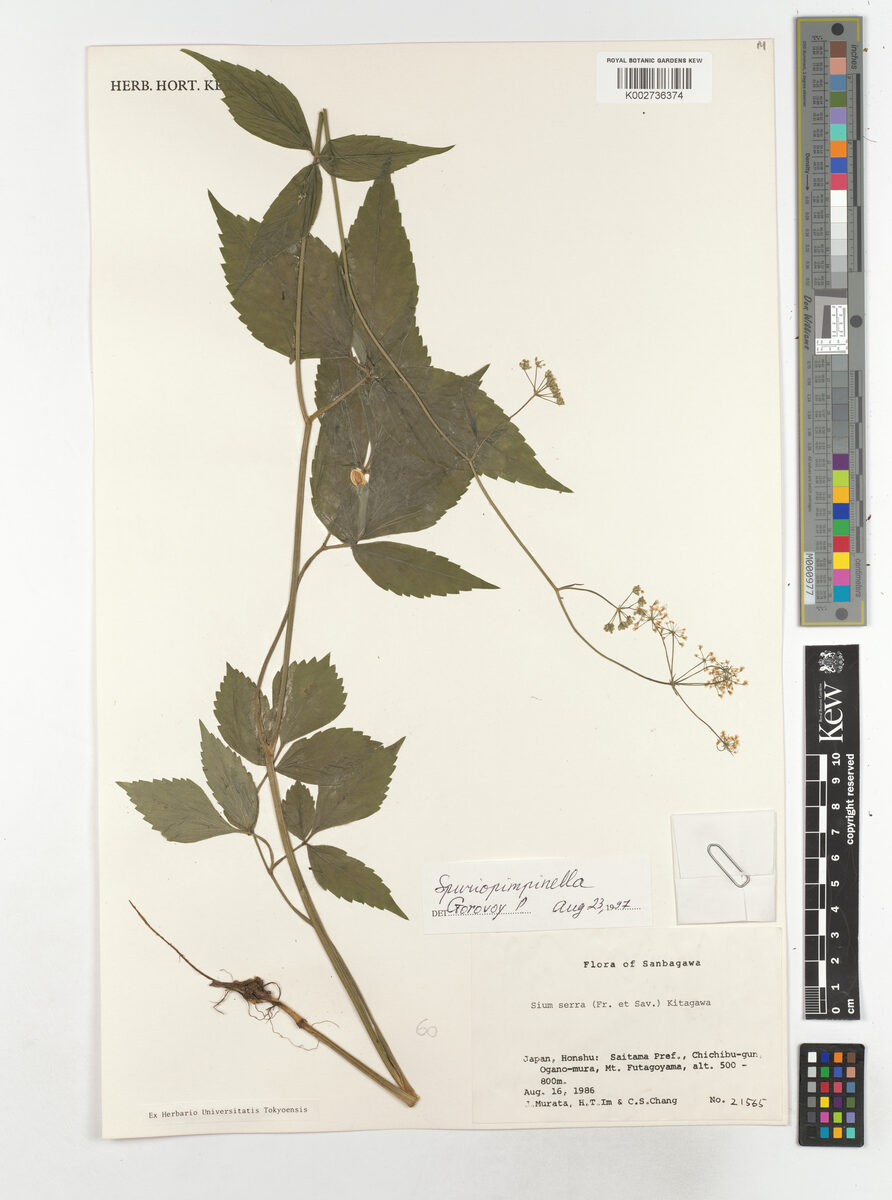
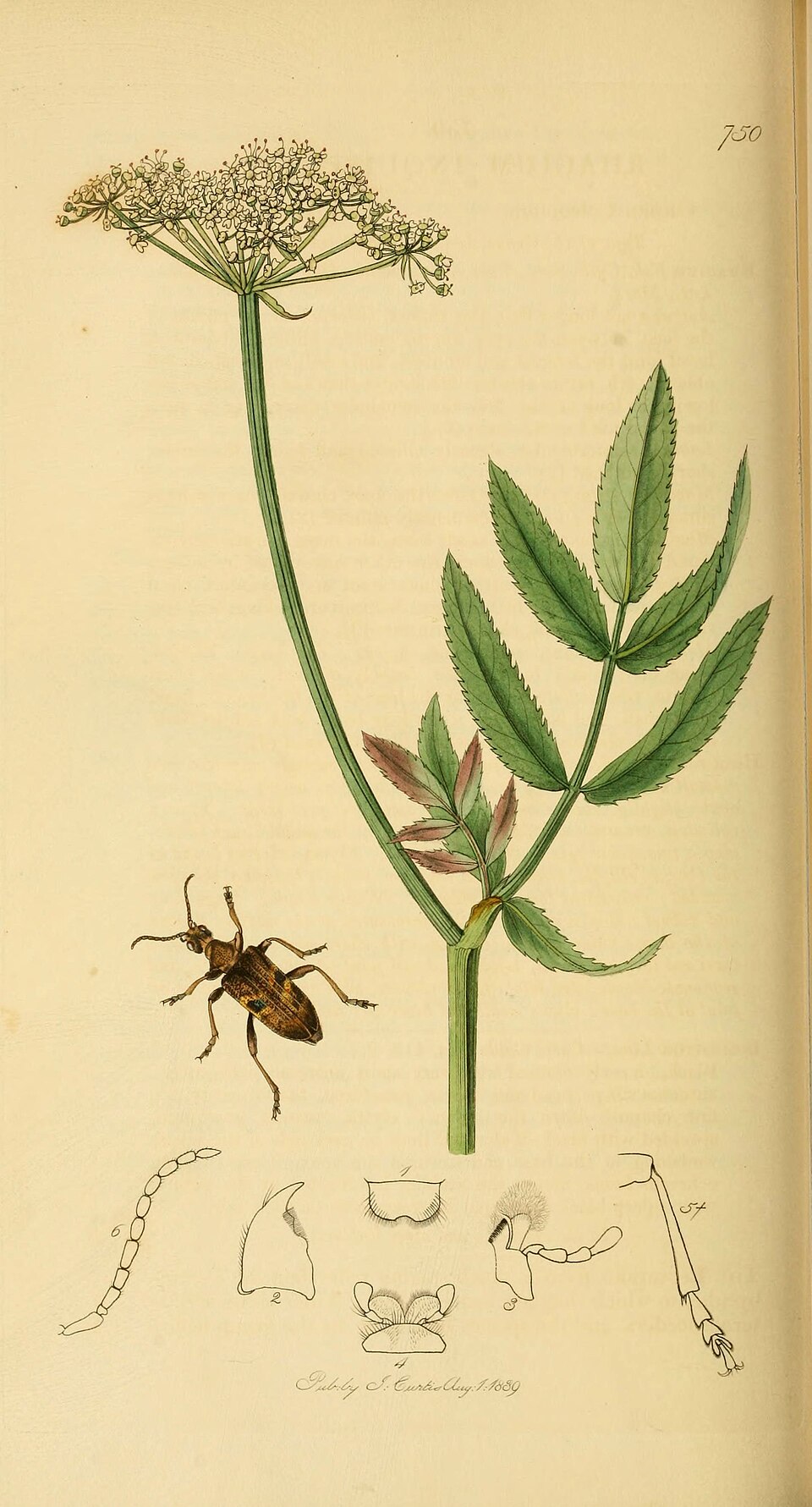
Sium sisarum
L.
Skirret, Chervin
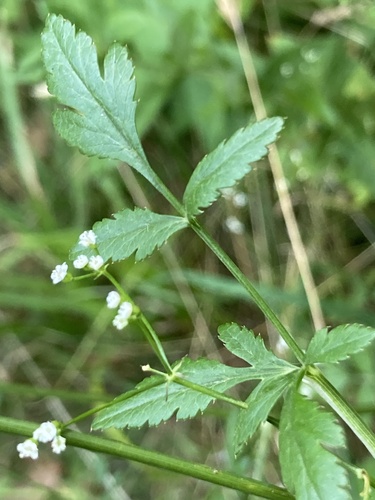
iNaturalist· cc-by-nc
(c) Molnár Ábel Péter, some rights reserved (CC BY-NC), uploaded by Molnár Ábel Péter
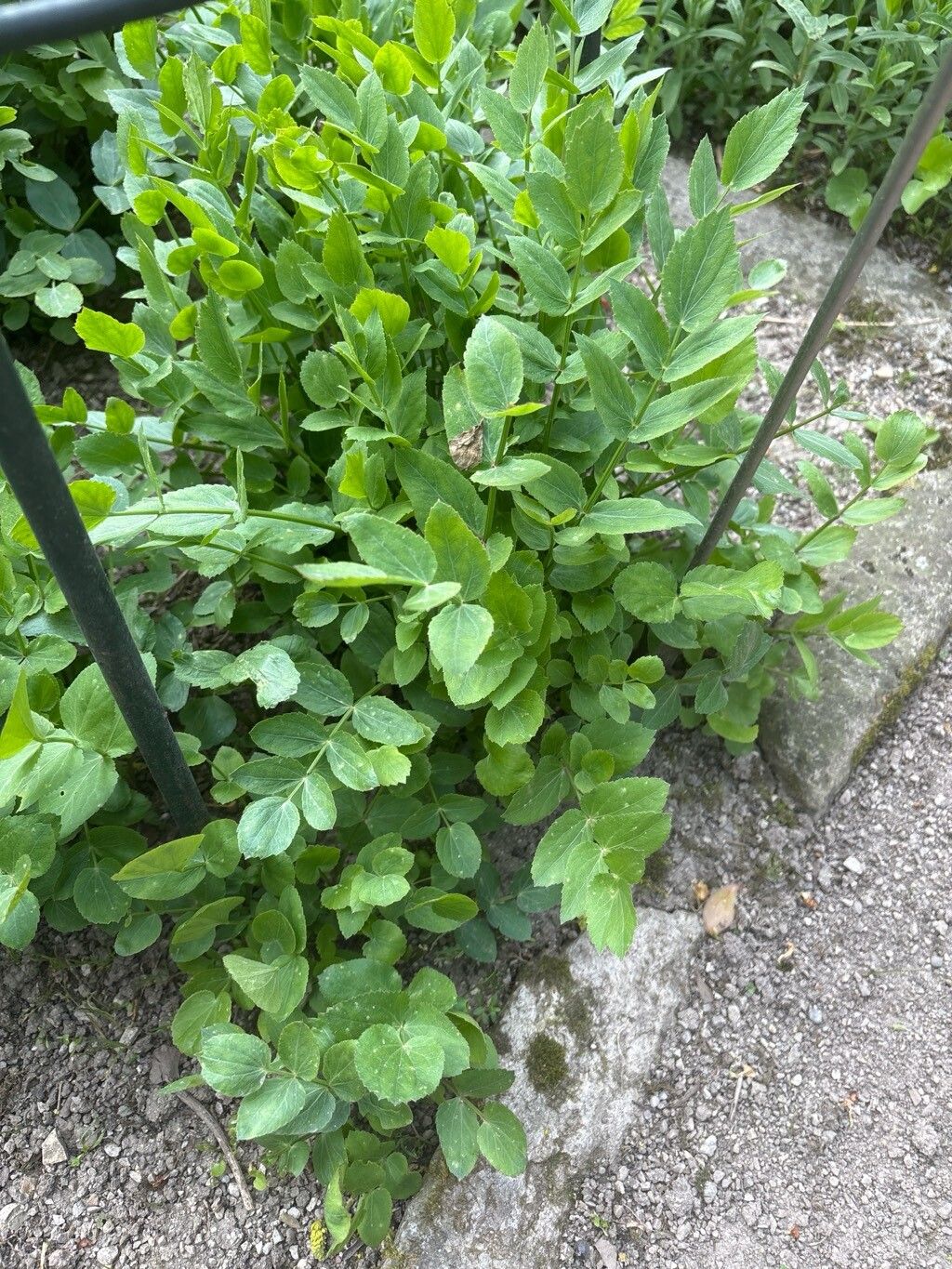
iNaturalist· cc-by-nc
(c) Anastasiia Merkulova, some rights reserved (CC BY-NC)
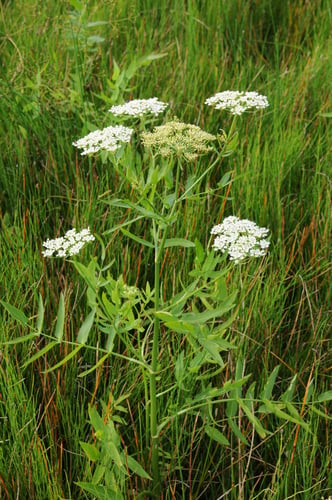
iNaturalist· cc-by-nc
(c) Anastasiia Merkulova, some rights reserved (CC BY-NC)
Summary
Source: WikipediaSium sisarum, commonly known as skirret, is a perennial plant of the family Apiaceae in the same family as carrots and parsnip. Skirret is grown as a root vegetable. The English name skirret is derived from the Middle English 'skirwhit' or 'skirwort', meaning 'white root'. In Scots it is known as crummock and in Irish as sciréad. Its Danish name sukkerrod, Dutch name suikerwortel and German name "Zuckerwurzel" translate as 'sugar root'. Skirret has a cluster of bright white, sweetish, somewhat aromatic roots, each approximately 15–20 centimetres (6–8 in) in length. These are used as a vegetable in the same manner as the common salsify, black salsify and the parsnip.
Description
A herb. It takes 2 years to complete its life cycle but is normally grown as an annual. Plants grow 60 cm to 1 m high. It forms sweet, fleshy grey-white tubers. They are clustered in bunches around the crown. The leaves are divided like parsnip leaves. They are pale green. The flowers are white.
Edible Uses
The root can be eaten raw or cooked. It is firm, sweet, and floury with a small woody core. Raw, the flavour is very agreeable — somewhat like a cross between carrot and parsnip with a nutty quality. The roots can also be boiled, baked, or added to soups. The roasted root has been used as a coffee substitute.
Traditional Uses
The small, sweet, fleshy roots are eaten. They are boiled and butter added. They are also used in soups and stews. They are normally scraped rather than peeled and adding lemon juice to prevent discoloration. The young leaves and shoots can be blanched and eaten as a salad. They are also cooked in stews. They are sometimes used as a coffee substitute.
Medicinal Uses
Appetizer.
Distribution
It suits cool temperate climates. It often grows in ditches and marshes. They are best suited to light sandy moist soil. It suits hardiness zones 5-9. In Hobart Botanical Gardens.
Where It Grows
Armenia, Asia, Australia, Azerbaijan, Balkans, Britain*, Bulgaria, Caucasus, Central Asia, China, Dagestan, Denmark, Europe, France, Germany, Hungary, Iran, Iraq, Japan, Kazakhstan, Kyrgyzstan, Middle East, Moldova, Netherlands, North America, Romania, Russia, Siberia, Spain, Tajikistan, Tasmania, Turkey, Türkiye, Turkmenistan, Ukraine, USA,
Cultivation
Prefers a light, rich, moisture retentive soil in full sun. Requires an abundance of moisture in the growing season or the roots will be tough. Plants are tolerant of some shade. Plants seem to be resistant to all insects and diseases. Skirret was at one time often grown for its edible root but has fallen into virtual disuse. This is a shame since the root is very tasty, easy to grow and relatively productive. The form S. sisarum sisarum should be used, its root is fleshy and succulent, S. sisarum lancifolium. (Bieb.) Thell. is sometimes offered but is unlikely to produce roots of culinary quality.
Propagation
Seed - sow late winter to early spring in a cold frame, or best sown in early April in situ. Germination can be slow. Prick seedlings into individual pots when large enough to handle and plant out in summer if sufficiently developed; otherwise overwinter in a cold frame and plant out the following spring. Division in early spring just before new growth begins, using the side roots to produce new plants. Larger divisions can go directly into permanent positions; smaller divisions are best potted up and grown on in a lightly shaded cold frame until well established before planting out in summer.
Other Uses
None known Special Uses Food Forest
Other Information
It is a commercially cultivated vegetable.
Synonyms
Also Known As
Bilmehink, Crummack, Girola, Mukago-ninjin, Schervola, Sokerot, Tirvas, Vinik, Vinye
References (23)
- Arora, R. K., 2014, Diversity in Underutilized Plant Species - An Asia-Pacific Perspective. Bioversity International. p 27
- Bremness, L., 1994, Herbs. Collins Eyewitness Handbooks. Harper Collins. p 218
- Dogan, A., et al, 2014, A review of edible plants on the Turkish Apiaceae species. J. Fac. Pharm. Istanbul, 44(2) pp 251-262 (as var. lancifolium)
- Ertug, F, Yenen Bitkiler. Resimli Türkiye Florası -I- Flora of Turkey - Ethnobotany supplement
- Facciola, S., 1998, Cornucopia 2: a Source Book of Edible Plants. Kampong Publications, p 22
Show all 23 references Hide references
- Hedrick, U.P., 1919, (Ed.), Sturtevant's edible plants of the world. p 609
- Hibbert, M., 2002, The Aussie Plant Finder 2002, Florilegium. p 291
- Hu, Shiu-ying, 2005, Food Plants of China. The Chinese University Press. p 606
- Jackes, D. A., 2007, Edible Forest Gardens
- Kays, S. J., and Dias, J. C. S., 1995, Common Names of Commercially Cultivated Vegetables of the World in 15 languages. Economic Botany, Vol. 49, No. 2, pp. 115-152
- Kiple, K.F. & Ornelas, K.C., (eds), 2000, The Cambridge World History of Food. CUP p 1852
- Lim, T. K., 2015, Edible Medicinal and Non Medicinal Plants. Volume 9, Modified Stems, Roots, Bulbs. Springer p 77
- Mukemre, M., et al, 2016, Survey of wild food plants for human consumption in villages of Catak, (Van-Turkey), Indian Journal of Traditional Knowledge. Vol. 15(2) pp. 183-191 (As Sium sisarum var. lancifolium)
- Plants for a Future database, The Field, Penpol, Lostwithiel, Cornwall, PL22 0NG, UK. http://www.scs.leeds.ac.uk/pfaf/
- Polat, R., et al, 2017, Survey of wild food plants for human consumption in Bingol, (Turkey). Indian Journal of Traditional Knowledge. Vol. 16(3) July 2017, pp. 378-384
- Romanowski, N., 2007, Edible Water Gardens. Hyland House. p 90
- Self, M., 1999, Phoenix Seeds catalogue. p 8
- Smith, K., 1998. Growing Uncommon Fruits and Vegetables. New Holland. p 130
- Tronickova, E. & Krejcova, Z., 1987, Ortaggi, Instituto Geografico de Agostini, Cecoslovacchia. p 52
- USDA, ARS, National Genetic Resources Program. Germplasm Resources Information Network - (GRIN). [Online Database] National Germplasm Resources Laboratory, Beltsville, Maryland. Available: www.ars-grin.gov/cgi-bin/npgs/html/econ.pl (10 April 2000)
- Wiersema, J. H. & Leon, B., 2013, World Economic Plants. A Standard Reference CRC Press. 2nd Ed. p 640
- World Checklist of Useful Plant Species 2020. Royal Botanic Gardens, Kew
- Zeven, A. C. & de West, J. M. J., 1982, Dictionary of cultivated plants and their regions of diversity. Wageningen. p 119