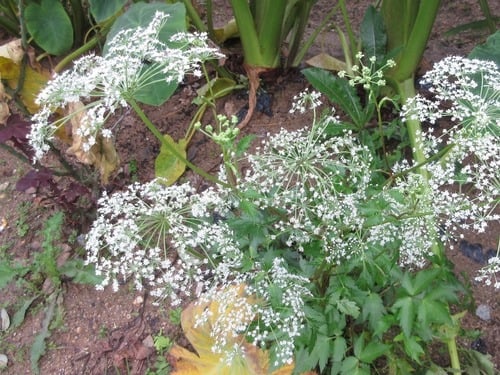
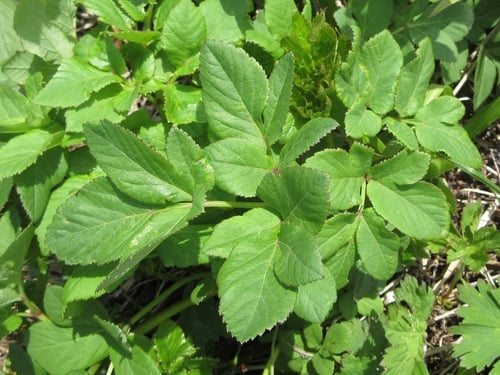
Angelica japonica
A. Gray
Japanese archangel
iNaturalist· cc-by-sa
(c) harum.koh, some rights reserved (CC BY-SA), uploaded by harum.koh
iNaturalist· cc-by-sa
(c) harum.koh, some rights reserved (CC BY-SA), uploaded by harum.koh
iNaturalist· cc-by-nc
(c) himeno, some rights reserved (CC BY-NC)
Summary
Source: WikipediaAngelica japonica is a species of flowering plant in the carrot family (Apiaceae). It is native to Japan, where it is found from the Kantō region westward to the island of Okinawa. Its natural habitat is along coastlines. Angelica japonica is a tall species, reaching up to 1.5 meters in height. Its leaves are dark and lustrous on the upper surface. It produces umbels of white flowers in April through June. It is similar to Angelica keiskei, but differs in several key features. Angelica japonica can be distinguished its red-striped stem, and leaves that are thicker with less coarse serration. In addition, Angelica keiskei does not produce its first flowers until late summer or fall.
Description
A hardy perennial growing to 1 m, Angelica japonica produces flowers in May to June with seeds ripening June to July. The self-fertile hermaphroditic flowers attract insects for pollination. It adapts to light sandy, medium loamy, and heavy clay soils with mildly acid to basic pH, but requires full sun and tolerates maritime exposure. The plant prefers moist growing conditions.
Edible Uses
The plant is eaten as a vegetable and has a fragrant, saline flavour. The exact part consumed is unspecified but is likely the leaves or the root. Seeds are used as a condiment.
Traditional Uses
It is used as a leafy vegetable.
This uses section is brief — help expand it
Medicinal Uses
None known.
Known Hazards
All members of this genus contain furocoumarins, which increase skin sensitivity to sunlight and may cause dermatitis.
Distribution
It is a temperate plant.
Where It Grows
Asia, China, Japan, Korea, Taiwan,
Cultivation
We have very little information on this species and do not know how hardy it will be in Britain, though judging by its native range it should succeed outdoors at least in the milder parts of this country and could be resistant to maritime exposure. The following notes are based on the general needs of the genus. Requires a deep moist fertile soil in dappled shade or full sun. Plants are reliably perennial if they are prevented from setting seed.
Propagation
Sow seed in a cold frame as soon as it is ripe, as viability drops quickly. Spring sowing is possible but expect lower germination rates. Light is required for germination. Once seedlings are large enough to handle, prick them out into individual pots and grow on in a cold frame through their first winter, then plant out in spring. Seed can also be sown directly in situ as soon as it is ripe.
Other Uses
None known.
Other Information
It is a cultivated food plant.
Notes
There are 50 Angelica species. They are temperate plants. It has anticancer properties.
Synonyms
References (5)
- Arora, R. K., 2014, Diversity in Underutilized Plant Species - An Asia-Pacific Perspective. Bioversity International. p 35 p 100 (As Angelica kiusiana)
- Kintzios, S. E., 2006, Terrestrial Plant-Derived Anticancer Agents and Plant Species Used in Anticancer research Critical Reviews in Plant Sciences. 25: pp 79-113
- Mem. Amer. Acad. Arts n. s. 6:390. 1858
- Plants for a Future database, The Field, Penpol, Lostwithiel, Cornwall, PL22 0NG, UK. http://www.scs.leeds.ac.uk/pfaf/
- Seidemann J., 2005, World Spice Plants. Economic Usage, Botany, Taxonomy. Springer. p 42