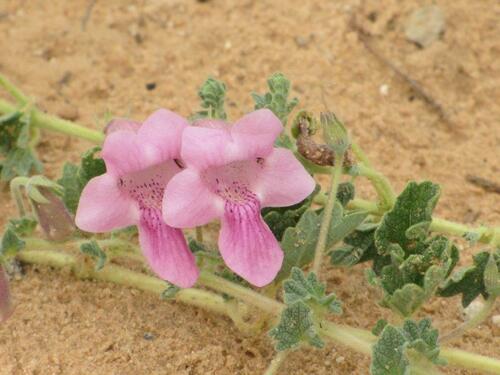
Sesamum calycinum
Welw.
Rose-pink sesame
iNaturalist· cc-by
(c) Robert Taylor, some rights reserved (CC BY)
iNaturalist· cc-by-nc
(c) Bart Wursten, some rights reserved (CC BY-NC), uploaded by Bart Wursten
Description
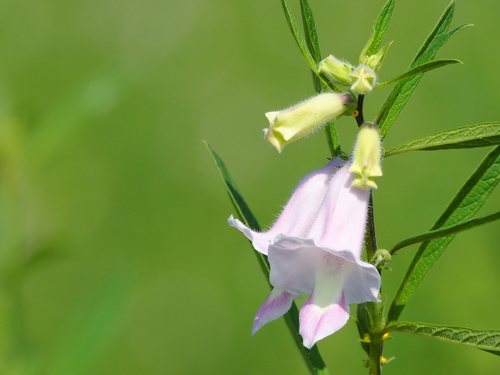
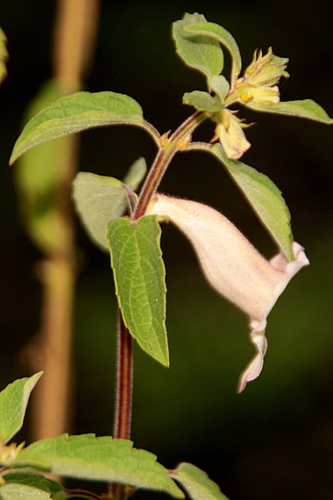
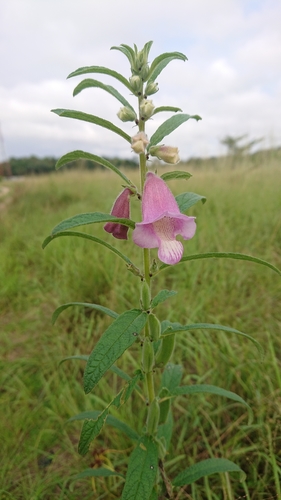
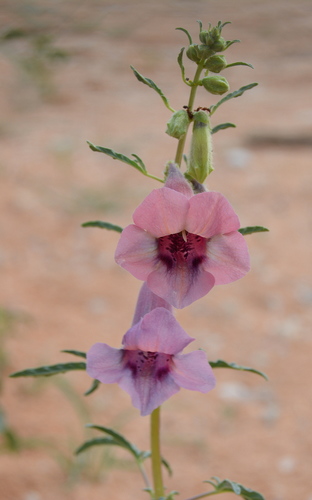
A herb that grows for one or a few years. The stem can be single or branched. The leaves at the top are long and thin and with almost no stalk. Lower leaves can have stalks and be divided into lobes. The flowers are 2-5 cm long and purple or pink. The fruit is a narrow capsule.
Edible Uses
Young leaves are cooked and eaten, often combined with other leaves such as Corchorus. Seeds are eaten as a snack and yield edible oil.
Traditional Uses
The young leaves are cooked and eaten. They are often cooked with other leaves such as Corchorus. The seeds are eaten as a snack.
This uses section is brief — help expand it
Medicinal Uses
The following medicinal uses are for the closely related S. Angustifolium. It is assumed that they also apply to this species. The whole plant, except the roots, is an ingredient of oxytocic medicines in N Nigeria, to hasten childbirth and to ease pain. The mucilage obtained from leaves rubbed in water is used to treat eye troubles, burns, wounds, stomach-ache, diarrhoea in children and to ease labour and delivery. A root decoction is used to treat cough. An infusion of the powdered roots is drunk to cure diarrhoea and other intestinal disorders. The seed oil is used to treat ringworm.
Distribution
A tropical plant. In Kenya it grows from sea level to 3,000 m altitude. It grows in light clay and sandy soils. It can grow in arid places.
Where It Grows
Africa, Angola, Asia, Botswana, Central Africa, East Africa, Kenya, Mozambique, Namibia, Nigeria, South Africa, Southern Africa, Tanzania, Uganda, West Africa, Zambia, Zimbabwe,
Cultivation
Plants can be grown from seeds. A spacing of 20 cm is suitable.
Other Uses
The following uses are for the closely related S. Angustifolium. It is assumed that they also apply to this species. The crushed leaves are used as a soap substitute, rubbed into the hair when washing it to give it a glossy look. They are also said to treat baldness. The sticky, crushed leaves have been used to trap tsetse flies on cattle, a fresh application giving protection for about 4 hours. The oil from the seeds has been suggested as suitable for the manufacture of soap.
Production
The tender leaves are plucked off the bush.
Nutrition
| Part | Moisture | kJ | kcal | Protein | Vit A | Vit C | Iron | Zinc |
|---|---|---|---|---|---|---|---|---|
| Leaves | 76.5 | — | — | 5.6 | — | 47 | 35.2 | — |
Also Known As
Amacande ga kanyamunya, Gargalium, Luta, Mahagua, Mlenda, Onyulo
References (22)
- Abukutsa-Onyango, Mary, 2007, The diversity of cultivated African leafy vegetables in three communities in western Kenya. AJFAND, Volume 7, No. 3
- Agea, J. G., et al 2011, Wild and Semi-wild Food Plants of Bunyoro-Kitara Kingdom of Uganda: etc. Environmental Research Journal 5(2) 74-86
- Flora Zambesiaca. http://apps.kew.org/efloras
- Fowler, D. G., 2007, Zambian Plants: Their Vernacular Names and Uses. Kew. p 83
- Fox, F. W. & Young, M. E. N., 1982, Food from the Veld. Delta Books. p 290
Show all 22 references Hide references
- Godfrey, J. et al, 2013, Harvesting, preparation and preservation of commonly consumed wild and semi-wild food plants in Bunyoro-Kitara Kingdom, Uganda. Int. J. Med. Arom. Plants. Vol.3 No.2 pp 262-282
- Grubben, G. J. H. and Denton, O. A. (eds), 2004, Plant Resources of Tropical Africa 2. Vegetables. PROTA, Wageningen, Netherlands. p 464
- Jardin, C., 1970, List of Foods Used In Africa, FAO Nutrition Information Document Series No 2.p 100
- Martin, F.W. & Ruberte, R.M., 1979, Edible Leaves of the Tropics. Antillian College Press, Mayaguez, Puerto Rico. p 211
- Masters, T., 2021, Traditional food plants of the upper Aswa River catchment of northern Uganda—a cultural crossroads. Journal of Ethnobiology and Ethnomedicine (2021) 17:24
- Maundu, P. et al, 1999, Traditional Food Plants of Kenya. National Museum of Kenya. 288p
- Mpasiwakomu, R. A., 2017, The Diversity and Utilization of Wild Edible and Medicinal Plant Species found in Uvinza Miombo Woodlands, Tanzania. M. Sc. thesis University of Tanzania.
- Mutie, F. G., 2020, Conservation of Wild Food Plants and Their Potential for Combatting Food Insecurity in Kenya as Exemplified by the Drylands of Kitui County. Plants 2020, 9, 1017
- Mutie, F. M., et al, 2023, Important Medicinal and Food Taxa (Orders and Families) in Kenya, Based on Three Quantitative Approaches. Plants 2023, 12, 1145
- Oniang’o, R., Grum, M. and Obel-Lawson, E., editors. 2008. Developing African leafy vegetables for improved nutrition. Regional workshop, 6-9 December 2005. Rural Outreach Program, Nairobi, Kenya. p 3
- Royal Botanic Gardens, Kew (1999). Survey of Economic Plants for Arid and Semi-Arid Lands (SEPASAL) database. Published on the Internet; http://www.rbgkew.org.uk/ceb/sepasal/internet [Accessed 5th May 2011] (As baumii)
- Ruiters-Welcome, A. K., 2019, Food plants of southern Africa. Ph.D. thesis. Univ. of Johannesburg p 85
- Smith, F. I. and Eyzaquirre, P., 2007, African leafy vegetables: Their role in the World Health Organization's global Fruit and Vegetables Initiative. AJFAND, Vol. 7 No. 3
- Terra, G.J.A., 1973, Tropical Vegetables. Communication 54e Royal Tropical Institute, Amsterdam, p 73
- Vernon, R., 1983, Field Guide to Important Arable Weeds of Zambia. Dept of Agriculture, Chilanga, Zambia. p 70
- Welcome, A. K. & Van Wyk, B.-E., 2019, An inventory and analysis of the food plants of southern Africa. South African Journal of Botany 122 (2019) 136–179
- World Checklist of Useful Plant Species 2020. Royal Botanic Gardens, Kew