Sesamum radiatum
K. Schumach. et Thonn.
Black beniseed
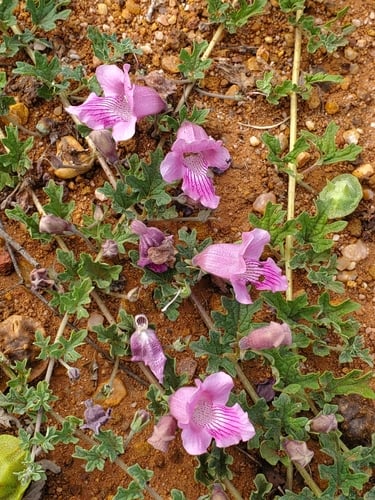
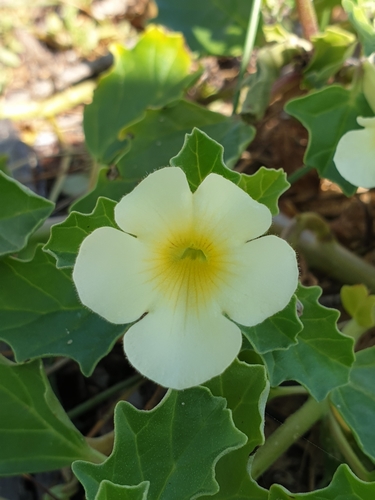
iNaturalist· cc-by-nc
(c) pgtz, some rights reserved (CC BY-NC), uploaded by pgtz
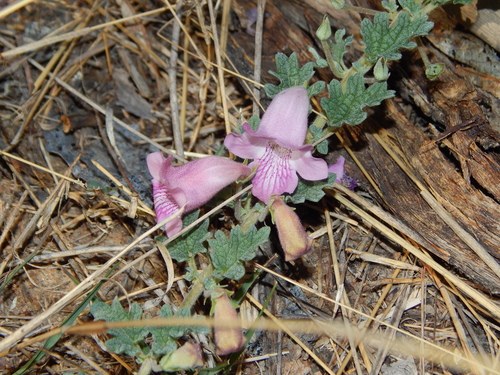
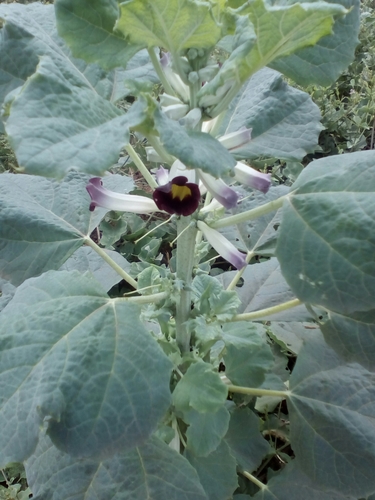
iNaturalist· cc-by-nc
(c) Robin Heymans, some rights reserved (CC BY-NC)
Summary
Source: WikipediaSesamum radiatum is a species of flowering plant in the Pedaliaceae. It is in the same genus as sesame, and is known by the English common names benniseed, black benniseed, black sesame, and vegetable sesame. (While the regular sesame, Sesamum indicum, may have black seeds, also referred to as black sesame, and is a related plant, it is a separate species from Sesamum radiatum.) It is native to west and central Africa, has been cultivated since ancient times in Africa, and is sometimes also used in tropical Asia where it has become naturalized to a small extent.
Description
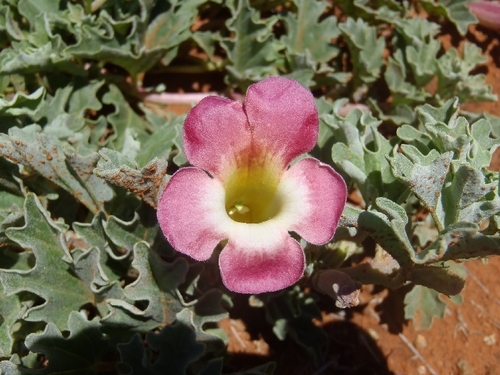
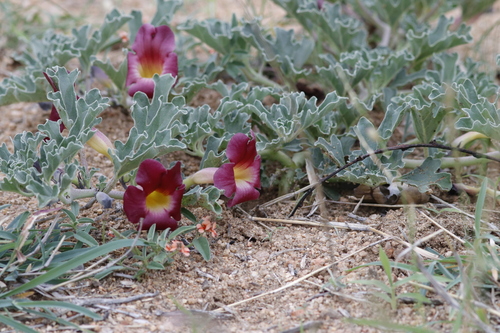
A hairy herb. It grows each year from seeds. It grows 1 m high. It has an unpleasant smell. The stems can be simple or branched. The leaves are opposite or alternate and simple. They are oval and 3-10 cm long by 2-5 cm wide. They are wedge shaped at the base and taper to the tip. The flowers occur singly in the axils of the leaves. The fruit is a 4 sided long capsule. It is 2-3,5 cm long. It is softly hairy. There are many seeds. The seeds are flattened and 2.5-3.5 mm long. The seed coat has lines going out from the centre.
Edible Uses
The seeds are eaten whole, made into a paste, ground into a powder, or pressed for a high-quality oil. The leaves can be eaten fresh or cooked and are used in Sub-Saharan Africa as a leaf vegetable. The leaves are mucilaginous in texture when cooked. The shoots can also be eaten and are used in soups and porridge.
Traditional Uses
The young leaves are finely cut, cooked and eaten with cereals or added to soups. Cooked leaves are slimy. The seeds are eaten. They are eaten toasted and whole or ground to a paste. The seeds yield an edible oil.
Medicinal Uses
The leaves are also used medicinally as a laxative, an antidote to scorpion venom and to treat sprains and ease childbirth. The stem and bark have also been noted for their anti-bacterial properties.
Distribution
A tropical plant. It grows in tropical Africa. It grows in open savannah in moist places.
Where It Grows
Africa, Angola, Benin, Burkina Faso, Cameroon, Cape Verde, Central Africa, Central African Republic, CAR, Congo DR, Côte d'Ivoire, East Africa, Equatorial Guinea, Gabon, Gambia, Ghana, Guinea, Guinée, Guinea-Bissau, Guyana, Ivory Coast, Liberia, Mali, Nigeria, Senegal, Sierra Leone, South America, Sudan, Tanzania, Togo, West Africa,
Cultivation
Plants can be grown from seeds. They can be sown directly or transplanted. Seeds germinate in 6-10 days. Seedlings are transplanted when 15 cm high. Second year plants can be pruned to encourage new growth.
Propagation
Seed - it can be sown into seedbeds, in seed boxes or directly into the place where it is to grow, placing 2 - 3 seeds per hole. Germination takes 6 - 10 days. Seedlings are transplanted at a spacing of approximately 15cm.
Other Uses
A leaf infusion is used as a shampoo and to kill head lice.
Production
First leaves can be harvested 8-10 weeks after sowing. They are then harvested every 7-10 days. Flowering and fruiting can continue while plants keep growing. Fruits mature in 6 weeks.
Other Information
It is a commercially cultivated vegetable. The leaves are popular. It is mainly used locally. It produces fresh leaves during the dry season. It has average palatability.
Synonyms
Also Known As
Agbo, Black sesame, Dosse, Dossi, Ekuku, Ewe atura, Gogoro, Lalo-caminho, Nonman, Tcabelaba, Tchaba-laba, Tissedoonte, Tiwadouanti, Toohoun, Touhoonom, Touhounom, Touwadouanti, Vegetable sesame, Wandu wandu, Wanguila, Zinzam
References (32)
- Abbiw, D.K., 1990, Useful Plants of Ghana. West African uses of wild and cultivated plants. Intermediate Technology Publications and the Royal Botanic Gardens, Kew. p 41
- Achigan-Dako, E, et al (Eds), 2009, Catalogue of Traditional Vegetables in Benin. International Foundation for Science.
- Adeoti, K. et al, 2012, Agromorphological characterization of Sesamum radiatum (Schum. & Thonn.) a neglected amd underutilized species of traditional leafy vegetable of great importance in Benin. African Journal of Agricultural Research. Vol. 7(24) pp. 3569-2578
- Avouhou, H. T., et al, 2012, Ethnobotanical Factors Influencing the Use and Management of Wild Edible Plants in Agricultural Environments in Benin. Ethnobotany Research & Applications Vol 10:571-592
- Burkill, H. M., 1985, The useful plants of west tropical Africa, Vol. 4. Kew.
Show all 32 references Hide references
- Busson, 1965,
- Catarino, L., et al, 2008, An annotated checklist of the vascular flora of Guinea-Bissau (West Africa). Blumea 53:1-222 p 97
- Catarino, L. et al, 2019, Edible Leafy Vegetables from West Africa (Guinea-Bissau): Consumption, Trade and Food Potential. Foods 2019, 8, 493
- Dalziel, J. M., 1937, The Useful plants of west tropical Africa. Crown Agents for the Colonies London.
- Dansi, A., et al, 2008, Traditional leafy vegetables and their use in the Benin Republic. Genet Resour Crop Evol (2008) 55:1239–1256
- Dansi, A., et al, 2012, Diversity of the Neglected and Underutilized Crop Species of Importance in Benin. The Scientific World Journal. Volume 2012, Article ID 932947, 19 pages
- Epenhuijsen C.W. van., 1974, Growing Native vegetables in Nigeria. FAO Rome, p 78
- Facciola, S., 1998, Cornucopia 2: a Source Book of Edible Plants. Kampong Publications, p 168
- Grivetti, L. E., 1980, Agricultural development: present and potential role of edible wild plants. Part 2: Sub-Saharan Africa, Report to the Department of State Agency for International Development. p 29, 49
- Grubben, G. J. H. and Denton, O. A. (eds), 2004, Plant Resources of Tropical Africa 2. Vegetables. PROTA, Wageningen, Netherlands. p 464
- INFOODSUpdatedFGU-list.xls
- Jardin, C., 1970, List of Foods Used In Africa, FAO Nutrition Information Document Series No 2.p 48, 101
- Kays, S. J., and Dias, J. C. S., 1995, Common Names of Commercially Cultivated Vegetables of the World in 15 languages. Economic Botany, Vol. 49, No. 2, pp. 115-152
- Lautenschläger, T., et al, 2018, First large-scale ethnobotanical survey in the province of Uíge, northern Angola. Journal of Ethnobiology and Ethnomedicine (2018) 14:51
- Martin, F.W. & Ruberte, R.M., 1979, Edible Leaves of the Tropics. Antillian College Press, Mayaguez, Puerto Rico. p 211
- Nayar, N.M., 1979, Sesame, in Simmonds, N.W., (ed), Crop Plant Evolution. Longmans. London. p 231
- Nyadanu, D., et al, 2015, Agro-biodiversity and challenges of on-farm conservation: the case of plant genetic resources of neglected and underutilized crop species in Ghana. Genet. Resourc. Crop Evol. 62(7):
- Okigbo, B.N., Vegetables in Tropical Africa, in Opena, R.T. & Kyomo, M.L., 1990, Vegetable Research and development in SADCC countries. Asian Vegetable Research and development Centre. Taiwan. p 44
- Omawale, 1973, Guyana's edible plants. Guyana University, Georgetown p 107
- Peters, C. R., O'Brien, E. M., and Drummond, R.B., 1992, Edible Wild plants of Sub-saharan Africa. Kew. p 160
- Salako, V. K. et al, 2013, Home gardens: an assessment of their biodiversity and potential contribution to conservation of threatened species and crop wild relatives in Benin. Genet Resour Crop Evol
- C. F. Schumacher, Beskr. Guin. pl. 282. 1827
- Segnon, A. C. & Achigan-Dako, E. G., 2014, Comparative analysis of diversity and utilization of edible plants in arid and semi-arid areas in Benin. Journal of Ethnobiology and Ethnomedicine 2014, 10:80
- Terra, G.J.A., 1973, Tropical Vegetables. Communication 54e Royal Tropical Institute, Amsterdam, p 73
- USDA, ARS, National Genetic Resources Program. Germplasm Resources Information Network - (GRIN). [Online Database] National Germplasm Resources Laboratory, Beltsville, Maryland. Available: www.ars-grin.gov/cgi-bin/npgs/html/econ.pl (10 April 2000)
- Wiersema, J. H. & Leon, B., 2013, World Economic Plants. A Standard Reference CRC Press. 2nd Ed. p 632
- World Checklist of Useful Plant Species 2020. Royal Botanic Gardens, Kew