Sesamum eriocarpum
(Decne) Byng & Christenh.
Large devil's thorn
No photos yet for Sesamum eriocarpum
Sign in to contribute a photoDescription
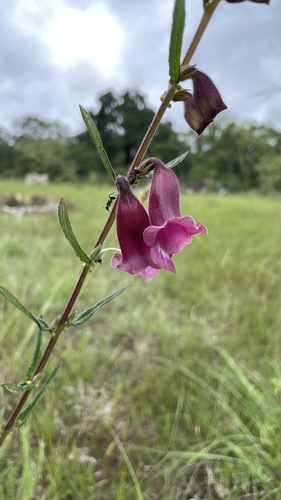
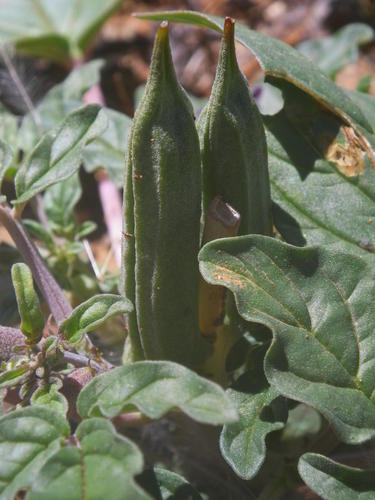
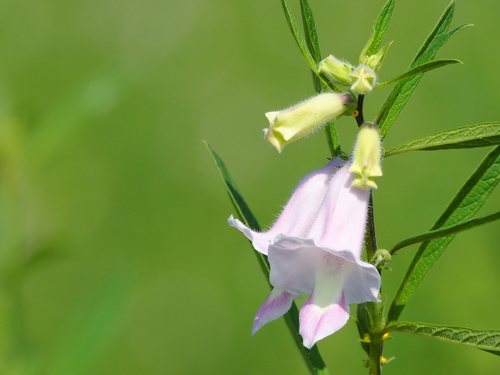
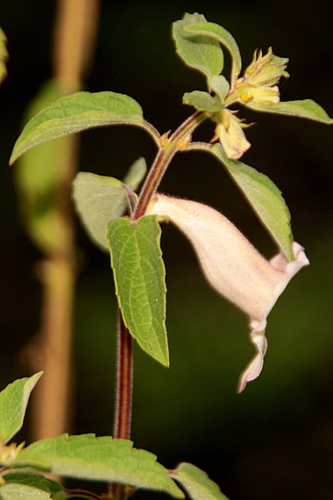
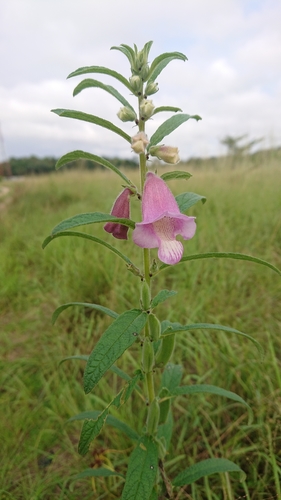
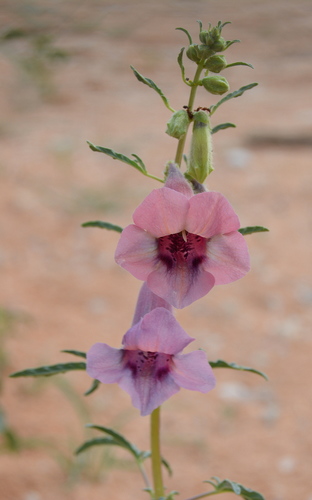
A herb that lies along the ground. It has stems 1.5 m long. The leaves are blue-green above and silvery white underneath. They are in opposite pairs. The leaves have irregular coarse teeth along the edges. The leaves are almost heart shaped. The flowers are pink and have darker markings on the lower lobes. They are about 3.5 cm long. They have 2 lips and 3 short lobes with a longer lobe underneath. The fruit is oval and flattened. It is 1.3 cm long. It has 2 sharp thorns on a ridge along the middle.
Edible Uses
The leaves are cooked and eaten.
Traditional Uses
The leaves are cooked and eaten.
This uses section is brief — help expand it
Distribution
It is a tropical plant. It grows in loose, sandy soil. It grows between 900-1,200 m above sea level. It can grow in arid places.
Where It Grows
Africa, Botswana, Congo DR, East Africa, Eswatini, Mozambique, South Africa, Southern Africa, Swaziland, Tanzania, Zambia, Zimbabwe,
Synonyms
Also Known As
Coa, Dinda, Ecua, Hiehlo, Hlehlo, Lichechua, Liramata, Sgagula, Tshetlho-etonanyana
References (5)
- Roodt, V., 1998, Common Wild Flowers of the Okavango Delta. Medicinal Uses and Nutritional value. The Shell Field Guide Series: Part 2. Shell Botswana. p 129 (As Dicerocaryum eriocarpum)
- Royal Botanic Gardens, Kew (1999). Survey of Economic Plants for Arid and Semi-Arid Lands (SEPASAL) database. Published on the Internet; http://www.rbgkew.org.uk/ceb/sepasal/internet [Accessed 5th May 2011] (As Dicerocaryum eriocarpum)
- Ruiters-Welcome, A. K., 2019, Food plants of southern Africa. Ph.D. thesis. Univ. of Johannesburg p 85 (As Dicerocaryum eriocarpum)
- Shackleton, S. E., et al, 1998, Use and Trading of Wild Edible Herbs in the Central Lowveld Savanna Region, South Africa. Economic Botany, Vol. 52, No. 3, pp. 251-259 (As Dicerocaryum eriocarpum)
- World Checklist of Useful Plant Species 2020. Royal Botanic Gardens, Kew