Sesamum triphyllum
Welw. ex Asch.
Thunderbolt flower, Wild sesame
iNaturalist· cc-by-nc
(c) copper, some rights reserved (CC BY-NC), uploaded by copper
iNaturalist· cc-by-nc
(c) Christine Sydes, some rights reserved (CC BY-NC), uploaded by Christine Sydes
iNaturalist· cc-by-nc
(c) Christine Sydes, some rights reserved (CC BY-NC), uploaded by Christine Sydes
Description
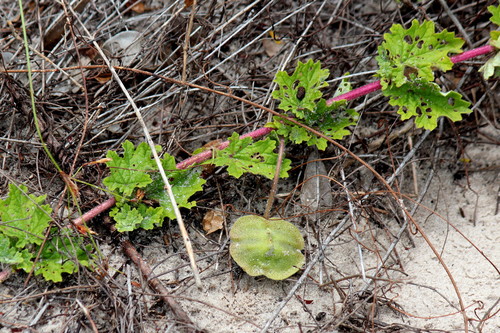
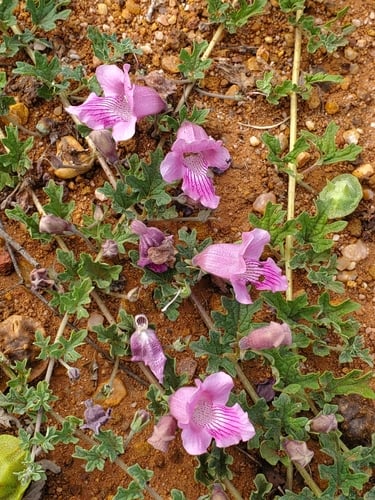
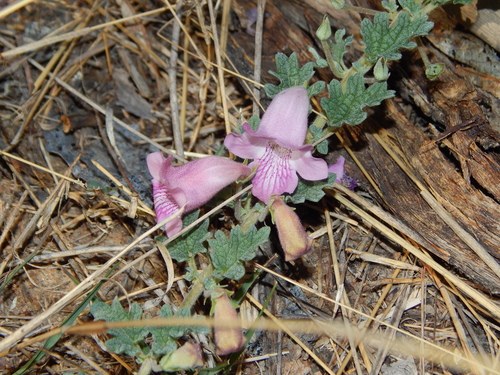
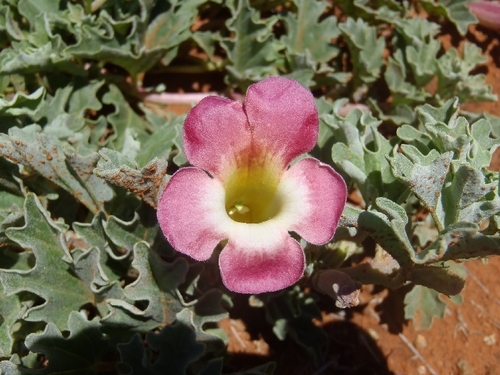
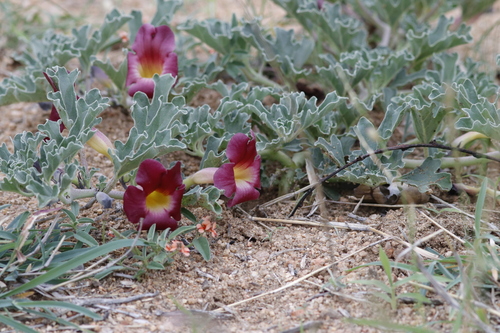
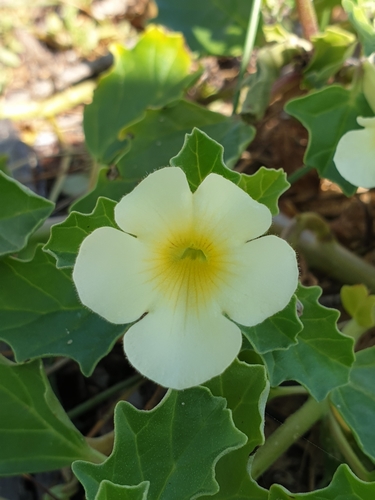
A herb. It is an annual plant. It has an unpleasant smell. It grows 2.5 m high. The leaves have 3-7 lobes. The leaves at the top can be simple. The flowers are tube shaped and divided into 5 shallowly lobed petals. They occur singly in the axils of leaves. They are pink. The fruit is a cylinder shaped capsule. It is four sided. It is 4 cm long. It has a pointy tip.
Edible Uses
The seeds are eaten as a snack and are used to produce cooking oil.
Traditional Uses
The seeds are eaten and used as a snack. They also provide cooking oil.
This uses section is brief — help expand it
Medicinal Uses
The vapour given off when boiling the leaves is said to be an effective cure for malaria. The roots are chewed, or taken as a decoction, to remedy menstruation pains. The decoction is also taken by pregnant women who have abdominal pains and are worried they might miscarry; as well as being used to ease chest pains.
Distribution
It is a subtropical plant. It grows in sandy and loamy soils. It grows between 150-1,670 m above sea level. It can grow in arid places.
Where It Grows
Africa, Angola, Botswana, Central Africa, East Africa, Eswatini, Mozambique, Namibia, South Africa, Southern Africa, Swaziland, Zimbabwe,
Other Uses
The roots contain a red dyeing material, which even in the herbarium stains paper, and might perhaps be used for dyeing purposes. Although the green stems appear rather weak, they have considerable strength when dried. They are valued as construction material in traditional houses, particularly for making doors.
Synonyms
References (6)
- INFOODSUpdatedFGU-list.xls
- Royal Botanic Gardens, Kew (1999). Survey of Economic Plants for Arid and Semi-Arid Lands (SEPASAL) database. Published on the Internet; http://www.rbgkew.org.uk/ceb/sepasal/internet [Accessed 5th May 2011]
- Ruiters-Welcome, A. K., 2019, Food plants of southern Africa. Ph.D. thesis. Univ. of Johannesburg p 86
- van Wyk, B-E., 2011, The potential of South African plants in the development of new food and beverage products. South African Journal of Botany 77 (2011) 857–868
- Welcome, A. K. & Van Wyk, B.-E., 2019, An inventory and analysis of the food plants of southern Africa. South African Journal of Botany 122 (2019) 136–179
Show all 6 references Hide references
- World Checklist of Useful Plant Species 2020. Royal Botanic Gardens, Kew