Schotia latifolia
Jacq.
Forest boerboon, Bush boer-bean
iNaturalist· cc-by-nc
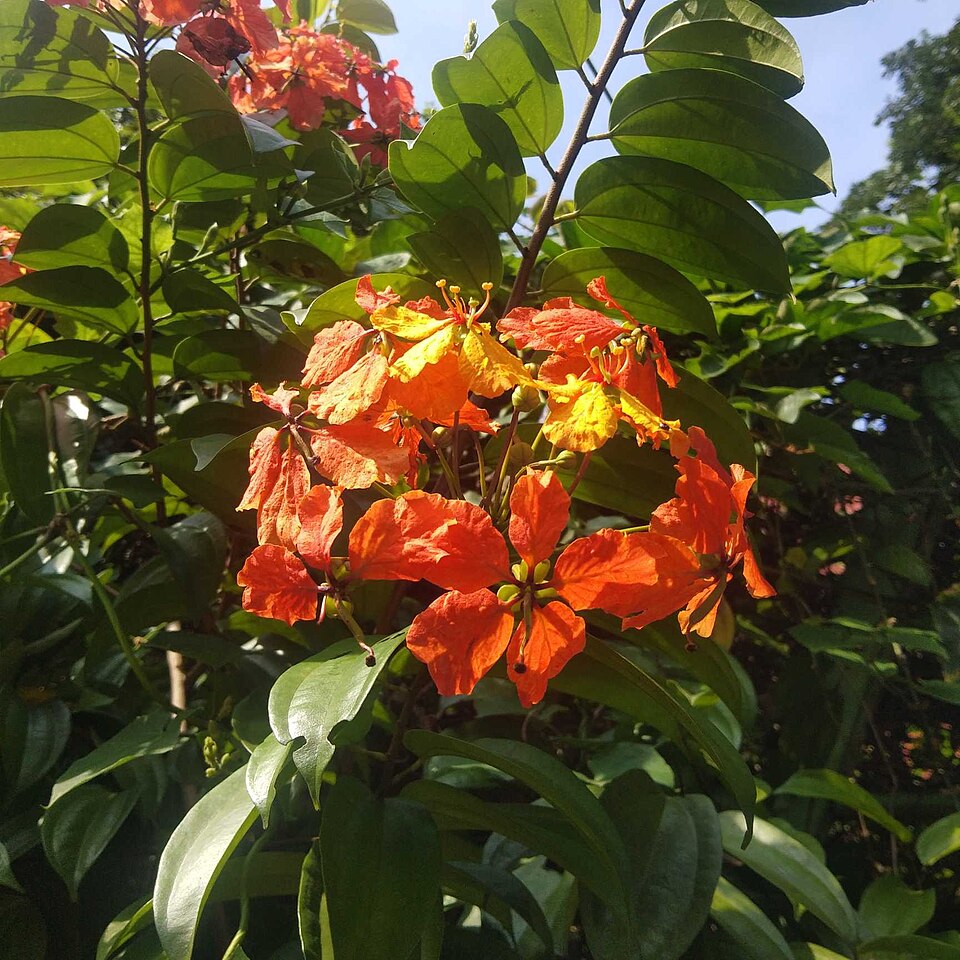
(c) qgrobler, some rights reserved (CC BY-NC), uploaded by qgrobler
iNaturalist· cc-by-nc
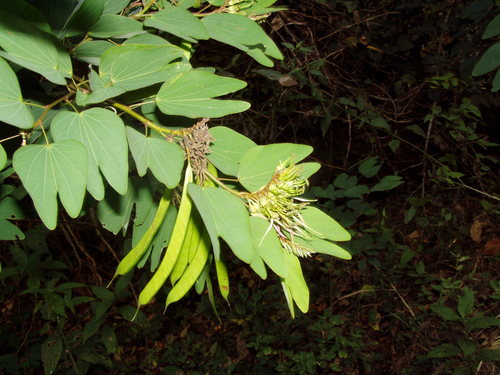
(c) Jacob Dirsuwei, some rights reserved (CC BY-NC), uploaded by Jacob Dirsuwei
iNaturalist· cc-by-nc
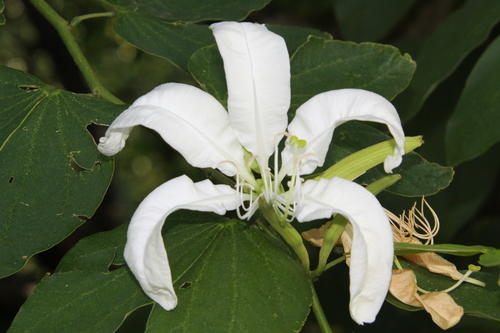
(c) Craig Peter, some rights reserved (CC BY-NC), uploaded by Craig Peter
Description
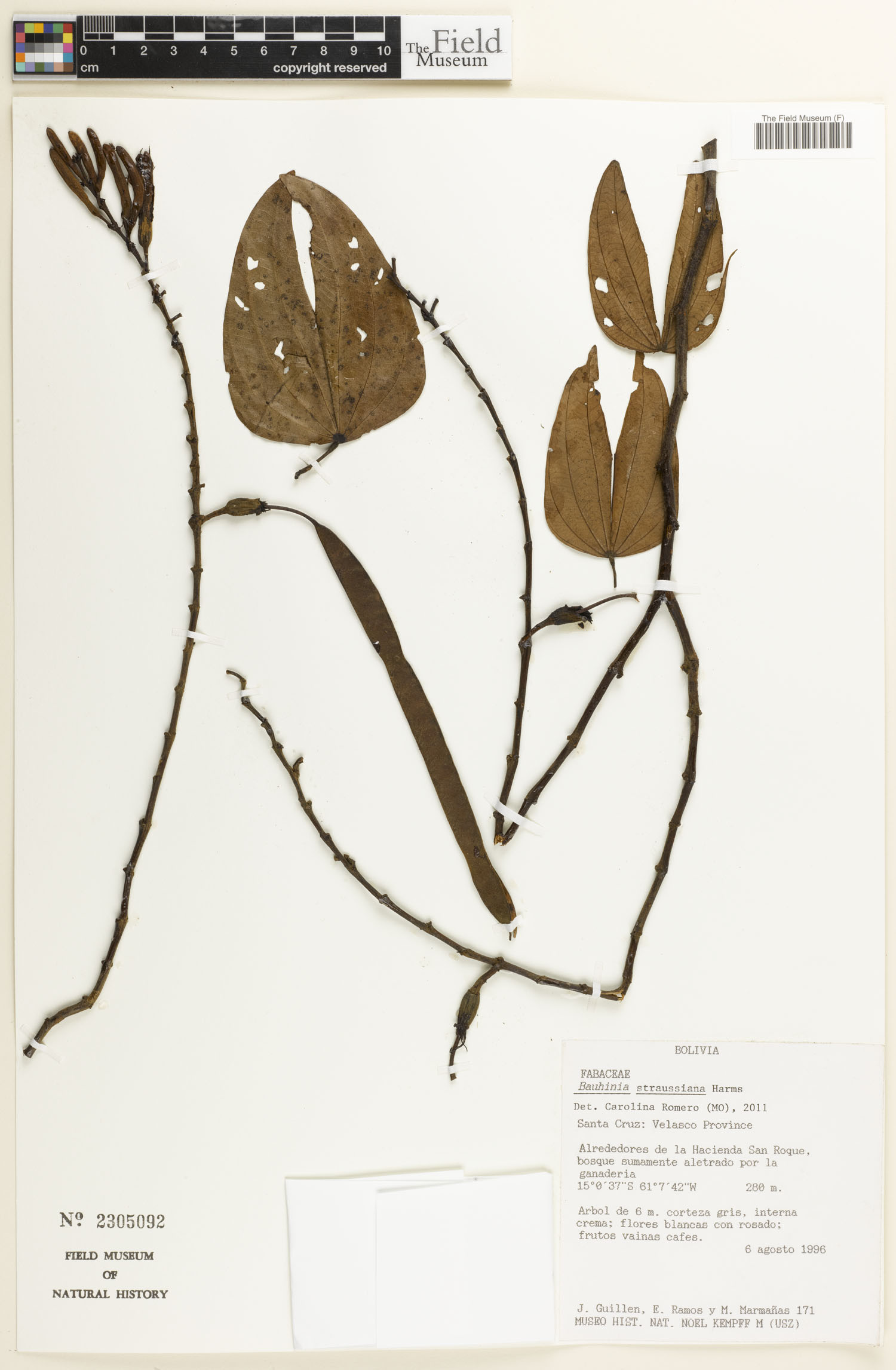
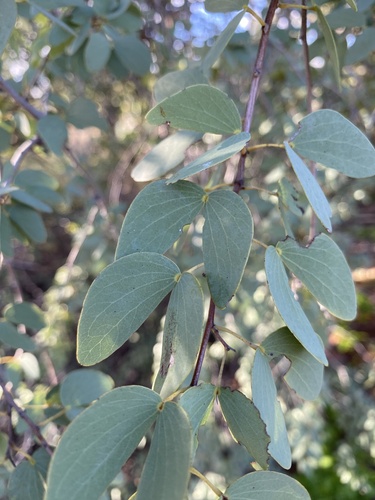
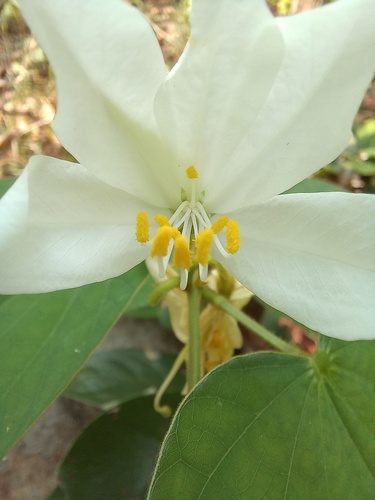
A medium to large tree It can grow 12-15 m tall in forest. The bark is smooth and grey or brown. The leaves are 10 cm long by 8 cm wide. They are on stalks 2.5 cm long. The leaves may or may not have hairs. In young leaves the midrib is sometimes slightly winged. There are 3-5 pairs of large oblong leaflets. These are 6.5 cm long by 4 cm wide. The upper leaflets are the largest. The base is lopsided. The tip can be pointed or round. The base can be tapered or round. The flowers are pale pink and usually have 5 petals. They are produced in open bundles at the ends of branches. The pods are 15 cm long. They are hard and round. Inside there are several light brown seeds with a yellow layer around them. The seeds in the green pods are edible.
Edible Uses
This tree can be used as a shade and ornamental tree. The leaves are browsed by stock. The seeds are edible either green, or mature. They can be used as a meal if roasted and ground. Traditionally the tree's bark has been used in tanning. It is also suitable to grow as a bonsai species.
Traditional Uses
The green pods were roasted and the seeds eaten.
This uses section is brief — help expand it
Medicinal Uses
Bark decoctions are taken to treat stomach-ache. The bark of Schotia latifolia is commonly used in South Africa to treat tick-borne diseases of livestock.
Distribution
A tropical plant. It grows in dry scrub forest. It can grow in arid places. It suits hardiness zones 9-12.
Where It Grows
Africa, Australia, Canary Islands, East Africa, India, Kenya, Mozambique, Slovenia, South Africa, Southern Africa,
Cultivation
Although many species within the family Fabaceae have a symbiotic relationship with soil bacteria, this species is said to be devoid of such a relationship and therefore does not fix atmospheric nitrogen.
Propagation
Like many species within the family Fabaceae, once they have been dried for storage the seeds of this species may benefit from scarification before sowing in order to speed up and improve germination. This can usually be done by pouring a small amount of nearly boiling water on the seeds (being careful not to cook them!) and then soaking them for 12 - 24 hours in warm water. By this time they should have imbibed moisture and swollen - if they have not, then carefully make a nick in the seedcoat (being careful not to damage the embryo) and soak for a further 12 hours before sowing. Sow the treated seeds in seed trays in a semi-shaded position. Germination should take place within a few weeks. Prick the seedlings out into individual containers once they have reached the two-leaf stage, being very careful not to damage the sensitive tap-root. Keep in semi-shade initially and then gradually harden them off. Ensure that the young plants never dry out completely.
Other Uses
The bark has been used as a dye producing a greenish colour, and for tanning. The tough, whitish wood is used for fence posts.
Notes
It forms hybrids with Schotia afra. Also as Caesalpinaceae.
Synonyms
Also Known As
Bean tree, Elephant hedge, Ntsongo, Umgxamu
References (14)
- Cundall, P., (ed.), 2004, Gardening Australia: flora: the gardener's bible. ABC Books. p 1325
- Fox, F. W. & Young, M. E. N., 1982, Food from the Veld. Delta Books. p 216
- Fragm. bot. 23. 1803
- http://www.botanic-gardens-ljubljana.com/en/plants
- Palgrave, K.C., 1996, Trees of Southern Africa. Struik Publishers. p 277
Show all 14 references Hide references
- Palmer, E and Pitman, N., 1972, Trees of Southern Africa. Vol. 2. A.A. Balkema, Cape Town p 855
- Peters, C. R., O'Brien, E. M., and Drummond, R.B., 1992, Edible Wild plants of Sub-saharan Africa. Kew. p 124
- Royal Botanic Gardens, Kew (1999). Survey of Economic Plants for Arid and Semi-Arid Lands (SEPASAL) database. Published on the Internet; http://www.rbgkew.org.uk/ceb/sepasal/internet [Accessed 26th April 2011]
- Ruiters-Welcome, A. K., 2019, Food plants of southern Africa. Ph.D. thesis. Univ. of Johannesburg p 60
- Shava, S., 2000, The Use of Indigenous Plants as Food by a Rural Community in the Eastern Cape: an Educational Exploration. Masters Thesis Rhodes University. p 67
- van Wyk, Ben-Erik, 2019, The diversity and multiple uses of southern African legumes. Australian Systematic Botany, 2019, 32, 519–546
- von Breitenbach, F., 1985, Southern Cape Tree Guide. Department of Environment Affairs, Forestry Branch. Pamphlet 360 Pretoria p 9
- Welcome, A. K. & Van Wyk, B.-E., 2019, An inventory and analysis of the food plants of southern Africa. South African Journal of Botany 122 (2019) 136–179
- World Checklist of Useful Plant Species 2020. Royal Botanic Gardens, Kew