Uraria crinita
(L.) Desv. ex DC.
Cat's tail, Cattail pea
iNaturalist· cc-by-nc
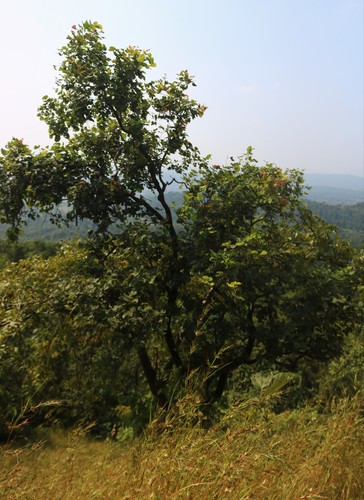
(c) 王美芳, some rights reserved (CC BY-NC), uploaded by 王美芳
iNaturalist· cc-by
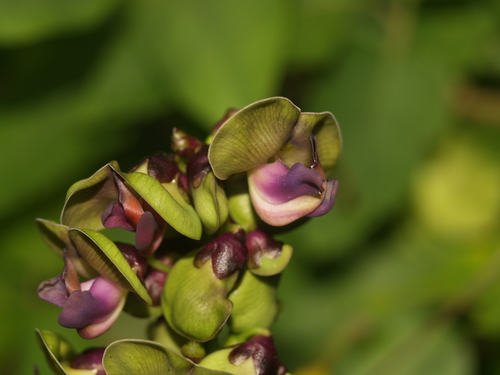
(c) Yj, some rights reserved (CC BY)
iNaturalist· cc-by-nc
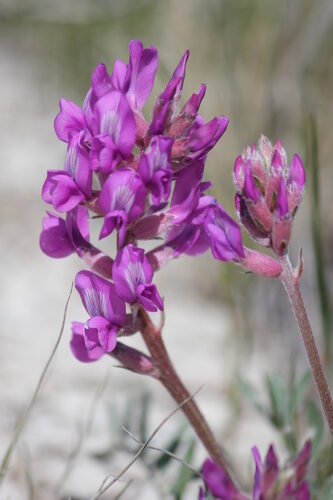
(c) cgbb2004, some rights reserved (CC BY-NC), uploaded by cgbb2004
Description
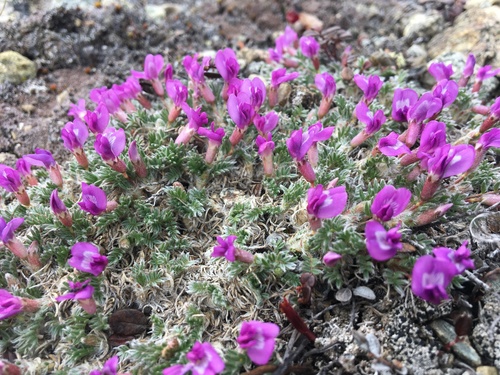
A shrub. It grows 1.5-2 m tall. It keeps growing from year to year. The leaves have 1-3 leaflets. The leaflets are finely hairy underneath. The flowers are pink or purple. Many flowers can occur together in a dense, erect raceme. The fruit are pods which have 5-7 joints. They are black.
Edible Uses
The leaves and roots are edible.
Medicinal Uses
This species is often used in traditional medicine, with different plant parts being used to cure a range of conditions including dysentery and diarrhoea; enlarged spleen and liver; tumours. It is also applied against pustules and fistulae. The whole plant is used medicinally for stopping bleeding, reducing fever, and relieving coughs. It is effective in driving out intestinal worms and other parasites and is sometimes used as a carminative for children. A decoction of the roots is used in the treatment of diarrhoea. The crushed leaves are applied externally to rid the hair of lice.
Distribution
A tropical plant. It grows below 850 m in Southern China. It suits hardiness zones 10-12. In Yunnan.
Where It Grows
Asia, Australia, Bangladesh, Cambodia, China, India, Indochina, Indonesia, Japan, Laos, Malaysia, Myanmar, Pacific, Philippines, Ryukyu, SE Asia, Sri Lanka, Taiwan, Thailand, Vietnam,
Cultivation
Plants are grown from seed.
Other Uses
The plant is used as a green manure and cover crop.
Notes
There are about 6 Uraria species. The whole plant is used medicinally. Also as Papilionaceae.
Synonyms
Also Known As
Dieng-kha-riu, Hahng-kar-rok, Hang karawk, Hauvi toc, Kedudong padang, Mao wei cao, Pokok ekur anjing, Pokok ekur kuching, Serengan hutan
References (9)
- Ambasta, S.P. (Ed.), 2000, The Useful Plants of India. CSIR India. p 661
- Burkill, I.H., 1966, A Dictionary of the Economic Products of the Malay Peninsula. Ministry of Agriculture and Cooperatives, Kuala Lumpur, Malaysia. Vol 2 (I-Z) p 2246
- Huang Puhua; H. Ohashi, FABACEAE (Draft), Trib. Desmodieae (Bentham) Hutchinson. Flora of China.
- Llamas, K.A., 2003, Tropical Flowering Plants. Timber Press. p 223
- Martin, F.W. & Ruberte, R.M., 1979, Edible Leaves of the Tropics. Antillian College Press, Mayaguez, Puerto Rico. p 201
Show all 9 references Hide references
- McMakin, P.D., 2000, Flowering Plants of Thailand. A Field Guide. White Lotus. p 98
- Pham-Hoang Ho, 1999, An Illustrated Flora of Vietnam. Nha Xuat Ban Tre. p 931
- Prodr. 2:324. 1825 (Desv., J. Bot. Agric. 1:123. 1813, nom. inval.)
- Xu, Z., Tao, G. & Tan, J., 1988, Tropical Wild Flowers and Plants in Xishuangbanna, Agricultural Publishing House. photo 101