Tylosema fassoglensis
(Kotschy ex Schweinf.) Torre et Hillcoat
Climbing marama bean, Sprawling bauhinia
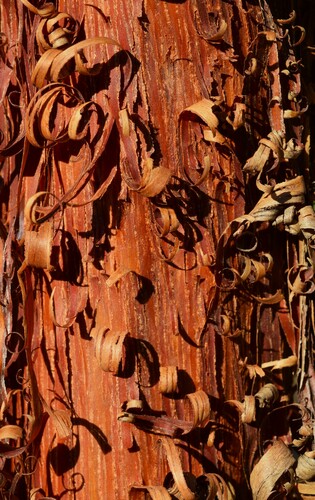
iNaturalist· cc-by-nc
(c) Troos van der Merwe, some rights reserved (CC BY-NC)
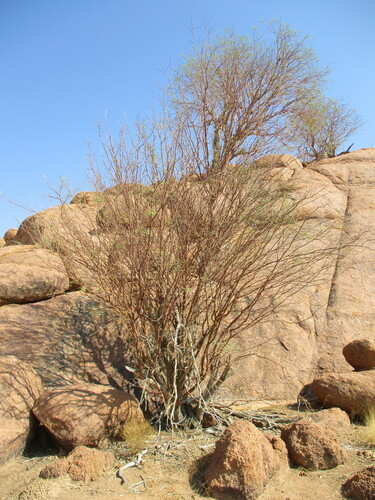
iNaturalist· cc-by-nc
(c) Troos van der Merwe, some rights reserved (CC BY-NC)
iNaturalist· cc-by-nc
(c) Troos van der Merwe, some rights reserved (CC BY-NC)
Description
A trailing or climbing plant. It is evergreen and shrubby. It can be 6 m long. It has a large tuberous root. This can be to a depth of 2.5 m. Young plant parts have rusty coloured hairs. The leaves are simple and almost round but with two lobes or divided at the tip. Leaves are 5-20 cm long by 6-23 cm wide. There are rusty hairs on the veins underneath the leaf. The flower clusters are 2-42 cm long on stalks 2-17 cm long. The flowers have 5 petals. Four of these are yellow and one is reduced to a green stub. The petals are yellow. The outer layer or sepals have wings. Fruit are 7-12 cm long and 4-7 cm wide. The seeds are not quite round and are 1.7-2.8 cm long.
Edible Uses
The young and mature pods are eaten raw or cooked. Seeds can be eaten raw but are usually cooked or roasted, and are also used as a coffee substitute. The tuberous roots are eaten raw, roasted, or crushed into meal, and also provide drinking water.
Traditional Uses
The pods are eaten raw or cooked. Young pods are eaten raw. The seeds can be eaten raw but are usually cooked or roasted. The seeds are also used as a coffee substitute. The tubers are eaten raw. They also provide water. They can be roasted and eaten or then stored for later use. They can also be crushed and pounded to make a meal.
Distribution
It is a tropical plant. It does well in seasonally wet and dry climates. It needs well-drained soil. In Malawi it grows at 900-1,200 m altitude. In Tanzania it grows up to 1,500 m above sea level and in areas with a rainfall between 1,000-1,600 mm. It needs full sun. It can grow in arid places. It suits hardiness zones 9-12.
Where It Grows
Africa, Angola, Botswana, Burundi, Central Africa, Congo, East Africa, Eswatini, Ethiopia, Kenya, Malawi, Mozambique, Namibia, Pacific, Papua New Guinea, PNG, Rwanda, South Africa, Southern Africa, Sudan, Swaziland, Tanzania, Uganda, Zambia, Zimbabwe,
Cultivation
Plants can be grown from seeds.
Production
Plants grow rapidly. Tubers up to 78 kg have been recorded. Seeds are collected at the ends of the rainy season.
Other Information
The pods and seeds are eaten especially by children. In Papua New Guinea it is grown in the Lae Botanical gardens.
Notes
Also as Caesalpinaceae.
Nutrition
| Part | Moisture | kJ | kcal | Protein | Vit A | Vit C | Iron | Zinc |
|---|---|---|---|---|---|---|---|---|
| Seeds | 7.5 | 452 | 108 | 43.5 | — | — | — | — |
| Pods | 72.5 | 446 | 107 | 6.4 | — | 39 | 0.5 | 2.2 |
| Tubers | 79.4 | 237 | 57 | 1.6 | — | 6.5 | 0.3 | 0.5 |
Synonyms
Also Known As
Ballai, Damkilo, Esinkarua, Ingwaila, Inkwapau, Inkwpan, Ivole, Khubalhulu, Lamoora, Mamoora, M'pauia, Mbalawala, Mkulumu, Mpandakwaya, Mpandopansi, Mphandwapansi, Mutukutupasi, Ombanui, Ozombanui, Umdabula
References (35)
- Addis, G., Asfaw, Z & Woldu, Z., 2013, Ethnobotany of Wild and Semi-wild Edible Plants of Konso Ethnic Community, South Ethiopia. Ethnobotany Research and Applications. 11:121-141
- Asfaw, Z. and Tadesse, M., 2001, Prospects for Sustainable Use and Development of Wild Food Plants in Ethiopia. Economic Botany, Vol. 55, No. 1, pp. 47-62
- Bircher, A. G. & Bircher, W. H., 2000, Encyclopedia of Fruit Trees and Edible Flowering Plants in Egypt and the Subtropics. AUC Press. p 55 (As Bauhinia fassoglense)
- Bol. Soc. Brot. ser. 2, 29:38. 1955
- Brink, M., 2006. Tylosema fassoglense (Schweinf.) Torre & Hillc. [Internet] Record from Protabase. Brink, M. & Belay, G. (Editors). PROTA (Plant Resources of Tropical Africa), Wageningen, Netherlands. < http://database.prota.org/search.htm>. Accessed 23 October 2009
Show all 35 references Hide references
- Fowler, D. G., 2007, Zambian Plants: Their Vernacular Names and Uses. Kew. p 32
- Fox, F. W. & Young, M. E. N., 1982, Food from the Veld. Delta Books. p 218
- Grivetti, L. E., 1980, Agricultural development: present and potential role of edible wild plants. Part 2: Sub-Saharan Africa, Report to the Department of State Agency for International Development. p 66 (As Bauhinia)
- Grubben, G. J. H. and Denton, O. A. (eds), 2004, Plant Resources of Tropical Africa 2. Vegetables. PROTA, Wageningen, Netherlands. p 565
- ILDIS Legumes of the World http:www:ildis.org/Legume/Web
- Jardin, C., 1970, List of Foods Used In Africa, FAO Nutrition Information Document Series No 2.p 108
- Kidane, B., et al, 2014, Ethnobotany of Wild and Semi-wild Edible Fruit Species used by Maale and Ari Ethnic Communities in South Ethiopia. Ethnobotany Research and Applications. Vol. 12, 1546-3465-12-455
- Long, C., 2005, Swaziland's Flora - siSwati names and Uses http://www.sntc.org.sz/flora/
- Lulekal, E., et al, 2011, Wild edible plants in Ethiopia: a review on their potential to combat food insecurity. Afrika Focus - Vol. 24, No 2. pp 71-121
- Malaisse, F., 1997, Se nourrir en floret claire africaine. Approche ecologique et nutritionnelle. CTA., p 69
- Martin, F.W. & Ruberte, R.M., 1979, Edible Leaves of the Tropics. Antillian College Press, Mayaguez, Puerto Rico. p 201
- Maundu, P. et al, 1999, Traditional Food Plants of Kenya. National Museum of Kenya. 288p
- Mutie, F. G., 2020, Conservation of Wild Food Plants and Their Potential for Combatting Food Insecurity in Kenya as Exemplified by the Drylands of Kitui County. Plants 2020, 9, 1017
- Mutie, F. M., et al, 2023, Important Medicinal and Food Taxa (Orders and Families) in Kenya, Based on Three Quantitative Approaches. Plants 2023, 12, 1145
- Llamas, K.A., 2003, Tropical Flowering Plants. Timber Press. p 197 (As Bauhinia fassoglensis)
- Peters, C. R., O'Brien, E. M., and Drummond, R.B., 1992, Edible Wild plants of Sub-saharan Africa. Kew. p 125
- Royal Botanic Gardens, Kew (1999). Survey of Economic Plants for Arid and Semi-Arid Lands (SEPASAL) database. Published on the Internet; http://www.rbgkew.org.uk/ceb/sepasal/internet [Accessed 26th April 2011]
- Ruffo, C. K., Birnie, A. & Tengnas, B., 2002, Edible Wild Plants of Tanzania. RELMA p 682
- Ruiters-Welcome, A. K., 2019, Food plants of southern Africa. Ph.D. thesis. Univ. of Johannesburg p 61
- Swaziland's Flora Database http://www.sntc.org.sz/flora
- Tredgold, M.H., 1986, Food Plants of Zimbabwe. Mambo Press. p 15
- USDA, ARS, National Genetic Resources Program. Germplasm Resources Information Network - (GRIN). [Online Database] National Germplasm Resources Laboratory, Beltsville, Maryland. Available: www.ars-grin.gov/cgi-bin/npgs/html/econ.pl (10 April 2000) (As Bauhinia fassoglensis)
- Verdcourt, B., 1979, Manual of New Guinea Legumes. Botany Bulletin No 11, Division of Botany, Lae, Papua New Guinea. p 123
- van Wyk, B-E., 2011, The potential of South African plants in the development of new food and beverage products. South African Journal of Botany 77 (2011) 857–868
- van Wyk, Ben-Erik, 2019, The diversity and multiple uses of southern African legumes. Australian Systematic Botany, 2019, 32, 519–546
- Wehmeyer, A. S, 1986, Edible Wild Plants of Southern Africa. Data on the Nutrient Contents of over 300 species
- Welcome, A. K. & Van Wyk, B.-E., 2019, An inventory and analysis of the food plants of southern Africa. South African Journal of Botany 122 (2019) 136–179
- Wiersema, J. H. & Leon, B., 2013, World Economic Plants. A Standard Reference CRC Press. 2nd Ed. p 703
- Williamson, J., 2005, Useful Plants of Malawi. 3rd. Edition. Mdadzi Book Trust. p 34 (As Tylosema fassoglense)
- World Checklist of Useful Plant Species 2020. Royal Botanic Gardens, Kew