Tylosema esculentum
(Burchell) A. Schreiber
Gemsbok bean, Marama bean, Camel's foot
iNaturalist· cc-by-nc
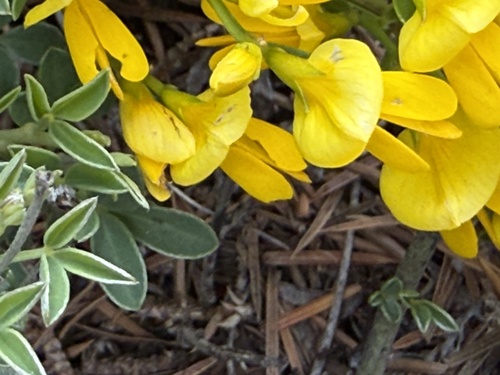
(c) Christine Sydes, some rights reserved (CC BY-NC), uploaded by Christine Sydes
iNaturalist· cc-by-nc
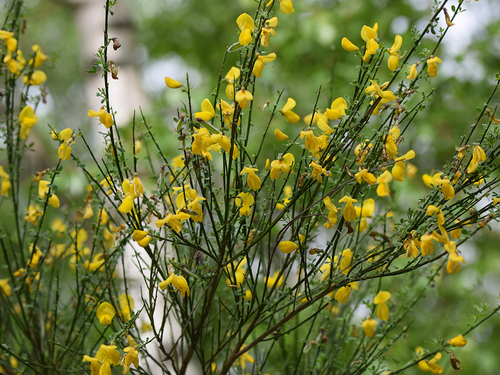
(c) Richard Gill, some rights reserved (CC BY-NC)
iNaturalist· cc-by-nc
(c) Richard Gill, some rights reserved (CC BY-NC)
Summary
Source: WikipediaTylosema esculentum, with common names gemsbok bean and marama bean or morama bean, is a long-lived perennial legume native to arid areas of southern Africa. Stems grow at least 3 metres (9.8 ft), in a prostrate or trailing form, with forked tendrils that facilitate climbing. A raceme up to 25 millimetres (1 in) long, containing many yellow-orange flowers, ultimately produces an ovate to circular pod, with large brownish-black seeds.
Description
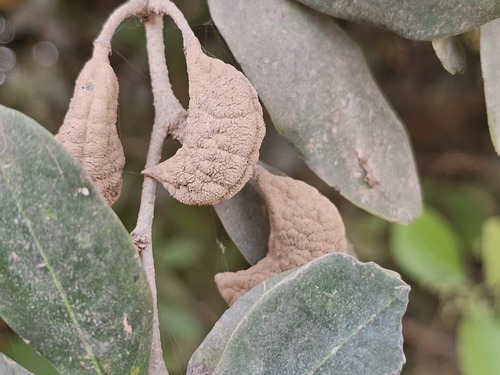
A herb or shrub. It is climbing and keeps growing from year to year. It has tuberous roots. The stem lie along the ground. They can be 6 m long. The lower parts can be woody. There are forked tendrils 1-4 cm long. The leaves are simple and arranged alternately. The leaf blade has 2 lobes. These are kidney shaped and 4-5 cm long by 5-6 cm wide. The flowers are in groups 16 cm long and at the sides. The flowers contain both sexes and are yellow turning red with age. The fruit is a oval pod 4-6 cm long by 3-4 cm wide and flattened. It is woody and usually has 1-2 seeds. The pod is constricted between the seeds. The seeds are round or oval and 2-2.5 cm long by about 1.5 cm wide. They are reddish-brown.
Edible Uses
The seeds are cooked and, once roasted, develop a delicious nutty flavour comparable to coffee beans or roasted cashews. They can be boiled with maize meal or ground into flour to make porridge or a coffee- or cocoa-like drink, and have been used as a culinary substitute for almonds. Nutritionally, the seeds contain around 30% protein (approaching that of the soya bean) and around 40% oil (approaching that of the peanut). Immature seeds and stems may be eaten cooked as a vegetable or added to soups. An edible oil extracted from the seed is similar to almond oil in consistency and taste — golden-yellow, with a nutty odour and a pleasant, slightly bitter flavour. The tuber is cooked by baking, boiling or roasting; young tubers are sweet and pleasant with a texture likened to artichoke. Tubers older than two years become fibrous and bitter and are generally not eaten, but they serve as an important emergency source of water for both humans and animals.
Traditional Uses
The root is sweet and nutritious. They are baked, boiled or roasted. The seeds are roasted or boiled and eaten. They are shelled and pounded and added to water to make soup. The seeds also produce an edible oil. The young stems are roasted and eaten. Young leafy shoots are occasionally eaten.
Medicinal Uses
None known
Distribution
A tropical plant. It is native to the Kalahari desert. It grows in hot arid areas. It can tolerate drought and low soil fertility. It often grows in areas with daily maximum temperatures of 37°C and a low rainfall of 100-900 mm. It is on sandy and limestone soils. It can tolerate frost. It grows between 800-1,600 m above sea level. It can grow in arid places.
Where It Grows
Africa, Angola, Botswana, Central Africa, Congo DR, East Africa, Eswatini, Ethiopia, Israel, Malawi, Mediterranean, Middle East, Mozambique, Namibia, South Africa, Southern Africa, Sudan, Swaziland, Tanzania, Uganda, USA, Zambia, Zimbabwe,
Cultivation
Plants are grown from seed. They germinate 9-10 days after planting. Plants can re-grow from the tubers. Seeds should not be soaked or planted in waterlogged soils.
Propagation
Seed — should not be pre-soaked, though scarification may improve germination. Germination typically begins after about 9 days.
Other Uses
Marama Bean is a nitrogen-fixing plant that improves soil fertility and can be used as a cover crop for erosion control while also providing edible seeds for human and animal consumption. It has potential as an ornamental ground cover plant. The seeds and kernels yield up to 50% by weight of a golden-yellow, transparent oil suitable for use in cosmetic preparations. The flowers are rich in nectar and pollen, attracting bees and other beneficial insects. The seeds and tubers serve as a food source for wildlife, and the plant provides some shelter, though it is not typically used for nesting or roosting. Ground cover created by the plant can provide habitat for invertebrates, and leaf litter offers shelter for beneficial insects.
Production
Plants flower between 2 to 4 years after planting. A tuber can weigh about 1 kg. They can weigh 12 kg but become fibrous with age. The seeds can be stored for several years and are still edible.
Other Information
It is a commercially cultivated vegetable. It is an important food of the Khoisan people in the Kalahari.
Notes
There are 5 Tylosema species. Also as Caesalpinaceae. The tuber is 9% protein. The seed is 30-39 % protein which is higher than peanut or soy bean. It apparently does not fix nitrogen.
Nutrition
| Part | Moisture | kJ | kcal | Protein | Vit A | Vit C | Iron | Zinc |
|---|---|---|---|---|---|---|---|---|
| Seed | 3.9 | 2660 | 636 | 32.9 | — | — | — | — |
| Leaves raw | 73.3 | 343 | 82 | 4.3 | — | — | — | — |
| Tubers | 90.5 | 125 | 30 | 0.6 | — | 2.5 | 0.3 | 0.2 |
Synonyms
Also Known As
Bauhinia, Ditsidi, Ganu, Gami, Lai, Litam-mani, Marumama, Morama, Muraki, Ombanui, Otjipiva, Ozombanui, Rama, Tammani, Tsi/tsin, Ts''hi
References (40)
- Akinola, R., et al, 2020, A Review of Indigenous Food Crops in Africa and the Implications for more Sustainable and Healthy Food Systems. Sustainability 2020, 12, 3493;
- Bircher, A. G. & Bircher, W. H., 2000, Encyclopedia of Fruit Trees and Edible Flowering Plants in Egypt and the Subtropics. AUC Press. p 55 (As Bauhinia bainesii and Bauhinia esculenta)
- Dakora, F. D., 2013, Biogeographic Distribution, Nodulation and Nutritional Attributes of Underutilized Indigenous Agrican Legumes. Acta Horticulturae Number 979 Vol. 1. p 53
- Engelter, C. & Wehmeyer, A. S., 1970, Fatty Acid Composition of Oils of Some Edible Seeds of Wild Plants. Journal of Agricultural and Food Chemistry. 18(1): 25-26 (As Bauhinia esculenta)
- Facciola, S., 1998, Cornucopia 2: a Source Book of Edible Plants. Kampong Publications, p 66 (As Tylosema esculentum)
Show all 40 references Hide references
- Food Composition Tables for use in Africa FAO http://www.fao.org/infoods/directory No. 645
- Fox, F. W. & Young, M. E. N., 1982, Food from the Veld. Delta Books. p 217
- Grivetti, L. E., 1980, Agricultural development: present and potential role of edible wild plants. Part 2: Sub-Saharan Africa, Report to the Department of State Agency for International Development. p 80
- Hedrick, U.P., 1919, (Ed.), Sturtevant's edible plants of the world. p 94 (As Bauhinia esculenta)
- Jardin, C., 1970, List of Foods Used In Africa, FAO Nutrition Information Document Series No 2.p 24, 58 (As Bauhinia esculenta)
- Kays, S. J., and Dias, J. C. S., 1995, Common Names of Commercially Cultivated Vegetables of the World in 15 languages. Economic Botany, Vol. 49, No. 2, pp. 115-152 (As Bauhinia esculenta)
- Kays, S. J., and Dias, J. C. S., 1995, Common Names of Commercially Cultivated Vegetables of the World in 15 languages. Economic Botany, Vol. 49, No. 2, pp. 115-152 (As Bauhinia esculenta)
- Keith, M. E. & Renew, A., 1975, Notes on some edible wild plants found in the Kalahari. Koedoe 18:1-12
- Kermath, B. M., et al, 2014, Food Plants in the Americas: A survey of the domesticated, cultivated and wild plants used for Human food in North, Central and South America and the Caribbean. On line draft. p 885
- Kew Plants of the World On line
- Leger, S., 1997, A Description of Today's Use of Plants in West Bushmanland (Namibia). German Development Service. PO Box 220035, 14061 Berlin, Germany. http://www.sigridleger.de/book/
- Lim, T. K., 2015, Edible Medicinal and Non Medicinal Plants. Volume 9, Modified Stems, Roots, Bulbs. Springer p 83
- Macmillan, H.F. (Revised Barlow, H.S., et al) 1991, Tropical Planting and Gardening. Sixth edition. Malayan Nature Society. Kuala Lumpur. p 329
- Martin, F.W. & Ruberte, R.M., 1979, Edible Leaves of the Tropics. Antillian College Press, Mayaguez, Puerto Rico. p 198 (As Bauhinia esculenta)
- Menninger, E.A., 1977, Edible Nuts of the World. Horticultural Books. Florida p 101
- Mitt. Bot. Staatssamml. Muunchen 3:611. 1960
- Okigbo, B.N., Vegetables in Tropical Africa, in Opena, R.T. & Kyomo, M.L., 1990, Vegetable Research and development in SADCC countries. Asian Vegetable Research and development Centre. Taiwan. p 42 (As Bauhinia esculenta)
- Peters, C. R., O'Brien, E. M., and Drummond, R.B., 1992, Edible Wild plants of Sub-saharan Africa. Kew. p 125
- Royal Botanic Gardens, Kew (1999). Survey of Economic Plants for Arid and Semi-Arid Lands (SEPASAL) database. Published on the Internet; http://www.rbgkew.org.uk/ceb/sepasal/internet [Accessed 26th April 2011]
- Ruiters-Welcome, A. K., 2019, Food plants of southern Africa. Ph.D. thesis. Univ. of Johannesburg p 61
- Tanno, T., Plant Utilization of the Mbuti Pygmies. (As Bauhinia esculenta)
- Terra, G.J.A., 1973, Tropical Vegetables. Communication 54e Royal Tropical Institute, Amsterdam, p 29 (As Bauhinia esculenta)
- Ulian, T., et al, 2020, Unlocking plant resources to support food security and promote sustainable agriculture. Plants, People, Planet. 2020;2:421–445.
- USDA, ARS, National Genetic Resources Program. Germplasm Resources Information Network - (GRIN). [Online Database] National Germplasm Resources Laboratory, Beltsville, Maryland. Available: www.ars-grin.gov/cgi-bin/npgs/html/econ.pl (10 April 2000) (As Bauhinia esculenta)
- van der Maesen, L.J.G., 2006. Tylosema esculentum (Burch.) A.Schreib. [Internet] Record from Protabase. Brink, M. & Belay, G. (Editors). PROTA (Plant Resources of Tropical Africa), Wageningen, Netherlands. < http://database.prota.org/search.htm>. Accessed 23 October 2009
- van Wyk, B., 2005, Food Plants of the World. An illustrated guide. Timber press. p 409 (As Bauhinia esculenta)
- van Wyk, Be, & Gericke, N., 2007, People's plants. A Guide to Useful Plants of Southern Africa. Briza. p 26
- van Wyk, B-E., 2011, The potential of South African plants in the development of new food and beverage products. South African Journal of Botany 77 (2011) 857–868
- van Wyk, Ben-Erik, 2019, The diversity and multiple uses of southern African legumes. Australian Systematic Botany, 2019, 32, 519–546
- Wehmeyer, A. S, 1986, Edible Wild Plants of Southern Africa. Data on the Nutrient Contents of over 300 species
- Welcome, A. K. & Van Wyk, B.-E., 2019, An inventory and analysis of the food plants of southern Africa. South African Journal of Botany 122 (2019) 136–179
- Wickens, G.E., 1995, Edible Nuts. FAO Non-wood forest products. FAO, Rome. p 141
- Wiersema, J. H. & Leon, B., 2013, World Economic Plants. A Standard Reference CRC Press. 2nd Ed. p 703
- Wilson, J.M. & Witcombe, J.R., Crops for Arid lands, in Wickens, G.E., Goodin, J.R., and Field, D.V.,(Eds.) 1985, Plants for Arid Lands. Unwin Hyman, London, p 44
- World Checklist of Useful Plant Species 2020. Royal Botanic Gardens, Kew