Santiria trimera
(Oliv.) Aubrev.
iNaturalist· cc-by-nc
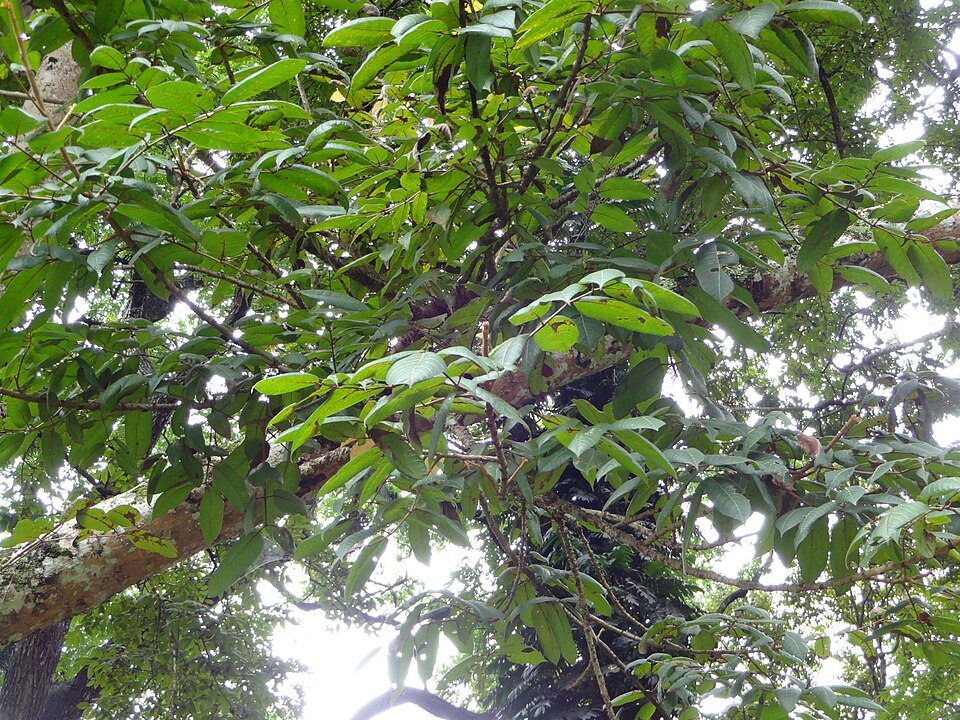
(c) Carel Jongkind, some rights reserved (CC BY-NC), uploaded by Carel Jongkind
iNaturalist· cc-by-nc
(c) Carel Jongkind, some rights reserved (CC BY-NC)
Description
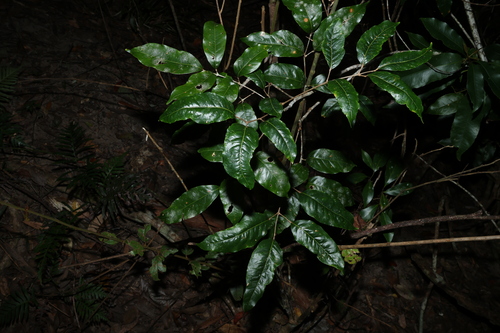
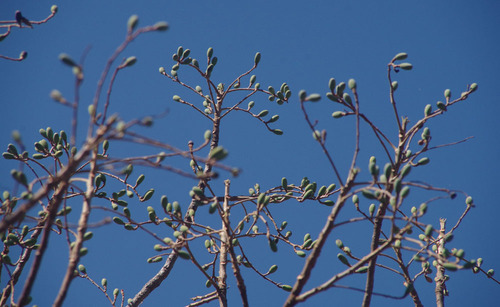
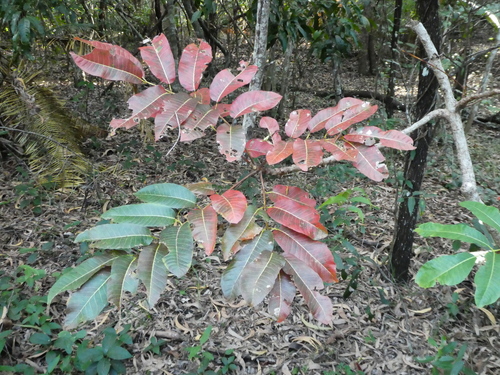
A small tree. It grows to 30 m high. The trunk is 1 m across. It has stilt roots. The bark smells strongly of turpentine. The leaves are without hairs. The leaves are compound with 3 pairs of leaflets and one leaflet at the end. The flowers are yellow. The fruit are fleshy and 2-2.5 cm long by 1.5 cm wide. The ripe fruit are black. There is one seed.
Edible Uses
Both the seeds and fruit are eaten; the oily seed is consumed and fruits are sold in markets as a cultivated food plant.
Traditional Uses
The seed is oily and is eaten. The fruit quality varies and some taste of turpentine. Others are attractive
This uses section is brief — help expand it
Medicinal Uses
The bark is aromatic with a smell like balsam. It yields an oleo-resin, though its use for therapeutic purposes is not recorded in West Africa. The bark is used as a treatment against chest complaints. The powdered bark, mixed with salt and palm-oil, is given to children as a treatment for whooping-cough, and is also considered to be vermifugal. The powdered bark is sprinkled on the sores of yaws. Bark-decoctions are used in massages and vapour-baths to treat fever-pains and eczema. Tannins, steroids and terpenes have been recorded in the bark and roots.
Known Hazards
Some fruits taste of turpentine, and fruit quality varies.
Distribution
It is a tropical plant. It often grows between 800-1000 m altitude. In Nigeria it has been recorded at 1,500 m above sea level.
Where It Grows
Africa, Benin, Cabinda, Cameroon, Central Africa, Central African Republic, CAR, Congo DR, Congo R, Côte d'Ivoire, Gabon, Ghana, Ivory Coast, Liberia, Nigeria, Sao Tome and Principe, Sierra Leone, Togo, West Africa,
Other Uses
The bark is aromatic with a smell like balsam. It yields an oleo-resin. The greyish to yellowish brown wood is fine-grained and even-textured. It is used to make a number of domestic articles and is also used for carving. The adventive aerial roots are used to decorate axe-handles and hunting-bows.
Other Information
It is a cultivated food plant. Fruit are sold in markets.
Nutrition
| Part | Moisture | kJ | kcal | Protein | Vit A | Vit C | Iron | Zinc |
|---|---|---|---|---|---|---|---|---|
| Fruit | 80.8 | 301 | 72 | 1.3 | — | — | 5 | — |
Synonyms
Also Known As
An-thanka, Damzin, Damzon, Domboe, Ebap, Ebo, Gologolo, Kafe, Libaba, Poba, Toab
References (19)
- Abbiw, D.K., 1990, Useful Plants of Ghana. West African uses of wild and cultivated plants. Intermediate Technology Publications and the Royal Botanic Gardens, Kew. p 48
- Billong Fils, P. E., et al, 2020, Ethnobotanical survey of wild edible plants used by Baka people in southeastern Cameroon. Journal or Ethnobiology and Ethnomedicine. 16:64 p 9
- Burkill, H. M., 1985, The useful plants of west tropical Africa, Vol. 1. Kew.
- FAO, 1995, Edible Nuts. Non Wood Forest Products 5.
- Food Composition Tables for use in Africa FAO http://www.fao.org/infoods/directory No. 1024
Show all 19 references Hide references
- Jardin, C., 1970, List of Foods Used In Africa, FAO Nutrition Information Document Series No 2.p 47, 161
- JSTOR Global Plants edible
- Koffi, K. G. et al, 2011, Diversity Gradients and Phylogeographic Patterns in Santiria trimera (Burseraceae). American Journal of Botany 98(2):254-264
- Latham, P & Mbuta, A., 2017, Useful Plants of Central Province, Democratic Republic of Congo. Volume 2. Salvation Army p 152
- Menninger, E.A., 1977, Edible Nuts of the World. Horticultural Books. Florida p 28
- Nkeoua, G. & Boundzanga, G. C., 1999, Donnees sur les produits forestieres non ligneux en Republique du Congo. FAO. p 35
- Raponda-Walker, A & Sillans, R., 1961, Les Plantes Utiles du Gabon. Editions Paul Lechevalier, Paris. p 111 (As Pachylobus balsamifera)
- Raponda-Walker, A & Sillans, R., 1961, Les Plantes Utiles du Gabon. Editions Paul Lechevalier, Paris. p 115 (As Pachylobus trimera)
- Savill, P. S. & Fox, J. E. D., Trees of Sierra Leone. p 61
- Vivien, J. & Faure, J.J., 1985, Abres des forets dense d'Afrique Centrale. Agence de Cooperation Culturelle et Technique. Paris. p 58
- Vivien, J., & Faure, J.J., 1996, Fruitiers Sauvages d'Afrique. Especes du Cameroun. CTA p 92
- Voorhoeve, A. G., 1965, Liberian high forest trees. Pudoc p 83
- Wickens, G.E., 1995, Edible Nuts. FAO Non-wood forest products. FAO, Rome. p 111
- World Checklist of Useful Plant Species 2020. Royal Botanic Gardens, Kew