Santalum lanceolatum
R. Br.
Sandalwood, Northern sandalwood, Bush plum
iNaturalist· cc-by-nc-nd
(c) Tim Waters, some rights reserved (CC BY-NC-ND)
iNaturalist· cc-by-nc
(c) lachlan_harriman, some rights reserved (CC BY-NC)
iNaturalist· cc-by-sa
(c) Douglas Goldman, some rights reserved (CC BY-SA), uploaded by Douglas Goldman
Summary
Source: WikipediaSantalum lanceolatum is an Australian tree of the family Santalaceae. It is commonly known as desert quandong, northern sandalwood, sandalwood, or true sandalwood and in some areas as burdardu. The mature height of this plant is variable, from 1 to 7 m. The flowers are green, white, and cream, appearing between January and October. The species has a distribution throughout central Australia, becoming scattered or unusual in more southern regions.
Description
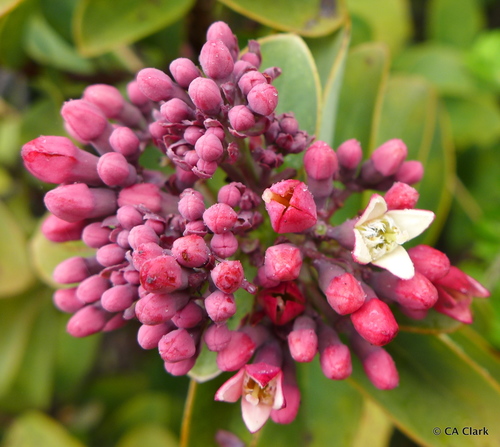
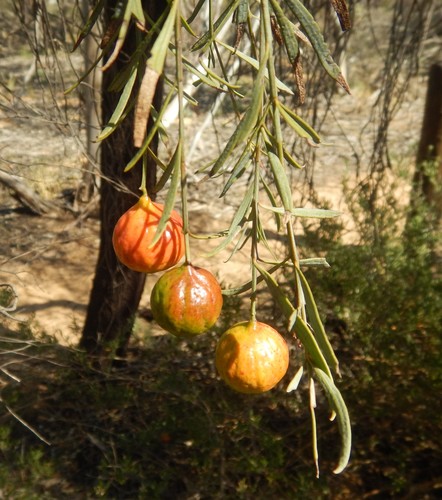
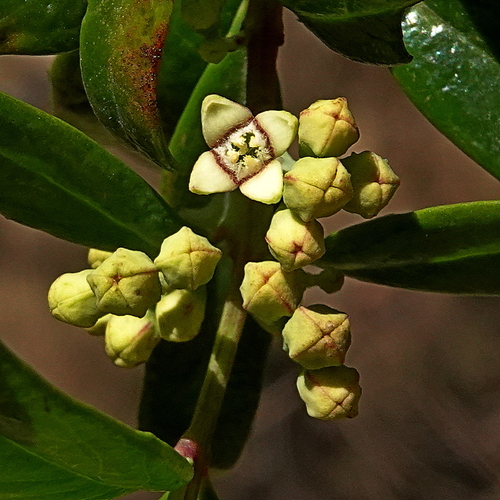
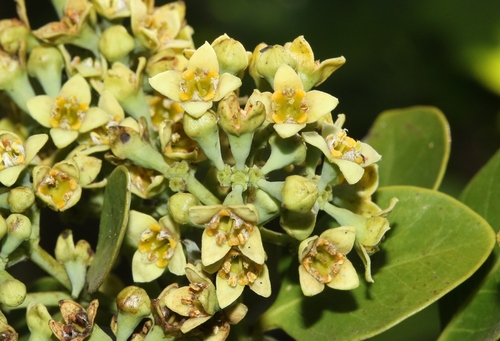
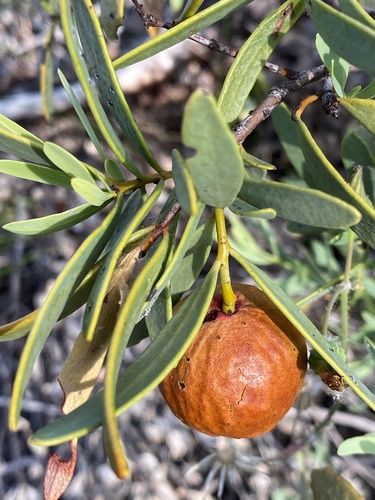
A shrub or small tree. It grows to 4-5 m high. The bark is grey and flaky. The branches hang down. They leaves are greyish-blue. They are fleshy. The leaves are 5 cm long by 3.5 cm wide. They taper at both ends. The flowers are in clusters at the ends of branches. Each flower is made up of 4 yellow-green fused petals. The fruit are round and red or black when ripe. They have a scar around the top. The fruit are in clusters on long stalks. The fruit have a small amount of flesh covering a single large seed. The plant grows as a parasite on the roots of other plants.
Edible Uses
The fruit can be eaten raw or cooked and has a sweetish flavour.
Traditional Uses
The fruit are eaten raw.
This uses section is brief — help expand it
Medicinal Uses
The plant has antirheumatic, narcotic, and purgative properties, and is also used in the treatment of boils, sores, and similar skin conditions.
Distribution
A tropical plant. It grows in inland Australia. They often grow in groups along water courses. They can also be at the base of rocky outcrops where water runs off. It can grow in arid places. It suits hardiness zones 10-12.
Where It Grows
Australia*,
Cultivation
Not known
Propagation
Propagate by seed.
Other Uses
The wood is aromatic.
Production
Plants are slow growing. Plants often fruit after favourable rains.
Nutrition
| Part | Moisture | kJ | kcal | Protein | Vit A | Vit C | Iron | Zinc |
|---|---|---|---|---|---|---|---|---|
| Fruit | 63.2 | 636 | 152 | 3.3 | — | 15 | 1.9 | 1.2 |
| Kernel | 0.3 | — | — | 10.7 | — | — | — | — |
Synonyms
Also Known As
Ankwerlay, Arnguli, Bilalur, Blue Bush, Kupata, Lanceleaf sandalwood, Ngamumbirra, Ngilunpa, Plumbush
References (48)
- Anon., 2003, Native Plants for the Fitzroy basin. Society for Growing Australian Plants Inc. (Rockhampton Branch) p 73
- Bindon, P., 1996, Useful Bush Plants. Western Australian Museum. p 220
- Bodkin, F., 1991, Encyclopedia Botanica. Cornstalk publishing, p 908
- Bonney, N., 2012, Edible Wild Native Plants for Southern Australia. p 110
- Boomsma, C.D., 1972, Native Tree of South Australia. Woods & Forests Department South Australia, Bulletin No.19. p 214
Show all 48 references Hide references
- Cancilla, D., 2018, Ethnobotanical and Ethnozoological Values Desktop Assessment - Eliwana Project. p 14
- Cherikoff V. & Isaacs, J., The Bush Food Handbook. How to gather, grow, process and cook Australian Wild Foods. Ti Tree Press, Australia p 171, 190
- Cribb, A.B. & J.W., 1976, Wild Food in Australia, Fontana. p 57
- Cundall, P., (ed.), 2004, Gardening Australia: flora: the gardener's bible. ABC Books. p 1310
- Eddie, C., 2007, Field Guide to Trees and Shrubs of Eastern Queensland Oil and Gas Fields. Santos p 210
- Facciola, S., 1998, Cornucopia 2: a Source Book of Edible Plants. Kampong Publications, p 224
- Goddard, C. & Kalotas A. (Eds.), Punu, 2002, Yankunytjatjara plant use. Jukurrpa books. p 50
- Green, J., (Ed.), 2003, Anmatyerr Plant Stories. AID Press. p 2
- Hall, N. et al, 1972, The Use of Trees and Shrubs in the Dry Country of Australia, AGPS, Canberra. p 389
- Hedrick, U.P., 1919, (Ed.), Sturtevant's edible plants of the world. p 593
- Hiddins, L., 1999, Explore Wild Australia with the Bush Tucker Man. Penguin Books/ABC Books. p 159
- Holliday, I., 1989, A Field Guide to Australian Trees. Hamlyn. p 292
- Hunter, J., 2015, Vegetation and flora of Naree and Yantabulla. A Draft Report to the Bush Heritage Australia
- INFOODSUpdatedFGU-list.xls
- INFOODS:FAO/INFOODS Databases
- Isaacs, J., 1987, Bush Food, Aboriginal Food and Herbal Medicine. Weldons. p 62
- Kenneally, K.E., Edinger, D. C., and Willing T., 1996, Broome and Beyond, Plants and People of the Dampier Peninsula, Kimberley, Western Australia. Department of Conservation and Land Management. p 178
- Lands, M., 1987, Mayi: Some Bush fruits of Dampierland. Magabala Books, Broome West Australia. p 17
- Lang, P. J., et al, 1986, Anangu Pitjantjatjara Lands Biological Survey. p 43
- Latz, P.K., 1996, Bushfires and Bushtucker: Aboriginal plant use in Central Australia. IAD Press Alice Springs p 261
- Latz, P & Wightman, G., 1995, Desert Bush Tucker Identikit. Common Native Food Plants of Central Australia. Parks & Wild Commission Northern territory. p 20
- Lazarides, M. & Hince, B., 1993, Handbook of Economic Plants of Australia, CSIRO. p 211
- Lord, E.E., & Willis, J.H., 1999, Shrubs and Trees for Australian gardens. Lothian. p 20
- Low, T., 1991, Wild Food Plants of Australia. Australian Nature FieldGuide, Angus & Robertson. p 176
- Low, T., 1992, Bush Tucker. Australia’s Wild Food Harvest. Angus & Robertson. p 14, 68
- McKerney, M. & White, H., 2011, Bush Tucker, Boomerangs & Bandages. Border River-Gwyder Catchment Management Authority p 109
- Miers, G., 2004, Cultivation and sustainable wild harvest of Bushfoods by Aboriginal Communities in Central Australia. RIRDC report W03/124 p 20
- Milson, J., 2000, Trees and Shrubs of north-west Queensland. DPI p 282
- Paczkowska, G . & Chapman, A.R., 2000, The Western Australian Flora. A Descriptive Calatogue. Western Australian Herbarium. p 527
- Plants for a Future database, The Field, Penpol, Lostwithiel, Cornwall, PL22 0NG, UK. http://www.scs.leeds.ac.uk/pfaf/
- Queensland Forest Service, 1991, Trees and Shrubs. Department of Primary Industries. p 113
- Scarth-Johnson, V., 2000, National Treasures. Flowering Plants of Cooktown and Northern Australia. Vera Scarth-Johnson Gallery Association. Cooktown, Australia. p 102
- Smith, K & I., 1999, Grow your own bushfoods. New Holland. Australia. p 62
- Smith, M & Kalotas, A. C., 1985, Bardi Plants: An Annotated List of Plants and Their Use by the Bardi Aborigines of Dampierland, in North-western Australia. Rec. West Aust. Mus. 1985, 12(3): 317-359
- Smith, N. M., 1991, Ethnobotanical Field Notes from the Northern Territory, Australia, J. Adelaide Bot. Gard. 14(1): 1-65
- Smith, Nicholas et al. 1993, Ngarinyman Ethnobotany: Aboriginal Plant Use from the Victoria River Area Northern Australia. Northern Territory Botanical Bulletin No 16. Parks and Wildlife Commission of the Northern Territory. p 41, 40
- Townsend, K., 1994, Across the Top. Gardening with Australian Plants in the tropics. Society for Growing Australian Plants, Townsville Branch Inc. p 331
- Townsend, K., 1999, Field Guide to Plants of the Dry Tropics. Society for Growing Australian Plants, Townsville Branch Inc. p 82
- Urban, A., 1990, Wildflowers of Inland Australia. Portside editions. p 28
- Vigilante, T., et al, 2013, Island country: Aboriginal connections, values and knowledge of the Western Kimberley islands in the context of an island biological survey. Records of the Western Australian Museum Supplement 81: 145-182
- Wheeler, J.R.(ed.), 1992, Flora of the Kimberley Region. CALM, Western Australian Herbarium, p 569
- Wightman, Glenn et al. 1994, Gurindji Ethnobotany: Aboriginal Plant Use from Daguragu Northern Australia. Northern Territory Botanical Bulletin No 18. Parks and Wildlife Commission of the Northern Territory. p 45, 46
- Wightman, Glenn et al. 1991, Alawa Ethnobotany: Aboriginal Plant Use from Minyerri, Northern Australia. Northern Territory Botanical Bulletin No 11. Parks and Wildlife Commission of the Northern Territory. p 24, 23