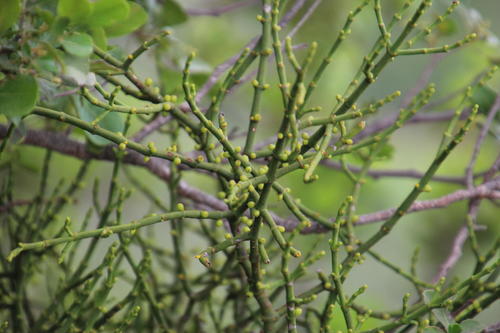
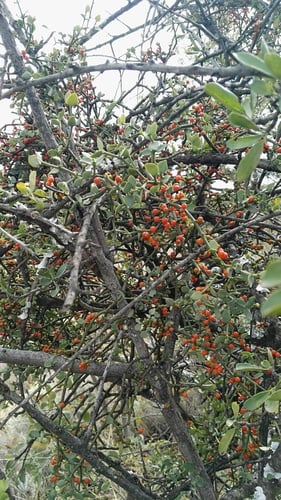
Scleropyrum aurantiacum
(Laut. et K. Schum) Pilger
gbif· cc0
President and Fellows of Harvard College
gbif· cc0
President and Fellows of Harvard College
gbif· cc0
President and Fellows of Harvard College
Description
A shrub or small tree up to 3-6 m high. The bark is light grey. The leaves are mid green above and more pale underneath. The fruit is red when mature. The seed inside the fruit is about 3-4 cm across. It has a thin shell.
Edible Uses
The kernel of the nut is cooked and eaten, and the young leaves are boiled and eaten.
Traditional Uses
The kernel of the nut is cooked and eaten. The young leaves are boiled and eaten.
This uses section is brief — help expand it
Distribution
A tropical plant. It occurs between 600 to 2,000 m altitude.
Where It Grows
Pacific, Papua New Guinea, PNG,
Production
Fruiting is seasonal. In Papua New Guinea it fruits July to August.
Other Information
A minor wild edible food in Papua New Guinea.
Synonyms
Also Known As
Afok, Mameagam
References (6)
- Bourke, M., 1995, Edible Indigenous Nuts in Papua New Guinea. In South Pacific Indigenous Nuts. ACIAR Proceedings No 69, Canberra. p 46
- French, B.R., 1986, Food Plants of Papua New Guinea, A Compendium. Asia Pacific Science Foundation p 196
- Leach, G. J., 1988, Bush Food Plants of the Blackwater and Karawari Rivers Area, East Sepik Province, Papua New Guinea. Science in New Guinea 14(2). p 104
- Plants of Papua New Guinea LAE herbarium record
- Walter, A. & Sam C., 2002, Fruits of Oceania. ACIAR Monograph No. 85. Canberra. p 234, 281
Show all 6 references Hide references
- World Checklist of Useful Plant Species 2020. Royal Botanic Gardens, Kew