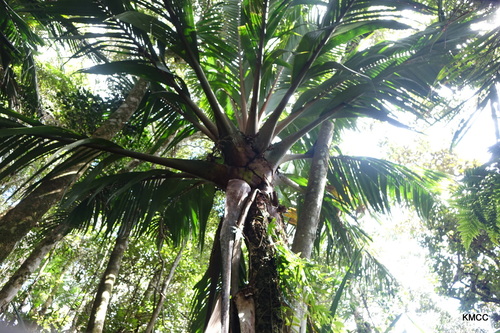
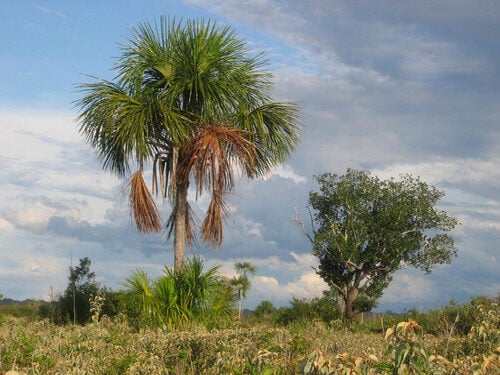
Salacca wallichiana
Mart.
Rakum palm
iNaturalist· cc-by-nc-nd
(c) Tatters ❀, some rights reserved (CC BY-NC-ND)
iNaturalist· cc-by-nc
(c) guanhong, some rights reserved (CC BY-NC)
iNaturalist· cc-by-nc
(c) guanhong, some rights reserved (CC BY-NC)
Summary
Source: WikipediaSalacca wallichiana is a species of plant in the family Arecaceae. The specific epithet (wallichiana) honors Danish botanist Nathaniel Wallich. It is found in Malaysia, Thailand, Myanmar, and Sumatra. It is valued for its edible fruit which is consumed across its native range.
Description
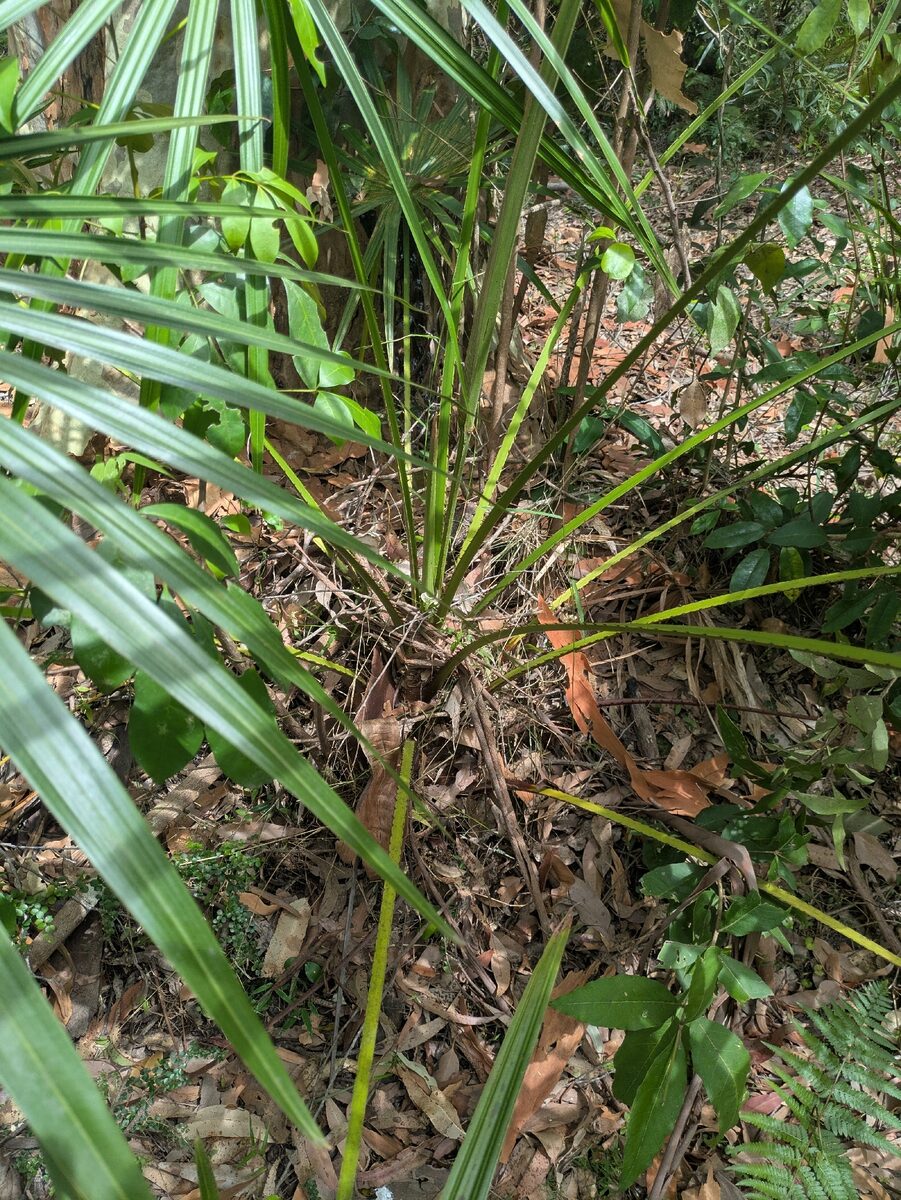
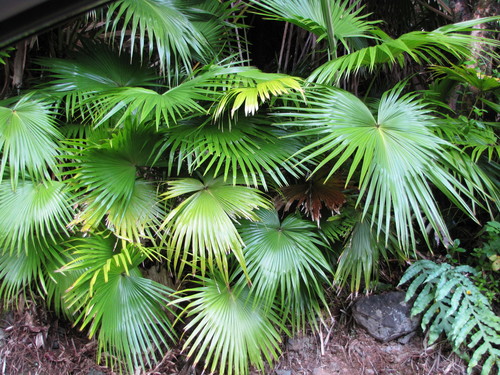
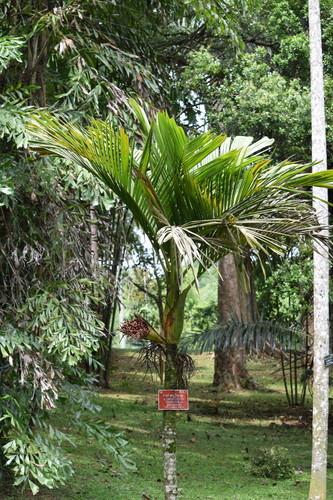
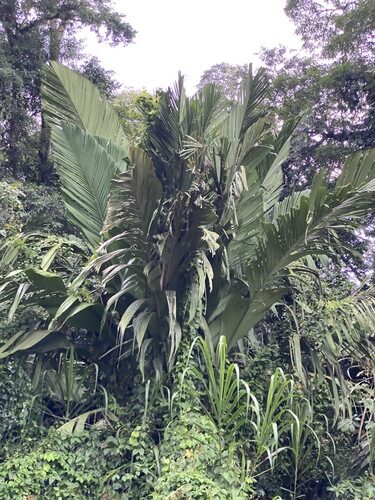
A large clustered shrubby palm. It grows to 12 m tall. The trunk can be creeping. The stems are 20-30 cm across. Aerial roots are often present. The back of the leaf stalks are heavily covered with spines. These can be 8 cm long. The leaves are 7.5 m long. They are produced in erect, dense tufts. The male flowering stalk is slender and hangs down. The fruit are oval and 7-8 cm long by 4 cm wide. They are reddish brown. They occur in dense clusters and are scaly. They are edible usually after cooking.
Edible Uses
The acid seeds are utilized as an ingredient in curries. The rakum palm is grown for the edible sarcotesta (fleshy seedcoat) of the fruit. The sour unripe fruit can be a substitute for lime in cooking, whereas the ripe fruit is sweet and consumed raw. For the sweetest fruit, the wild form should be harvested 28 weeks after anthesis (hand pollination). At this age the sugar content is 13 - 14° Brix. Fruits over 30 weeks old develop an unpleasant flavour. Fruits which are used for cooking can be harvested after 25 weeks. The fruit is a drupe, occurring in dense heads, obovoid, 2.5 cm long, the skin (epicarp) consisting of orange-brown scales with reflexed brittle points; endocarp not differentiated.
Traditional Uses
The fruit (seeds) are used as acid flavouring in curries.
This uses section is brief — help expand it
Distribution
A tropical plant. It grows in swamps and seasonally flooded places. It SE Thailand is grows from sea level to 500 m altitude. In Cairns Botanical Gardens.
Where It Grows
Asia, Australia, Cambodia, China, Indochina, Indonesia, Laos, Malaysia, Myanmar, SE Asia, Singapore, Thailand,
Cultivation
Salacca wallichiana is a plant of the hot, moist tropical lowlands. It grows in areas where the mean annual rainfall is within the range 2,500 - 3,000mm with a dry season of 5 - 6 months. A dry season is needed for good fruit set; spadices emerging in the rainy season tend to rot and the viability of the pollen is poor. The temperature range required is 22 - 32°c; lower temperatures reduce flowering. Thrives in soils ranging from sandy loam to heavy clay. On low-lying wetlands it grows better than most fruit trees. Prefers a pH in the range 5 - 6, tolerating 4.5 - 6.5. Established plants can stand drought very well but, for a good yield of fruit, irrigation is required in the dry season. In its natural habitat and in mixed orchards rakum is commonly found growing under shade, but in commercial orchards the palms can be grown successfully without shade, provided they are irrigated. Plants commence flowering when about 5 - 6 years old. The plant flowers all year round, the fruit ripening 7 - 9 months after flowering. Nearly all fruit set, however, takes place early in the dry season, leading to a very seasonal harvesting of the fruit. The average annual fruit yield varies between 6 - 12 t/ha depending on the cultivars. The skin of 10 - 16 week-old fruitlets is brown, turning darker to almost black at 17 - 23 weeks, gradually changing to orange when the fruit ripens. The flesh of 10 - 19 week-old fruits is off-white and turns to light yellow when the fruits are 20 - 22 weeks old; as the fruit grows it gradually assumes a more yellow-orange colour. The stones in 10 - 19 week-old fruits are white and contain a jelly-like substance. The colour changes to yellow at 20 - 23 weeks of age and to brown thereafter while the contents harden. For the superior sala cultivars, harvesting time is 36 weeks and not later than 38 weeks after pollination. At harvest each fruit cluster or the entire infructescence is cut with a hooked knife or pruning shears on long handles. In young non-bearing orchards, removing suckers is the most unpleasant chore, but a must. One or two stems per clump are sufficient for good yield. Dense clumps yield poorly and are difficult to harvest. Leaf pruning is not advisable, but may be necessary to facilitate orchard operations. Hand pollination can raise yields substantially. Several cultivars with superior fruits have been developed. A dioecious species, both male and female forms need to be grown if fruit and seeds are required. About 1 male plant to every 15 females is considered sufficient for good pollination. Xenia effects are quite noticeable in S. Wallichiana, so it is important to choose a compatible male strain.
Propagation
Seed - best sown as soon as it is ripe, it quickly loses its viability. The fresh seed germinates readily and propagation from seed is easy. Germination usually takes place in less than 10 days, with about 90% germination rate. Vegetative propagation of improved forms is usually recommended. Stem sections 1 - 2 metres long are taken from ageing, high-quality clones. These are buried in the soil and covered with a mulching material such as rice straw. The soil is kept moist to force viable buds on the cuttings to sprout. The plantlets are separated from the stem and nursed in polythene bags for a year before planting out in the field at the beginning of the rainy season. Vegetative propagation by separating rooted suckers from the mother palms is less common.
Other Uses
Wild clumps in the forest not only produce food, but are also a major source of cork, thatch and other construction materials in rural areas. The wild, spiny form is grown as a fruit-bearing fence.
Synonyms
Also Known As
Asam kumbang, Cho-la-ka, Kumbak, Kumbar, Rakam, Rekam, Sala, Salak kumbar, Salak rengam, Thai, Yin-ngan
References (18)
- Arora, R. K., 2014, Diversity in Underutilized Plant Species - An Asia-Pacific Perspective. Bioversity International. p 85
- Burkill, I.H., 1966, A Dictionary of the Economic Products of the Malay Peninsula. Ministry of Agriculture and Cooperatives, Kuala Lumpur, Malaysia. Vol 2 (I-Z) p 2325 (As Zalacca wallichiana)
- Davis, S.D., Heywood, V.H., & Hamilton, A.C. (eds), 1994, Centres of plant Diversity. WWF. Vol 1 or 2. p 139 (As Zalacca)
- Dransfield, J., et al, 2004, A preliminary checklist to Thai Palms. Thai For. Bull. (Bot.) 32:32-72
- Facciola, S., 1998, Cornucopia 2: a Source Book of Edible Plants. Kampong Publications, p 31
Show all 18 references Hide references
- Haynes, J., & McLaughlin, J., 2000, Edible palms and Their Uses. University of Florida Fact sheet MCDE-00-50-1 p 13
- Hist. nat. palm. 3:201, t. 118, 119. 1838
- Hodel, D.R. (Ed.), 1998, The Palms and Cycads of Thailand. Allen Press, Lawrence KS 66044 USA. p 164
- Johnson, D.V., 1998, Tropical palms. Non-wood Forest products 10. FAO Rome. p 48
- Jones, D.L., 1994, Palms throughout the World. Smithtonian Institution, Washington. p 54
- Kuhnlein, H. V., et al, 2009, Indigenous Peoples' food systems. FAO Rome p 176
- Milow, P., et al, 2013, Malaysian species of plants with edible fruits or seeds and their evaluation. International Journal of Fruit Science. 14:1, 1-27
- PROSEA No.
- Riffle, R.L. & Craft, P., 2003, An Encyclopedia of Cultivated Palms. Timber Press. p 450
- USDA, ARS, National Genetic Resources Program. Germplasm Resources Information Network - (GRIN). [Online Database] National Germplasm Resources Laboratory, Beltsville, Maryland. Available: www.ars-grin.gov/cgi-bin/npgs/html/econ.pl (10 April 2000)
- van Wyk, B., 2005, Food Plants of the World. An illustrated guide. Timber press. p 334
- Wiersema, J. H. & Leon, B., 2013, World Economic Plants. A Standard Reference CRC Press. 2nd Ed. p 604
- World Checklist of Useful Plant Species 2020. Royal Botanic Gardens, Kew