Astrocaryum malybo
H. Karst
Anchamba palm, Chingale palm
iNaturalist· cc-by-nc
(c) Pedro José Cardona Camacho, some rights reserved (CC BY-NC), uploaded by Pedro José Cardona Camacho
iNaturalist· cc-by-nc
(c) Pedro José Cardona Camacho, some rights reserved (CC BY-NC), uploaded by Pedro José Cardona Camacho
iNaturalist· cc-by-nc-sa
(c) Mateo Hernandez Schmidt, some rights reserved (CC BY-NC-SA), uploaded by Mateo Hernandez Schmidt
Description
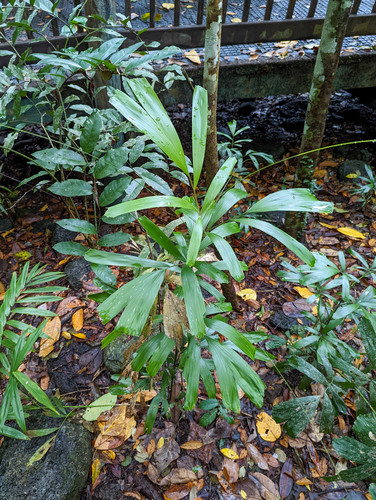
A solitary palm. The stems are short and underground. There are 10-20 leaves. They are 5 m long. There are 96-120 leaflets on each side. They are arranged regularly, they are arranged in the same plane and are horizontal. The flowering stalk is erect. There are 1-3 female flowers on each flowering branch. The fruit are oval and 3.5 cm long by 2.6 cm across. They are purple to black.
Edible Uses
We have no specific information for this species, but the fruits and seeds of various species in this genus are reported to be used for oil production in the Amazon region. Existing analyses of fruit fat content show a relatively homogeneous composition among the different species, with around. 20% of fat content in the mesocarp, mostly composed of oleic and palm itic acids, and 20 - 35% of fat content in the endosperm, with a predominance of lauric acid.
Medicinal Uses
The liquid endosperm is used medicinally.
Distribution
A tropical plant. They grow in lowland rainforest usually below 300 m above sea level.
Where It Grows
Asia, Colombia*, Indonesia, SE Asia, South America,
Cultivation
Plants can be grown from seeds.
Other Uses
The veins of the leaflets of very young leaves are used for making mats, baskets, and related crafts. The leaves are used to make brooms.
Notes
There are about 40-50 Astrocaryum species.
Also Known As
Palem malibo, Palma estera, Malibu
References (6)
- Bircher, A. G. & Bircher, W. H., 2000, Encyclopedia of Fruit Trees and Edible Flowering Plants in Egypt and the Subtropics. AUC Press. p 46
- Henderson, A., Galeano, G and Bernal, R., 1995, Field Guide to the Palms of the Americas. Princeton. p 205
- Lopez-Diago, D. & Garcia, N., 2021, Wild edible fruits of Colombia. Biota ColomBiana 22 (2) p 30
- Menninger, E.A., 1977, Edible Nuts of the World. Horticultural Books. Florida p 126
- Roa, J. A. G. & Boada, D. S. G., 2018, Fundación para el Fortalecimiento de la Fruticultura y Plantas Alimenticias no Convencionales en Colombia.
Show all 6 references Hide references
- Sukarya, D. G., (Ed.) 2013, 3,500 Plant Species of the Botanic Gardens of Indonesia. LIPI p 755