Quercus muehlenbergii
Engelm.
Yellow chestnut oak, Chinquapin oak, Yellow oak, Rock oak
iNaturalist· cc-by-nc
(c) Nathan Taylor, some rights reserved (CC BY-NC), uploaded by Nathan Taylor
iNaturalist· cc-by-nc
(c) Susan Crawford Tracy, some rights reserved (CC BY-NC), uploaded by Susan Crawford Tracy
iNaturalist· cc-by-sa
(c) Douglas Goldman, some rights reserved (CC BY-SA), uploaded by Douglas Goldman
Summary
Source: WikipediaQuercus muehlenbergii, the chinquapin (or chinkapin) oak, is a deciduous species of tree in the white oak group (Quercus sect. Quercus). The species was often called Quercus acuminata in older literature. Quercus muehlenbergii (often misspelled as muhlenbergii) is native to eastern and central North America. It ranges from Vermont to Minnesota, south to the Florida panhandle, and west to New Mexico in the United States. In Canada it is only found in southern Ontario, and in Mexico it ranges from Coahuila south to Hidalgo.
Description
A medium sized tree. It grows 15-30 m high. It spreads 12 m wide. It is taller if amongst other trees. The trunk is 60 cm across. The trunk is straight and without branches till the crown. It is strongly tapered with a swollen base. The leaves are 10-18 cm long. They are narrow and taper to both ends. They are coarsely toothed. The upper surface is glossy green and it is greyish green and with downy hairs underneath. There are 10-15 straight veins on each side. The leaf stalk is slender and 1-3 cm long. The fruit are acorns which are 12-25 mm long. they have short stalks. The cup is deep and bowl shaped. It covers about one third of the acorn.
Edible Uses
The seed must be cooked and grows up to 18mm long. It contains very little bitter tannin and is quite sweet, making for pleasant eating — it tastes particularly good when baked in an oven. Any bitter seeds can be leached by washing thoroughly in running water, though minerals are also lost in the process. Both whole seeds and ground powder can be leached — whole seeds may take several days or weeks, and a traditional method was to place them wrapped in a cloth bag in a running stream. Ground powder leaches more quickly. A taste test confirms when enough tannin has been removed. The traditional preparation involved burying seeds in boggy ground over winter and digging up the germinating seeds in spring, by which point most astringency would have gone. The roasted seed can be used as a coffee substitute.
Traditional Uses
The acorns are roasted with butter and salt or dipped in clarified sugar then eaten.
This uses section is brief — help expand it
Medicinal Uses
An infusion of the bark has been used to treat vomiting. Any galls produced on the tree are strongly astringent and can be used in the treatment of haemorrhages, chronic diarrhoea, and dysentery.
Distribution
It is a temperate plant. It occurs on dry rocky slopes. It is often on limestone soils. It suits hardiness zones 5-9. Arboretum Tasmania.
Where It Grows
Australia, Canada, Mexico, North America, Tasmania, USA,
Cultivation
Prefers a good deep fertile loam which can be on the stiff side. Young plants tolerate reasonable levels of side shade. Tolerates moderate exposure, surviving well but being somewhat stunted. Prefers warmer summers than are usually experienced in Britain, trees often grow poorly in this country and fail to properly ripen their wood resulting in frost damage overwinter. Growth is fairly rapid for an oak, especially when the tree is young, though it slows down with age. Seed production is cyclic, a year with high yields is followed by 2 - 3 years of light crops. The tree flowers on new growth produced in spring, the seed ripening in its first year. Q. muhlenbergii brayi (Small.)Sarg. has somewhat larger seeds than the type, sometimes 3cm long. Closely related to Q. prinus. Trees are often confused with Q. prinus, Q. prinoides and Q. michauxii. Trees respond well to coppicing. Intolerant of root disturbance, trees should be planted in their permanent positions whilst young. Hybridizes freely with other members of the genus. Plants in this genus are notably resistant to honey fungus.
Propagation
Seed loses viability quickly if allowed to dry out. It can be stored moist and cool over winter, but is best sown as soon as it is ripe in an outdoor seed bed with protection from mice and squirrels. Small quantities can be sown in deep pots in a cold frame. Because plants develop a deep taproot, they should be moved to their permanent positions as soon as possible — seeds sown in situ produce the best trees. Do not leave trees in a nursery bed for more than 2 growing seasons, as they will transplant very poorly.
Other Uses
A mulch of leaves placed around plants repels slugs, grubs, and similar pests. Fresh leaves should not be used as they can inhibit plant growth. Oak galls, formed by insect larvae feeding within them, are a rich source of tannin once the insect has left, and can also be used as a dyestuff. The wood is heavy, very hard, strong, close-grained, and durable, weighing 53lb per cubic foot. It is not abundant enough to be used commercially, but is valued for fencing, cooperage, and as an excellent fuel.
Notes
There are about 600 Quercus species.
Synonyms
References (12)
- Cundall, P., (ed.), 2004, Gardening Australia: flora: the gardener's bible. ABC Books. p 1125
- Facciola, S., 1998, Cornucopia 2: a Source Book of Edible Plants. Kampong Publications, p 116
- Farrar, J.L., 1995, Trees of the Northern United States and Canada. Iowa State University press/Ames p 262
- Glowinski, L., 1999, The Complete Book of Fruit Growing in Australia. Lothian. p 136
- Grandtner, M. M., 2008, World Dictionary of Trees. Wood and Forest Science Department. Laval University, Quebec, Qc Canada. (Internet database http://www.wdt.qc.ca)
Show all 12 references Hide references
- Jackes, D. A., 2007, Edible Forest Gardens
- Kermath, B. M., et al, 2014, Food Plants in the Americas: A survey of the domesticated, cultivated and wild plants used for Human food in North, Central and South America and the Caribbean. On line draft. p 736
- Little, E.L., 1980, National Audubon Society Field Guide to North American Trees. Alfred A. Knopf. p 398
- Moerman, D. F., 2010, Native American Ethnobotany. Timber Press. p 463
- Plants for a Future database, The Field, Penpol, Lostwithiel, Cornwall, PL22 0NG, UK. http://www.scs.leeds.ac.uk/pfaf/
- Trans. Acad. Sci. St. Louis 3:391. 1877 "muehlenbergii"
- www.desert-tropicals.com
More from Fagaceae
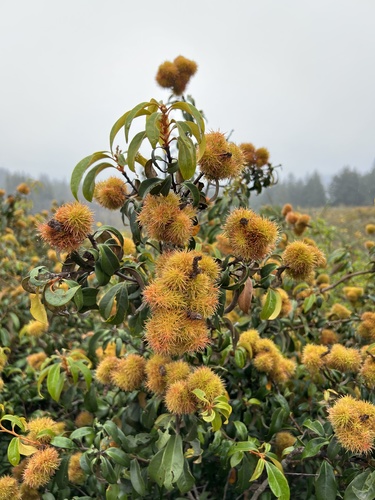
Chrysolepis chrysophylla
Golden chinkapin, Golden chestnut
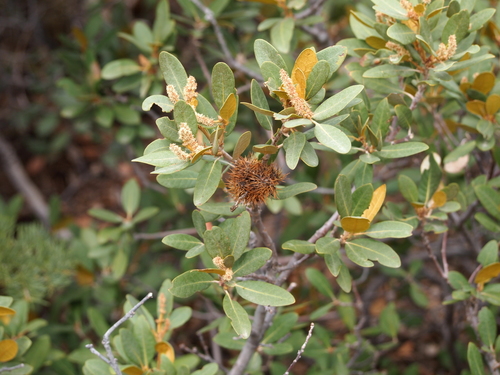
Chrysolepis sempervirens
Dwarf golden chinquapin, Bush or Dudley sierra chinquapin, Sierra chinquapin
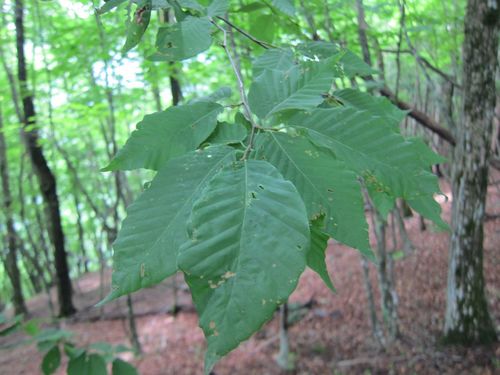
Fagus crenata
Japanese beech
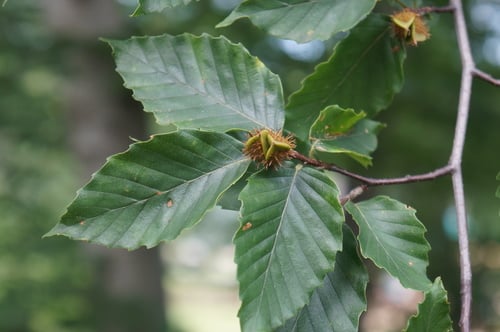
Fagus grandifolia
American beech, Beech mast
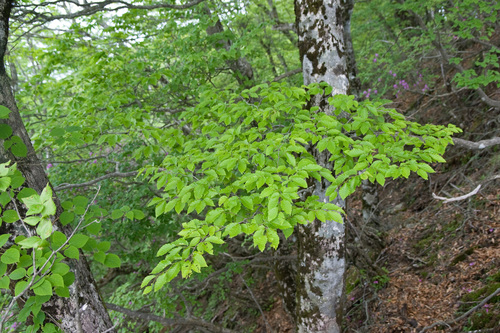
Fagus japonica
Japanese beech, Japanese blue beech
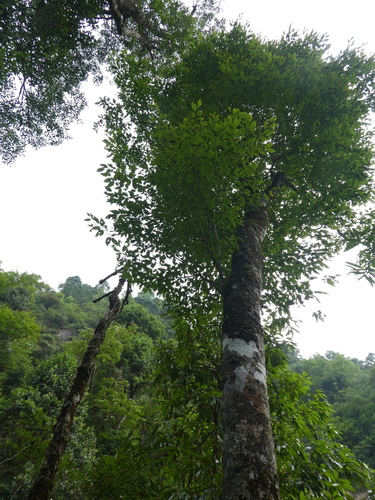
Fagus longipetiolata
Cu cuong dai, Shui qing gang