Plukenetia corniculata
Sm.
iNaturalist· cc-by
(c) Samuel Lee, some rights reserved (CC BY), uploaded by Samuel Lee
gbif· cc0
President and Fellows of Harvard College
Description
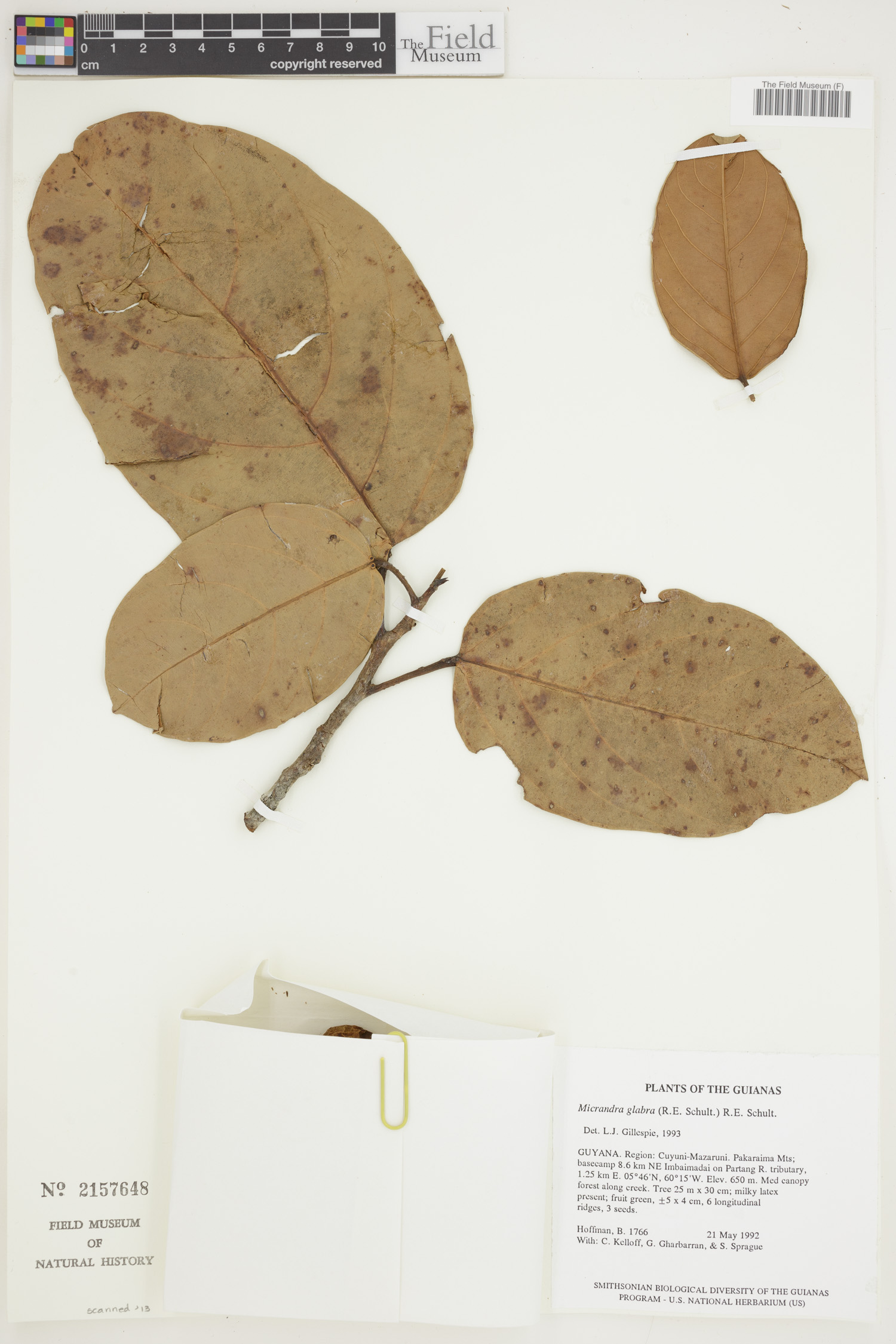
A slightly woody climber. The stems are twining. It has some hairs. The leaf stalks are 2-8 cm long. The leaves are oval or triangle shaped and 7-16 cm long by 4-11 cm wide. They are heart shaped at the base and there are fine teeth along the edge. The flowering shoots are narrow and 2-5 cm long at the ends of branches. The fruit is a capsule that has 4 lobes or wings.
Edible Uses
The leaves are eaten as a vegetable with a sweet taste and an elder-like smell. The mature seeds are also eaten.
Traditional Uses
The leaves are eaten as a vegetable. They have a sweet taste and smell of elder. The mature seeds are eaten.
This uses section is brief — help expand it
Distribution
A tropical plant.
Where It Grows
Asia, Australia, Bangladesh, Himalayas, India, Indochina, Indonesia, Malaysia, Northeastern India, Philippines, SE Asia, Sikkim, Thailand, Timor-Leste,
Other Information
They are sold in markets. It is a cultivated food plant.
Synonyms
Also Known As
Akar pina-pina, Aroi tang-tang angin, Chumbai, Painapaina, Pepina, Pina-pina
References (8)
- Arora, R. K., 2014, Diversity in Underutilized Plant Species - An Asia-Pacific Perspective. Bioversity International. p 45, 108 (Also as Pterococcus corniculata)
- Burkill, I.H., 1966, A Dictionary of the Economic Products of the Malay Peninsula. Ministry of Agriculture and Cooperatives, Kuala Lumpur, Malaysia. Vol 2 (I-Z) p 1865 (As Pterococcus corniculatus)
- Hedrick, U.P., 1919, (Ed.), Sturtevant's edible plants of the world. p 508
- Martin, F.W. & Ruberte, R.M., 1979, Edible Leaves of the Tropics. Antillian College Press, Mayaguez, Puerto Rico. p 192 (As Pterococcus corniculatus)
- Pawera, L., et al, 2020, Wild Food Plants and Trends in Their Use: From Knowledge and Perceptions to Drivers of Change in West Sumatra, Indonesia, Foods. 2020, 9, 1240
Show all 8 references Hide references
- Terra, G.J.A., 1973, Tropical Vegetables. Communication 54e Royal Tropical Institute, Amsterdam, p 70 (As Pterococcus corniculatus)
- World Checklist of Useful Plant Species 2020. Royal Botanic Gardens, Kew
- Zeven, A. C. & de West, J. M. J., 1982, Dictionary of cultivated plants and their regions of diversity. Wageningen. p 52