Croton macrostachyus
Hochst. ex Delile
Broad-leaved croton
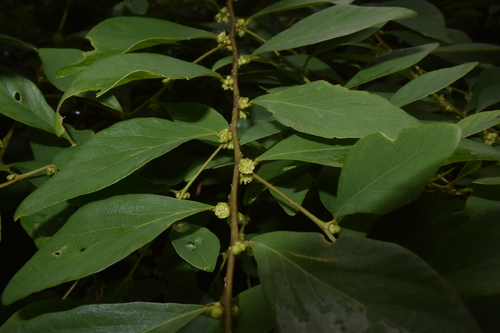
iNaturalist· cc-by-nc
(c) pgkaestner, some rights reserved (CC BY-NC), uploaded by pgkaestner
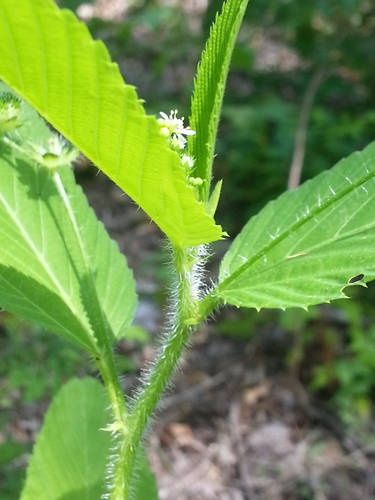
iNaturalist· cc-by-nc
(c) Odile Weber, some rights reserved (CC BY-NC)
Summary
Source: WikipediaCroton macrostachyus is a species of flowering plant native to the mountains of Sub-Saharan Africa.
Description
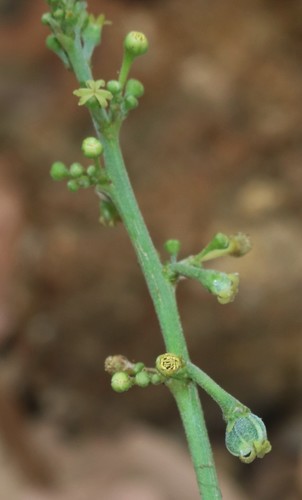
A tree. It grows 25 m high. It loses its leaves for a short time. The crown is rounded and open with spreading branches. The bark is pale grey and finely cracked. The leaves are large and green. They turn orange before they fall. They are oval with a rounded base and taper to the tip. There can be teeth along the edge. The leaves are 5-19 cm long by 4015 cm wide. The leaves are on long stalks crowded at the ends of small branches. The flowers are yellow to white and have a sweet scent. The male and female flowers are on separate shoots. They are in erect spikes. The male flowering shoots are 25 cm long. The female shoots are 10 cm long. The fruit are green when young. They are on drooping spikes 10 cm long. They have 3 lobes.
Edible Uses
The young shoots are cooked and eaten.
Traditional Uses
Caution: Seeds are poisonous. The young shoots are cooked and eaten.
This uses section is brief — help expand it
Medicinal Uses
Although somewhat toxic, broad-leaved croton is widely used in traditional African medicine. Most parts of the plant are employed in the treatment of various conditions, but it is especially valued for ridding the body of parasites and toxins, and for dealing with skin problems. The seeds contain about 19% of an oil which is a slightly viscous, yellow-orange fluid and slightly vesicant. The seeds also contain several saponins and a resin, which is said to be more toxic to insects than rotenone. The stem bark and twigs contain lupeol, betulin and several fatty acids. The fruits contain crotepoxide, which inhibits certain tumours in animal models. Crotepoxide also shows moderate trypanocidal activity against Trypanosoma brucei and Trypanosoma evansii. A hexane extract of the leaves has shown antibacterial activity against Bacillus subtilis, Micrococcus luteus and Staphylococcus aureus in vitro. Root and stem bark extracts showed low antibacterial activities. The juice from the leaves is used as an anthelmintic. The leaves or young shoots are eaten to treat fever and oedema. A boiled leaf decoction is drunk, or the ashes taken orally, as a treatment for cough. A decoction of the young leafy shoots, combined with Justicia schimperiana, pepper, butter and milk, is used in the treatment of jaundice, and for an eruptive disease resembling small-pox. Juice from the fresh leaves is applied on wounds to hasten clotting, and is also used to treat sores, warts and ringworm. An extract of leaves is used against itchy scalp. The mashed leaves are used as a poultice to treat haemorrhoids. A powder made from the leaves and twig bark is eaten to calm insanity and possession. Root decoction is used as an anthelmintic for tapeworm, as a purgative, and for the treatment of malaria and venereal diseases. The bark is abortifacient and uterotonic. A maceration is taken to expel a retained placenta. The bark is an ingredient of an effective purgative and vermifuge. Bark from the stems and roots is boiled in water and newly born babies are bathed in the mixture as a remedy for skin rash. The oil obtained from the seeds is vesicant and powerfully purgative. The seed is eaten to procure an abortion. A preparation of the seed is instilled into the ear as a remedy for ear-troubles. The crushed leaves and seed admixed are drunk in water as a remedy for tapeworm. The fruit is eaten, and a root-decoction drunk, as a remedy for venereal disease.
Known Hazards
Croton macrostachyus has a wide range of uses, including timber, agroforestry, medicine, and as an ornamental plant. The plant is fast-growing and drought-tolerant, and is used in reforestation projects, for erosion control, and as a shade tree in coffee plantations. Its flowers are attractive to bees, and its leaves are used for mulch and green manure to improve soil. It is also used as a hedge or an ornamental and shade tree in gardens. Its wood is cream-colored, moderately soft, of medium weight, and perishable. It is used for carpentry, boxes, crates, and tools, but more frequently for fuel and charcoal. The plant is somewhat toxic, but most parts of the plant are used for a variety of medical treatments, particularly for ridding the body of parasites and toxins and treating skin conditions. Juice from crushed leaves is used as an anthelmintic, applied to wounds to hasten clotting, and used to treat sores, warts, ringworm, and itchy scalp. Root decoctions are also used as an anthelmintic and to treat malaria and venereal diseases. Root decoctions and the oil from seeds are used as a purgative or as an abortifacient.
Distribution
A tropical plant. It grows near the edges of forests and in gaps in the forests. In Malawi it grows from about 1,000-2,250 m altitude.
Where It Grows
Africa, Angola, Cameroon, Central Africa, Congo, East Africa, Eritrea, Ethiopia, Guinea, Guinée, Kenya, Malawi, Mozambique, Nigeria, Rwanda, Sierra Leone, Southern Africa, Tanzania, Uganda, West Africa, Zambia, Zimbabwe,
Cultivation
Plants can be grown from seeds. Seeds germinate in 30-60 days.
Propagation
Seed - pre-sowing treatment is not necessary. Direct sowing is the preferred method. Under ideal conditions, seeds germinate within 30 - 60 days, with an expected germination rate of healthy, mature seedlots being about 40-70%. The fruits are sun dried to release seeds and can be stored for some months if kept cool, dry and free from insects. Seeds can be stored for at least 2 years when dried to below 8% mc and stored cool (20 deg. C or less).
Other Uses
The seeds contain about 19% oil, which is a slightly viscous, yellow-orange fluid and slightly vesicant. It is used medicinally. The plant (part not specified) is used as a detergent for washing jars and pots. The cream-coloured wood is of medium weight, moderately soft, perishable and susceptible to attack by wood borers. It is difficult to saw. It is used for carpentry, heavy-duty flooring, poles, boxes, crates and tool handles. The wood is mainly used for fuel and the production of charcoal. It burns well, even when green, but with a rather unpleasant spicy odour. Due to its drought hardiness and fast growth, the tree is considered useful for reforestation of shifting sand dunes, degraded waste land, hill slopes, ravines and lateritic soils. It is also grown as a hedge plant and is suitable for intercropping. The tree is used to provide shade in villages and in coffee plantations. It is employed in soil conservation. The leaf fall provides mulch and green manure. The flowers are heavily scented and are unusually attractive to bees.
Notes
Probably edible. The leaves are used as fodder for animals.
Also Known As
Bisana, Ciwalika, Islami, Itambukh, Mbwani, Mtutu, Musogasoga, Shekeshek, Tambukh, Umubonobono
References (6)
- Berihun, T. & Molla, E., 2017, Study on the Diversity and Use of Wild Edible Plants in Bullen District Northwest Ethiopia. Hindawi Journal of Botany. Article ID 8383468
- Fowler, D. G., 2007, Zambian Plants: Their Vernacular Names and Uses. Kew. p 25
- Molla, A., Ethiopian Plant Names. http://www.ethiopic.com/aplants.htm
- White, F., Dowsett-Lemaire, F. and Chapman, J. D., 2001, Evergreen Forest Flora of Malawi. Kew. p 248
- World Checklist of Useful Plant Species 2020. Royal Botanic Gardens, Kew
Show all 6 references Hide references
- www.zimbabweflora.co.zw 2011