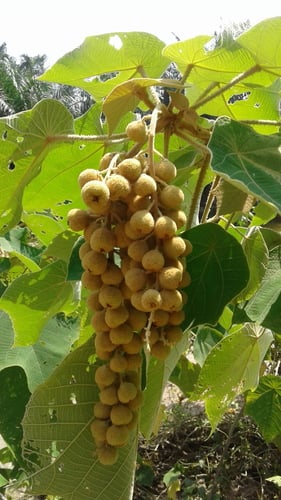
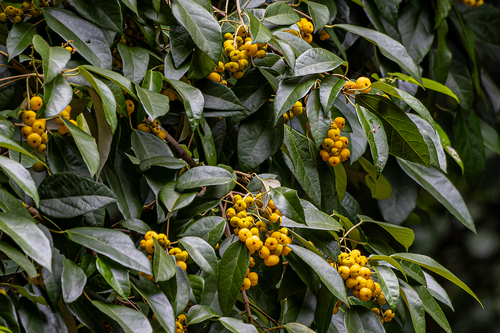
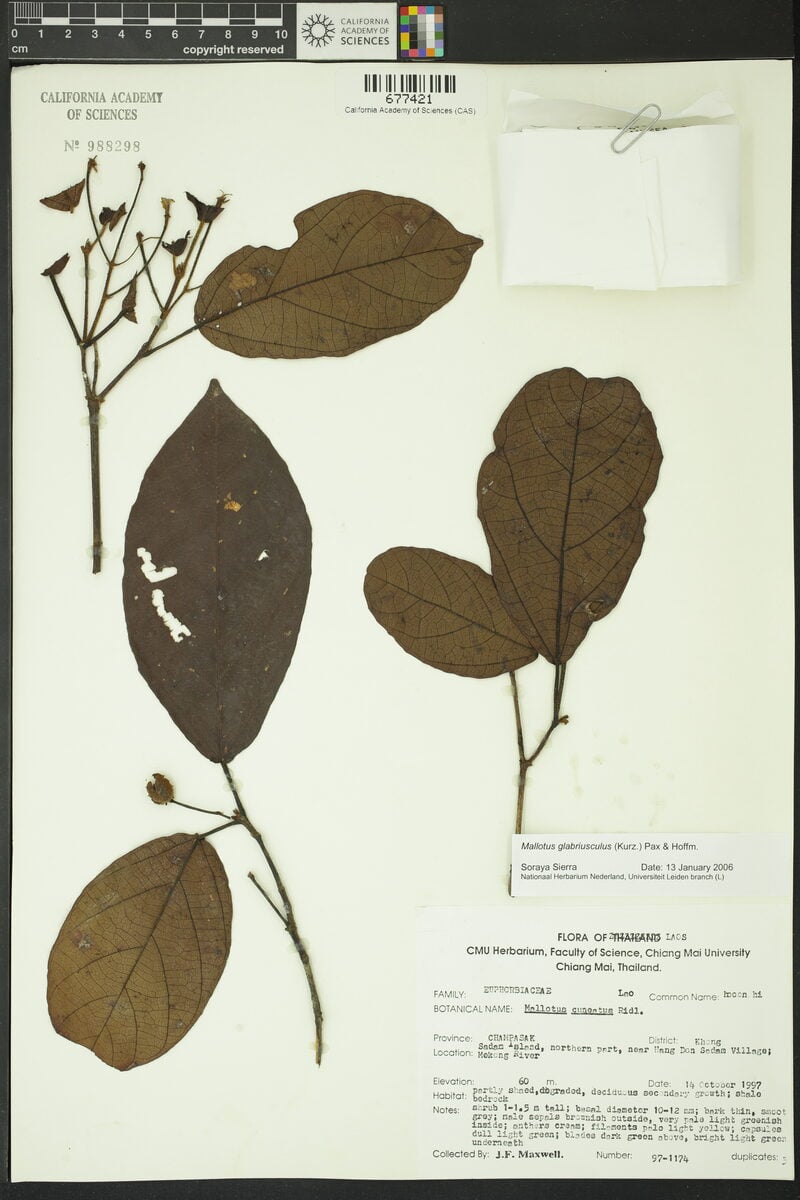
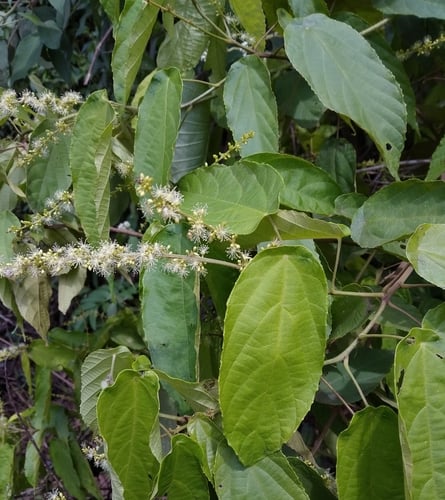
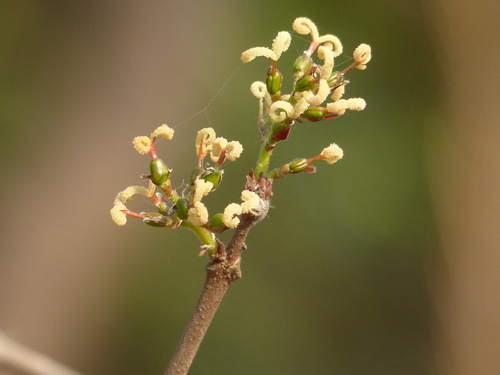
Croton persimilis
Mull.Arg.
iNaturalist· cc-by-nc
(c) rolandwirth, some rights reserved (CC BY-NC), uploaded by rolandwirth
iNaturalist· cc0
no rights reserved
Summary
Source: WikipediaCroton persimilis is a species of tree in the Euphorbiaceae family. It is native to an area from Thailand in mainland Southeast Asia to southern Yunnan, China and to the Indian subcontinent. It is a pioneer species with a short life span. The plant is used in the traditional medicines of various peoples.
Description
A shrub or small tree. It grows 10 m tall. It loses its leaves during the year. The trunk can be 25 cm across
This description is brief — help expand it
Edible Uses
The ripe fruit are slightly acidic and occasionally eaten. The leaves are also eaten.
Traditional Uses
Caution: The ripe fruit are slightly acidic and occasionally eaten.
This uses section is brief — help expand it
Medicinal Uses
The leaves of the species are used in Thai traditional medicine for postpartum (after childbirth) care. The bark and leaves, at times boiled, are used to treat a variety of ailments in Na Siao subdistrict, Chaiyaphum Province, northern Thailand. Villagers living on the plateau of Phnom Kulen National Park, Siem Reap Province, northwestern Cambodia, use dried pieces of the trunk and branches to make a "green tea" to treat stomachache, and use the wood-chips mixed with other plants in a decoction for postpartum care. Four ethnic groups living in the Wayanad District, Kerala, India, the Kattunaikkan, Kuruchiyar, Mullakuruman, and Adiyan people, use the plant to treat inflammation.
Known Hazards
The seed oil is very similar to that of Croton tiglium, and the seeds are likewise purgative and considered poisonous. Croton oil, obtained from the seed, is heavily irritating; contact with the skin causes inflammation and oedema. The toxic principles are crotonol, an extremely vesicant resin; and crotin, a delayed-action poison which causes blood-clotting. Symptoms of croton oil poisoning are firstly pain at the back of the throat, then in the anus. A dose of bismuth is an immediate antidote. Several esters of the diterpene phorbol have been isolated from croton resin. These are extremely irritant and also tumour promotors. Their presence in Croton tiglium and other Croton species means their consumption is sometimes held responsible for certain forms of nasopharyngeal cancer as they are able to activate Epstein-Barr viruses.
Distribution
It is a tropical plant.
Where It Grows
Asia, Bangladesh, Cambodia, China, India, Indochina, Laos, Myanmar, Northeastern India, SE Asia, Sri Lanka, Thailand, Vietnam,
Cultivation
It can be grown as a hedge.
Other Uses
The plant can be successfully used as a rootstock for commercially cultivated strains of Croton stellatopilosus in order to provide protection from root rot. The yellowish-white wood is coarse-grained and moderately hard. It is mainly used for fuel. The tree is often planted as a fast-growing living fence.
Notes
Croton roxburghii Wall. is a synonym of Baliospermum solanifolium (Burm.) Suresh.
Synonyms
References (5)
- Gangwar, A. K. & Ramakrishnan, P. S., 1990, Ethnobotanical Notes on Some Tribes of Arunachal Pradesh, Northeastern India. Economic Botany, Vol. 44, No. 1 pp. 94-105 (As Croton roxburghii)
- Khumgratok, S., Edible Plants in Cultural Forests of Northeastern Thailand. Mahasarakham University Thailand. (As Croton roxburghii)
- Kumar, R. & Saikia, P., 2020, Wild edible plants of Jharkhand and their utilitarian perspectives. Indian Journal of Traditional Knowledge Vol 19 (2), April 2020, pp 237-250 (As Croton oblongifolius)
- Majumdar, K and Datta, N., 2009, Traditional wild edible fruits for the forest dwellers of Tripura, India. Pleione 3(2) 167-178 (As Croton oblongifolius)
- Teron, R. & Borthakur, S. K., 2016, Edible Medicines: An Exploration of Medicinal Plants in Dietary Practices of Karbi Tribal Population of Assam, Northeast India. In Mondal, N. & Sen, J.(Ed.) Nutrition and Health among tribal populations of India. p 152 (As Croton roxburghii)