Pteridium esculentum
(Forster f.) Cockayne
Bracken, fern, Common bracken
iNaturalist· cc-by-sa
(c) jraus, some rights reserved (CC BY-SA)
iNaturalist· cc-by-nc
(c) 鄭子琪, some rights reserved (CC BY-NC), uploaded by 鄭子琪
iNaturalist· cc-by-nc
(c) Adrian Gale, some rights reserved (CC BY-NC), uploaded by Adrian Gale
Summary
Source: WikipediaPteridium esculentum, commonly known as bracken fern, Austral bracken or simply bracken, is a species of the bracken genus native to a number of countries in the Southern Hemisphere. Although it is now known to contain the carcinogen ptaquiloside, the rhizome of the plant was a staple in traditional Māori diets in New Zealand and was eaten by Indigenous Australians.
Description
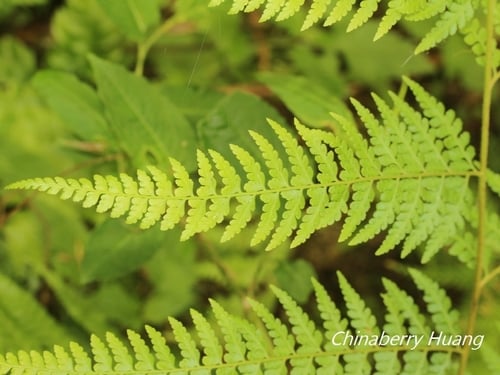
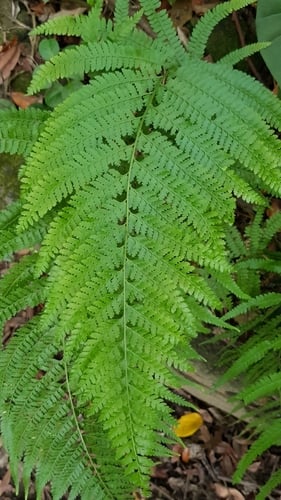
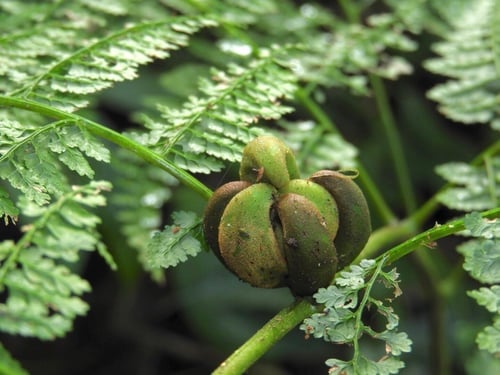
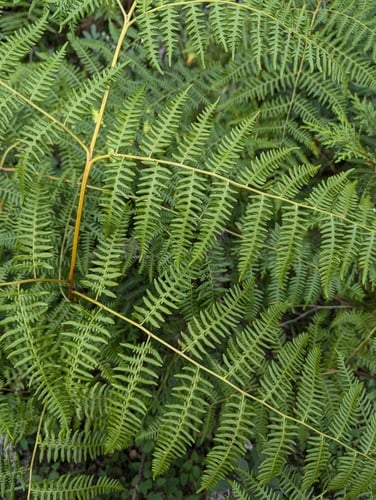
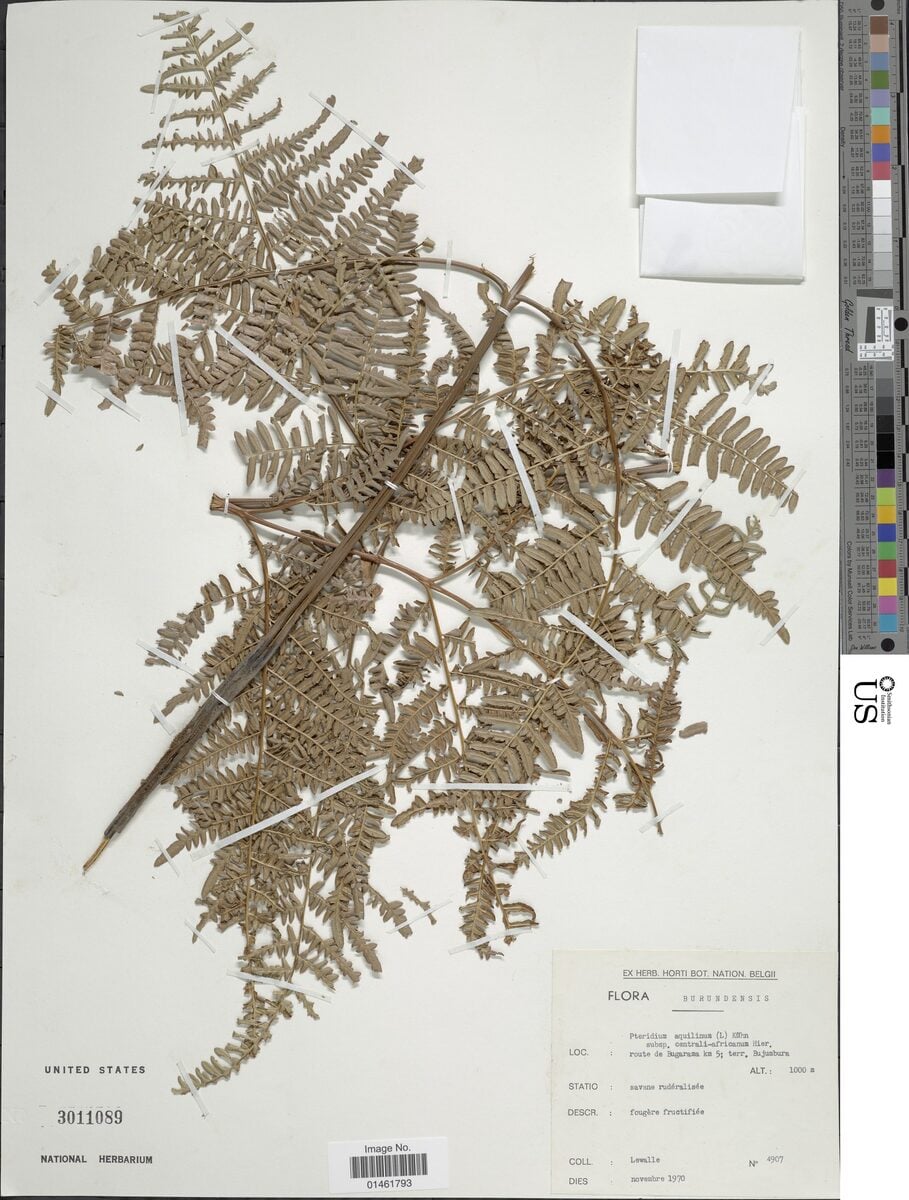
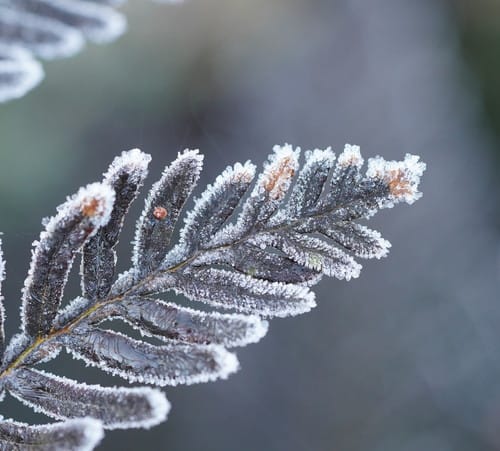
A fern. It grows 0.8-1.5 m tall. The frond is rigid and greatly divided. The leaflets are small and narrow. They are dark green and leathery. The edges of the leaves tends to turn under. There are long rhizomes (underground stems) covered with fine brown hairs. The spores are beneath the fronds. These are very small.
Edible Uses
The young unfurled fronds are eaten as a vegetable after being soaked in water for 24 hours and dried before cooking. The young underground rhizomes are ground into a paste and mixed with wheat or barley flour, or roasted, crushed, and baked.
Traditional Uses
The young unfurled fonds are eaten as a vegetable. They should be soaked in water for 24 hours and dried before being cooked and eaten. The young underground rhizomes are also eaten. It is ground to a paste and can be mixed with wheat or barley flour. The roots are roasted, crushed into a paste and then baked. CAUTION: Bracken has been linked with stomach cancer.
Known Hazards
Bracken has been linked with stomach cancer. The fern contains ptaquiloside, a chemical which causes cancer, and another chemical which slows down bone marrow formation.
Distribution
It is a temperate plant. It grows in undergrowth in wet dense forests above 400-500 m altitude in the tropics. It does best in moist places. In Northeastern India it grows between 1,600-3,200 m above sea level. It suits hardiness zones 8-11. Tasmania Herbarium.
Where It Grows
Asia, Australia, Britain, Canada, Cambodia, China, Europe, Fiji, India, Indochina, Japan, Korea, Malaysia, New Zealand, North America, Northeastern India, Pacific, Samoa, SE Asia, Tasmania, Vanuatu, Worldwide,
Notes
Caution: The fern contains ptaquiloside a chemical which causes cancer and a chemical which slows down formation of bone marrow.
Nutrition
| Part | Moisture | kJ | kcal | Protein | Vit A | Vit C | Iron | Zinc |
|---|---|---|---|---|---|---|---|---|
| Frond tip | 80.9 | 205 | 49 | 6.4 | — | — | 0.8 | 1.8 |
| Root | 72.6 | 199 | 48 | 0.8 | — | — | 6.3 | 2.6 |
Synonyms
Also Known As
Geewan, Gurgi, Makkitch, Mawkum, Mukine, Muulaa, Rahurahu, Ta, Thnang
References (46)
- Ambasta S.P. (Ed.), 2000, The Useful Plants of India. CSIR India. p 500
- Bodkin, F., 1991, Encyclopedia Botanica. Cornstalk publishing, p 846
- Burkill, I.H., 1966, A Dictionary of the Economic Products of the Malay Peninsula. Ministry of Agriculture and Cooperatives, Kuala Lumpur, Malaysia. Vol 2 (I-Z) p 1855
- Caton, J.M. & Hardwick, R. J., 2016, Field Guide to Useful Native Plants from Temperate Australia. Harbour Publishing House. p 116
- Chaffey, C.H., 1999, Australian Ferns. Growing them successfully. Kangaroo Press. p 203
Show all 46 references Hide references
- Cherikoff V. & Isaacs, J., The Bush Food Handbook. How to gather, grow, process and cook Australian Wild Foods. Ti Tree Press, Australia p 121f, 196
- Crowe, A., 1997, A Field Guide to the Native Edible Plants of New Zealand. Penguin. p 108
- Cundall, P., (ed.), 2004, Gardening Australia: flora: the gardener's bible. ABC Books. p 1106
- Dashorst, G.R.M., and Jessop, J.P., 1998, Plants of the Adelaide Plains & Hills. Botanic Gardens of Adelaide and State Herbarium. p 44
- Daw, B., Walley, T. & Keighery, G., 2001, Bush Tucker. Plants of the South-West. Department of Conservation and Land Management. Western Australia. p 14
- Esperanca, M. J., 1988. Surviving in the wild. A glance at the wild plants and their uses. Vol. 2. p 139
- Etoh, T. & Sundaresan, 1985, Food Plants in Fiji and Their Utilization. Kagoshima Univ. Res. Center S. Pac, Occasional Papers, No. 5. p. 145-164.
- Facciola, S., 1998, Cornucopia 2: a Source Book of Edible Plants. Kampong Publications, p 122
- Food Composition Tables for use in East Asia FAO http://www.fao.org/infoods/directory No. 415
- Franklin, J., Keppel, G., & Whistler, W., 2008, The vegetation and flora of Lakeba, Nayau and Aiwa Islands, Central Lau Group, Fiji. Micronesica 40(1/2): 169–225, 2008
- Gott, B & Conran, J., 1991, Victorian Koorie Plants. PO Box 666 Hamilton, Victoria 3300, Australia. p 25
- Harris, S., Buchanan, A., Connolly, A., 2001, One Hundred Islands: The Flora of the Outer Furneaux. Tas Govt. p 210
- Hardwick, R.J., 2000, Nature's Larder. A Field Guide to the Native Food Plants of the NSW South Coast. Homosapien Books. p 25
- Haslam, S., 2004, Noosa's Native Plants. Noosa Integrated Catchment Assn. Inc. p 272
- Hastings Advance Community College, 2017, Uses for Native Plants of the Mornington Peninsula. 86pp. p 64
- Hedrick, U.P., 1919, (Ed.), Sturtevant's edible plants of the world. p 534 (As Pteris aquilina)
- Heo, B., et al., 2009, Antiproliferative Activity of Korean Wild Vegetables on Different Human Tumor Cell Lines. Plant Foods for Human Nutrition. 64:257-263
- Hiddins, L., 1999, Explore Wild Australia with the Bush Tucker Man. Penguin Books/ABC Books. p 130
- Hu, Shiu-ying, 2005, Food Plants of China. The Chinese University Press. p 272
- Hunter, J. T. & Sheringham, P., 2006, Vegetation and Floristics of Melville Range Nature Reserve. A Report to the New South Wales Parks and Wildlife Service. p 178
- Hussey, B.M.J., Keighery, G.J., Cousens, R.D., Dodd, J., Lloyd, S.G., 1997, Western Weeds. A guide to the weeds of Western Australia. Plant Protection Society of Western Australia. p 12
- Isaacs, J., 1987, Bush Food, Aboriginal Food and Herbal Medicine. Weldons. p 104
- Lamp, C & Collet F., 1989, Field Guide to Weeds in Australia. Inkata Press. p 231
- Lazarides, M. & Hince, B., 1993, Handbook of Economic Plants of Australia, CSIRO. p 201
- Lim, T. K., 2015, Edible Medicinal and Non Medicinal Plants. Volume 9, Modified Stems, Roots, Bulbs. Springer p 70
- Low, T., 1991, Wild Herbs of Australia and New Zealand. Angus & Robertson. p 83 (Drawing)
- Low, T., 1991, Wild Food Plants of Australia. Australian Nature FieldGuide, Angus & Robertson. p 115
- Low, T., 1992, Bush Tucker. Australia’s Wild Food Harvest. Angus & Robertson. p 107
- MacKinnon, A., et al, 2009, Edible & Medicinal Plants of Canada. Lone Pine. p 385
- Melzer, R. & Plumb, J., 2011, Plants of Capricornia. Belgamba, Rockhampton. p 408
- Paczkowska, G . & Chapman, A.R., 2000, The Western Australian Flora. A Descriptive Calatogue. Western Australian Herbarium. p 24
- Phon, P., 2000, Plants used in Cambodia. © Pauline Dy Phon, Phnom Penh, Cambodia. p 515
- Skinner, G. & Brown, C., 1981, Simply Living. A gatherer's guide to New Zealand's fields, forests and shores. Reed. p 33
- Stern, G., 1986, Australian Weeds. A Source of Food and Medicine. Harper & Row. p 28
- Tasmanian Herbarium Vascular Plants list p 95
- Tsering, J., et al, 2017, Ethnobotanical appraisal on wild edible plants used by the Monpa community of Arunchal Pradesh. Indian Journal of Traditional Knowledge. Vol 16(4), October 2017, pp 626-637
- Turner, N., 1995, Food Plants of Coastal First Peoples. Royal BC Museum Handbook p 30
- Turner, N., 1997, Food Plants of Interior First Peoples. Royal BC Museum Handbook p 46
- van Wyk, B., 2005, Food Plants of the World. An illustrated guide. Timber press. p 315
- White, G., 2008, The Bush Tucker Survival Guide. https://www.survival.org.au
- Woolmore, E et al, 2002, King Island Flora: A Field Guide. p 116