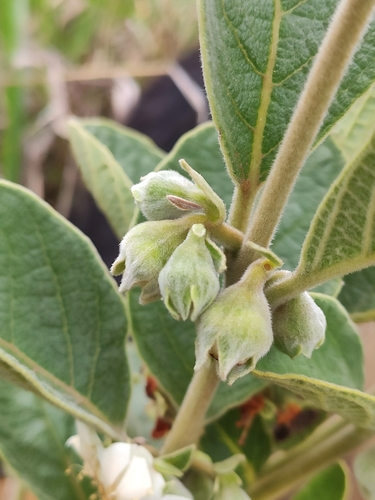
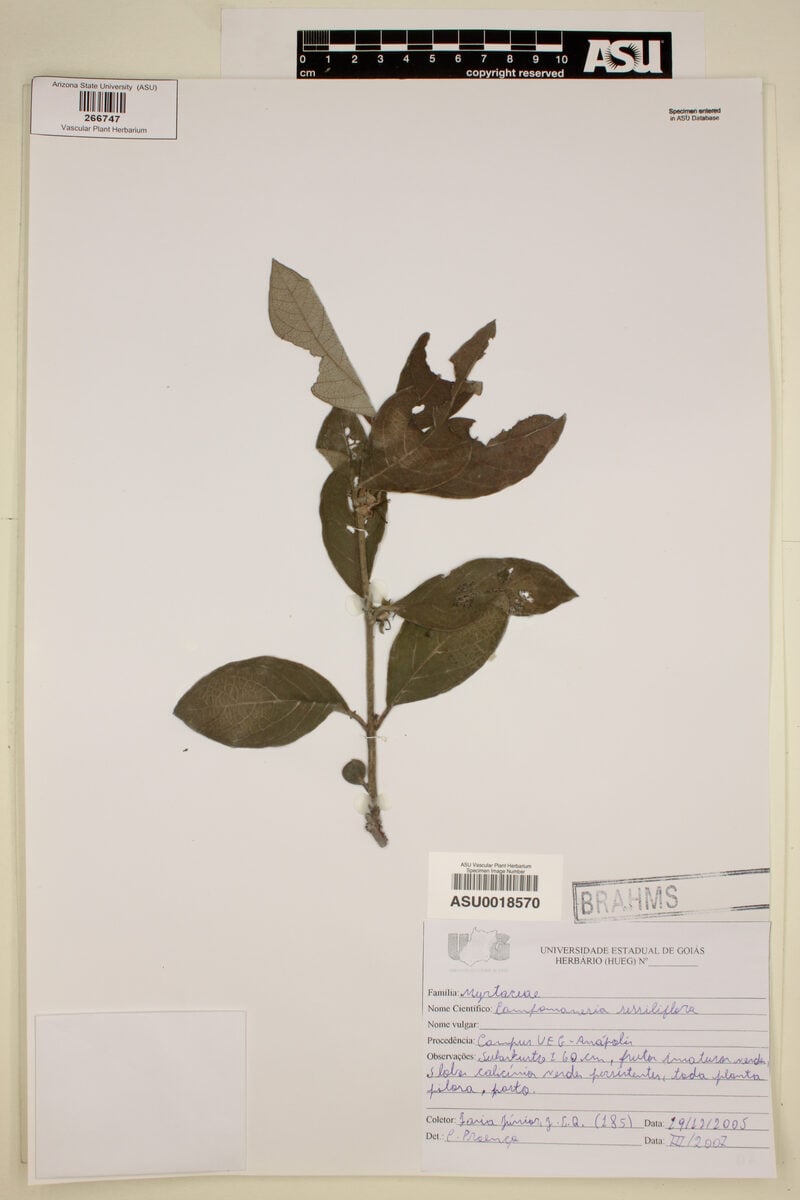
Psidium sartorianum
(O. Berg) Nied.
Sarte's guava, Puerto Rican Guava
iNaturalist· cc-by
(c) Francisco Farriols Sarabia, some rights reserved (CC BY), uploaded by Francisco Farriols Sarabia
iNaturalist· cc-by-nc
(c) JOSE JAVIER MAY CHAN, some rights reserved (CC BY-NC), uploaded by JOSE JAVIER MAY CHAN
iNaturalist· cc-by-nc
(c) JOSE JAVIER MAY CHAN, some rights reserved (CC BY-NC), uploaded by JOSE JAVIER MAY CHAN
Description
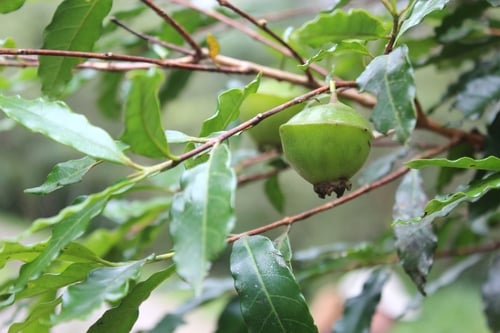
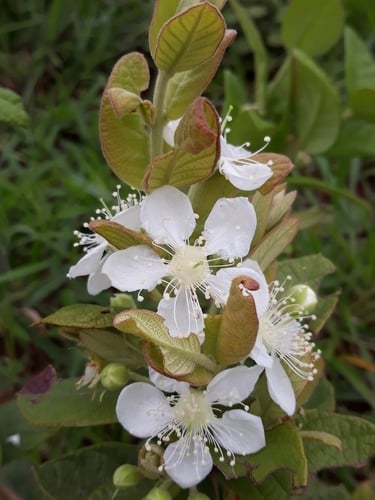
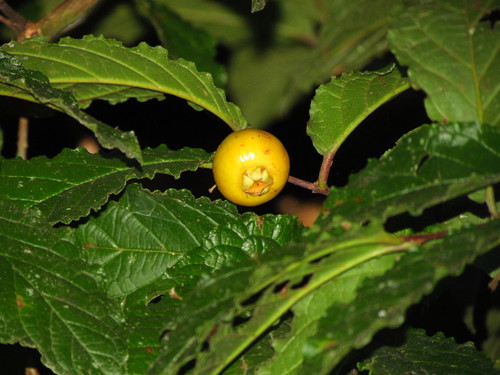
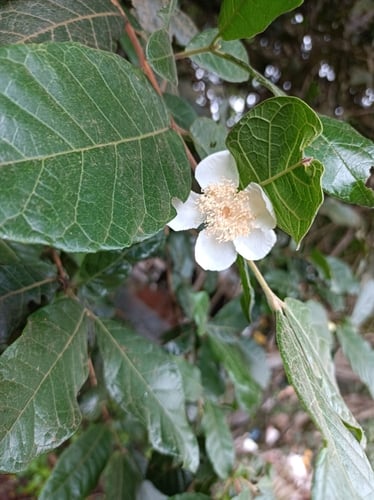
A tree. It grows 10-15 m high. The trunk can be 60 cm across. The leaves are sword shaped or narrowly oval. They are 2-7 cm long by 1-2 cm wide. The flowers usually occur singly. The fruit are round or pear shaped. The fruit are small, yellow and aromatic. They are 1-2.5 cm across with 1-5 seeds.
Edible Uses
The berries of Psidium oligospermum are edible, reportedly with a slight taste of turpentine, and geese are reported to frequently consume the berries. The wood of the tree is used locally in the Galápagos Islands as fencing or a building material, but is not very hardy nor enduring.
Traditional Uses
The fruit can be eaten fresh. They are also used for jellies. They are also dried. They are used for making a drink.
This uses section is brief — help expand it
Medicinal Uses
The leaves have medicinal properties.
Distribution
A tropical plant. It can survive some frost. It grows in deciduous tropical forests between 700-2,450 m above sea level. In Brisbane Botanical gardens.
Where It Grows
Asia, Australia, Belize, Bolivia, Brazil, Central America*, Colombia, Costa Rica, Cuba, Ecuador, El Salvador, French Guiana, Guatemala, Guianas, Guyana, Honduras, Indonesia, Mexico*, Nicaragua, North America, Panama, Puerto Rico, SE Asia, South America, Suriname, Venezuela, West Indies,
Cultivation
Plants can be grown from seed.
Propagation
Seed - best sown as soon as it is ripe in a sunny position in a nursery seedbed. The germination rate is normally quite low, with the seed sprouting within 28 - 35 days.
Other Uses
The bark is rich in tannin. The wood is medium-textured, moderately heavy, hard, with moderate mechanical properties and not very durable when exposed to the elements. It can be used for internal general construction, simple furniture, plywood, boxes etc. The wood is used for fuel and to make charcoal.
Notes
There are about 150 Psidium species.
Synonyms
Also Known As
Arrayan, Arrayán, Capulin, Guayaba agria, Guayabillo, Jambu amerika, Mije, Pichiche, Sartori guava
References (31)
- Altschul, S.V.R., 1973, Drugs and Foods from Little-known Plants. Notes in Harvard University Herbaria. Harvard Univ. Press. Massachusetts. no. 3050
- Arriaga, M. R. et al, 2014, Catalogue of fruit species in the southeast of the State of Mexico, Mexico. Revista Mexicana de Ciencias Agricolas Vol. 5 Num. 8. pp 1509-1517
- Bircher, A. G. & Bircher, W. H., 2000, Encyclopedia of Fruit Trees and Edible Flowering Plants in Egypt and the Subtropics. AUC Press. p 75 (As Calyptranthes tonduzii)
- Bortolotto, I. M., et al, 2018, Lista preliminar das plantas alimenticias nativas de Mato Grosso do Sul, Brasil. Iheringia, Serie Botanica, Porto Alegre, 73 (supl.):101-116
- Casas, A., et al, 1996, Plant Management Among the Nahua and the Mixtec in the Balsas River Basin, Mexico: An Ethnobotanical Approach to the Study of Plant Domestication. Human Ecology, Vol. 24, No. 4 pp. 455-478
Show all 31 references Hide references
- Cruz, I. M., et al, 2015, Edible fruits and seeds in the State of Mexico. Revista Mexicana de Ciencias Agricolas. Vol. 6. Num. 2 pp 331-346
- Darley, J.J., 1993, Know and Enjoy Tropical Fruit. P & S Publishers. p 47
- Facciola, S., 1998, Cornucopia 2: a Source Book of Edible Plants. Kampong Publications, p 159
- Facciola, S., 1998, Cornucopia 2: a Source Book of Edible Plants. Kampong Publications, p 158 (As Mitranthes sartoriana)
- Grandtner, M. M., 2008, World Dictionary of Trees. Wood and Forest Science Department. Laval University, Quebec, Qc Canada. (Internet database http://www.wdt.qc.ca)
- Grandtner, M. M. & Chevrette, J., 2013, Dictionary of Trees, Volume 2: South America: Nomenclature, Taxonomy and Ecology. Academic Press p 546
- Hermandez Bermejo, J.E., and Leon, J. (Eds.), 1994, Neglected Crops. 1492 from a different perspective. FAO Plant Production and Protection Series No 26. FAO, Rome. p16
- Kermath, B. M., et al, 2014, Food Plants in the Americas: A survey of the domesticated, cultivated and wild plants used for Human food in North, Central and South America and the Caribbean. On line draft. p 724
- Lopez-Diago, D. & Garcia, N., 2021, Wild edible fruits of Colombia. Biota ColomBiana 22 (2) p 46
- Martin, F.W., C.W. Campbell and R.M. Ruberté, 1987, Perennial edible fruits of the tropics - An inventory. United States Department of Agriculture, Agricultural Research Service, Agriculture Handbook No. 642. Washington, D.C., USA p 42
- Miguel, E., et al, 1989, A checklist of the cultivated plants of Cuba. Kulturpflanze 37. 1989, 211-357
- Piedra-Malagón, E. M., et al, 2022, Edible native plants of the Gulf of Mexico Province. Biodiversity Data Journal 10: e80565 p 26
- Pio-Leon, J. F., et al, 2017, Prioritizing Wild Edible Plants of potential new crops based on Deciduous Forest traditional knowledge by a Rancher community. Botanical Sciences 95(1): 47-59
- Recher, P, 2001, Fruit Spirit Botanical Gardens Plant Index. www.nrg.com.au/~recher/ seedlist.html p 3
- Roa, J. A. G. & Boada, D. S. G., 2018, Fundación para el Fortalecimiento de la Fruticultura y Plantas Alimenticias no Convencionales en Colombia.
- Segura, S., et al, 2018, The edible fruit species in Mexico. Genet Resour Crop Evol (2018) 65:1767–1793
- Standley, P. C. & Record, S. J., 1936, The Forests and Flora of British Honduras. (Belize). p 285
- Sukarya, D. G., (Ed.) 2013, 3,500 Plant Species of the Botanic Gardens of Indonesia. LIPI p 692
- Torre, de la, L., et al, 2008, Enciclopedia de las Plantas Útiles del Ecuador. Herbario QCA. Pontificia Universidad Católica del Ecuador. p 470
- Uphof,
- USDA, ARS, National Genetic Resources Program. Germplasm Resources Information Network - (GRIN). [Online Database] National Germplasm Resources Laboratory, Beltsville, Maryland. Available: www.ars-grin.gov/cgi-bin/npgs/html/econ.pl (10 April 2000)
- Van den Eynden, V., et al, 2003, Wild Foods from South Ecuador. Economic Botany 57(4): 576-603
- Wiersema, J. H. & Leon, B., 2013, World Economic Plants. A Standard Reference CRC Press. 2nd Ed. p 568
- www.colecionandofrutas.org
- www.tradewindsfruit.com
- Yetman, D., 2002, The Guarijios of the Sierra Madre: Hidden People of Northwestern Mexico. University of New Mexico Press. p 212