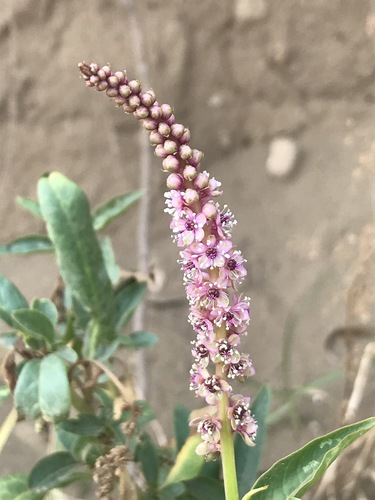
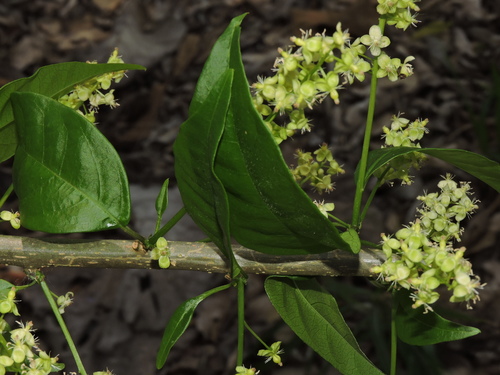
Phytolacca rivinoides
Kunth & C. D. Bouche
Venezuela pokeberry
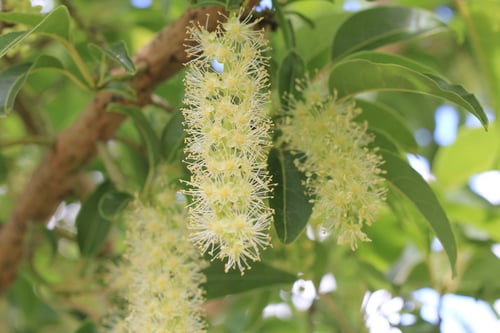
iNaturalist· cc-by-nc
(c) Cody Chapman, some rights reserved (CC BY-NC), uploaded by Cody Chapman
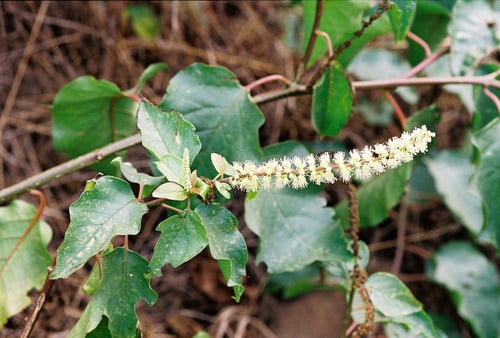
iNaturalist· cc-by-nc
(c) Juan David Rodriguez Hurtado, some rights reserved (CC BY-NC), uploaded by Juan David Rodriguez Hurtado
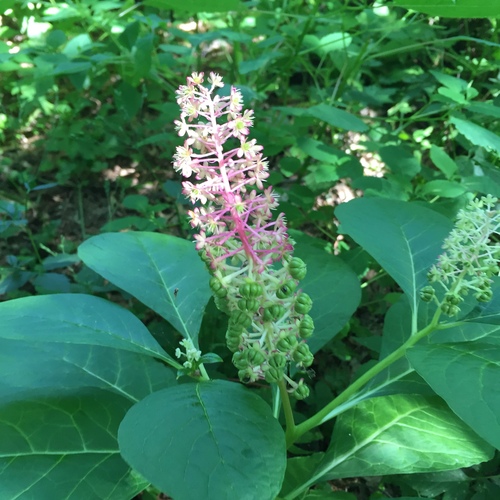
iNaturalist· cc-by-nc
(c) skemmanuel, some rights reserved (CC BY-NC), uploaded by skemmanuel
Summary
Source: WikipediaPhytolacca rivinoides, also known by its common name Venezuelan pokeweed, is a species of shrub in the family Phytolaccaceae.
Description
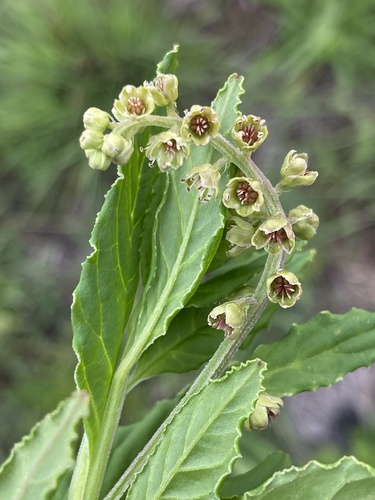
A scrambling or climbing herb. From a woody base it has shoots 5 m long. The leaves are narrowly oval and 9-17 cm long by 5-7 cm wide. The flowering shoots are 15-50 cm long. The fruit are berries 2-6 mm across. The seeds are small and black.
Edible Uses
Young leaves are cooked and eaten as a vegetable, and dried leaves are boiled for tea. The fruit are also eaten.
Traditional Uses
The young leaves are cooked and eaten as a vegetable. The leaves are boiled and used for tea. Caution: Plants in this group can have toxic components.
Medicinal Uses
The juice of the roots is purgative. A decoction is drunk in the treatment of syphilis. The juice of the fruits is purgative. The leaves and young stem are eaten as a treatment for diabetes. Liquid from the leaves crushed in water is rubbed onto hair to kill lice, fleas and to treat dandruff. A decoction of the boiled leaves is used as a wash for treating fevers. The plant (part unspecified) is used for treating rabies, lung diseases and tumours. The plant contains carbomethoxy oleanolic acid.
Known Hazards
Plants in this group can have toxic components.
Distribution
A tropical plant. It grows in tropical America. It grows in lower mountain rainforest. It can grow up to 2,600 m above sea level.
Where It Grows
Amazon, Argentina, Asia, Barbados, Bolivia, Brazil, Central America*, Colombia, Costa Rica, Cuba, Dominica, Dominican Republic, Ecuador, Greater Antilles, Grenada, Guadeloupe, French Guiana, Guatemala, Guianas, Guyana, Haiti, Honduras, Jamaica, Martinique, Mexico, Montserrat, Nicaragua, North America, Pacific, Panama, Peru, Philippines, Puerto Rico, SE Asia, South America, St Kitts, St Lucia, St. Vincent and Grenadines, Suriname, Trinidad-Tobago, Venezuela, West Indies*,
Cultivation
The seeds can remain viable in the soil for many years until light and temperature allow them to germinate.
Other Uses
The roots contain saponins and are sometimes used as a substitute for soap. The liquid obtained from the leaves crushed in water is rubbed onto the hair in order to kill lice and fleas.
Other Information
It is cultivated.
Notes
There are 25 Phytolacca species.
Synonyms
Also Known As
Agouman, Agouman bef, Airombo, Atosaram Babarro, Bakalau tape, Boho, Callaloo, Deer calalu, Finchunu tape, Guanchaparron, Guaparron, Hatun chukllu, Hatun sara, Huahuara, Izenna, Jaboncillo, Jabon panka, Joklhkgk, Jorga, Lang bef, Mapanke'an, Quelite rojo, Sega, Soga, Tilba pata, Tuta yuyu, Wampakar, Wataraku, Yahmolli noso totolkilitl, Yakibe, Yocoto, Yukutu
References (31)
- Altschul, S.V.R., 1973, Drugs and Foods from Little-known Plants. Notes in Harvard University Herbaria. Harvard Univ. Press. Massachusetts. no. 929
- Barfod, A. S. & Kvist, L. P., 1996, Comparative Ethnobotanical Studies of the Amerindian Groups in Coastal Ecuador. The Danish Academy of Sciences and Letters. p 81, 83
- Castaneda, H., & Stepp, J. R., 2007, Ecosystems as Sources of Useful Plants for the Guaymi People of Costa Rica. Ethnobotany Journal. 5:249-257
- Coe, F. G., and Anderson, G. J., 1996, Ethnobotany of the Garifuna of Eastern Nicaragua. Economic Botany 50(1) pp 71-107
- Coe, F. G. & Anderson, G. J., 1997, Ethnobotany of the Miskitu of Eastern Nicaragua. Journal of Ethnobiology 17(2): 171-214
Show all 31 references Hide references
- Coe, F. G. and Anderson, G. J., 1999, Ethnobotany of the Sumu (Ulwa) of Southeastern Nicaragua and Comparisons with Miskitu Plant Lore. Economic Botany Vol. 53. No. 4. pp. 363-386
- D'Ambrosio, U., & Puri, R. K., 2016, Foodways in transition: food plants, diet and local perceptions of change in a Costa Rican Ngäbe community. Journal of Ethnobiology and Ethnomedicine (2016) 12:3 p 27
- Diaz-Jose, J., et al, 2019, Traditional Knowledge of Edible Wild Plants Used by Indigenous Communities in Zongolica, Mexico. Ecology of Food and Nutrition.
- Etkin, N. L. (Ed.), 1994, Eating on the Wild Side, Univ. of Arizona. p 140, 158
- Facciola, S., 1998, Cornucopia 2: a Source Book of Edible Plants. Kampong Publications, p 168
- Johnson, M. and Colquhoun, A., 1996, Preliminary Ethnobotanical Survey of Kurupukari: An Amerindian Settlement of Central Guyana. Economic Botany, Vol. 50, No. 2, pp. 182-194
- Katz, E., et al, 2012, No greens in the forest? Note on the limited consumption of greens in the Amazon. Acta Soc Bot Pol 81(4):283–293
- Kermath, B. M., et al, 2014, Food Plants in the Americas: A survey of the domesticated, cultivated and wild plants used for Human food in North, Central and South America and the Caribbean. On line draft. p 655
- Kew Plants of the World Online
- C. S. Kunth, Sp. nov. hort. berol. 15. 1849 ("1848") (Ann. Sci. Nat. Bot. ser. 3, 11:231. 1849)
- Langlois, H. C., 2004, Ethnobotanical analysis of different successional stages as sources of wild edible plants for the Guaymi people in Costa Rica. M. Sc. thesis University of Florida.
- Lentz, D. L., 1993, Medicinal and Other Economic Plants of the Paya of Honduras. Economic Botany, Vol. 47, No. 4, pp. 358-370 (As Phytolacca rivenoides)
- Omawale, 1973, Guyana's edible plants. Guyana University, Georgetown p 95
- Martin, F.W. & Ruberte, R.M., 1979, Edible Leaves of the Tropics. Antillian College Press, Mayaguez, Puerto Rico. p 212
- Pena, F. B., et al, 1998, Los quelites de la Sierra Norte de Puebla, Mexico: Inventory Y Formas de Preparacion. Bol. Soc. Bot. Mexico 62:49-62
- Piedra-Malagón, E. M., et al, 2022, Edible native plants of the Gulf of Mexico Province. Biodiversity Data Journal 10: e80565 p 27
- Plants of Haiti Smithsonian Institute http://botany.si.edu/antilles/West Indies
- Roa, J. A. G. & Boada, D. S. G., 2018, Fundación para el Fortalecimiento de la Fruticultura y Plantas Alimenticias no Convencionales en Colombia.
- Smith, N., Mori, S.A., et al, 2004, Flowering Plants of the Neotropics. Princeton. p 292 (Drawing)
- Torre, de la, L., et al, 2008, Enciclopedia de las Plantas Útiles del Ecuador. Herbario QCA. Pontificia Universidad Católica del Ecuador. p 492
- Uphof,
- Useful Tropical Plants.
- van Andel, T., 2000, Useful plants of Guyana. Non-timber forest products of the North-West District of Guyana. Part 2. A Field Guide. Tropenbos-Guyana Programme. p 299
- Wiersema, J. H. & Leon, B., 2013, World Economic Plants. A Standard Reference CRC Press. 2nd Ed. p 525
- World Checklist of Useful Plant Species 2020. Royal Botanic Gardens, Kew
- Zuchowski W., 2007, Tropical Plants of Costa Rica. A Zona Tropical Publication, Comstock Publishing. p 304