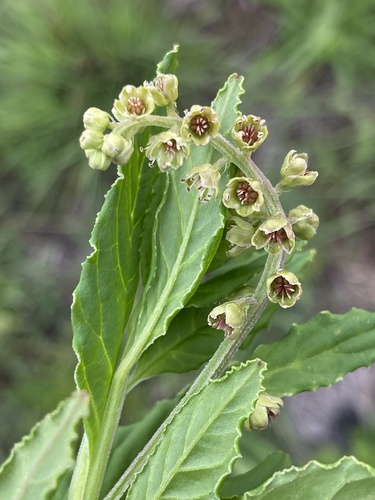
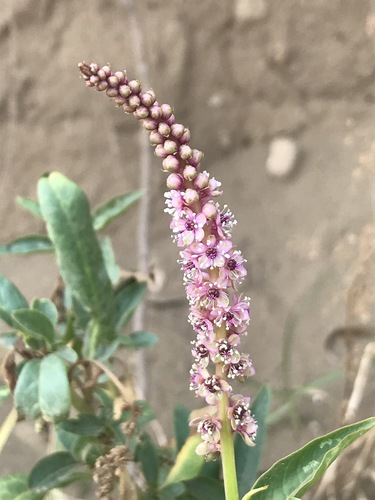
Phytolacca americana
L.
Pokeweed
iNaturalist· cc-by-nc
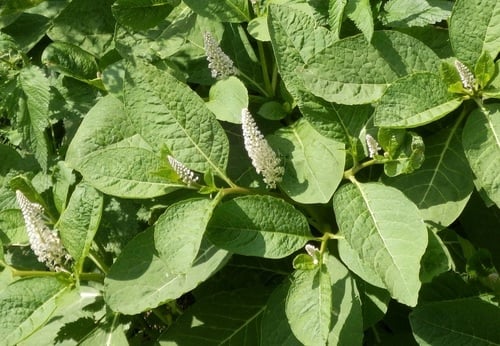
(c) Craig K. Hunt, some rights reserved (CC BY-NC), uploaded by Craig K. Hunt
iNaturalist· cc0
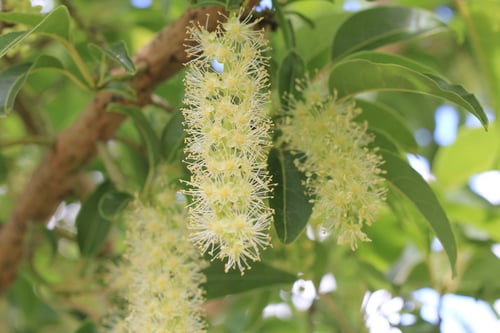
no rights reserved, uploaded by Bram vd Bergh
iNaturalist· cc-by-nc
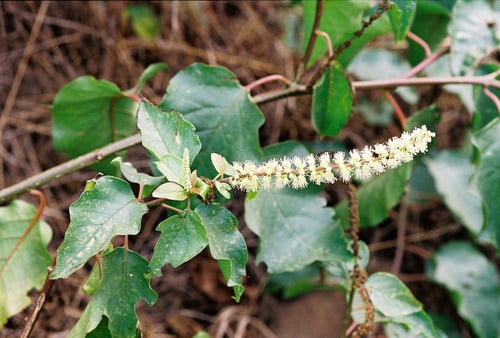
(c) Nathan Taxel, some rights reserved (CC BY-NC), uploaded by Nathan Taxel
Summary
Source: WikipediaPhytolacca americana, also known as American pokeweed, pokeweed, poke sallet, pokeberry, dragonberries, pigeonberry weed, and inkberry, is a poisonous, herbaceous perennial plant in the pokeweed family Phytolaccaceae. This pokeweed grows 1 to 3 metres (4 to 10 ft). It has simple leaves on green to red or purplish stems and a large white taproot. The flowers are green to white, followed by berries which ripen through red to purple to almost black which are a food source for songbirds such as gray catbird, northern mockingbird, northern cardinal, and brown thrasher, as well as other birds and some small non-avian animals (i.e., for species that are unaffected by its mammalian toxins). Pokeweed is native to eastern North America, the Midwest, and the South, with more scattered populations in the far West where it was introduced. It is also naturalized in parts of Europe and Asia. It is considered a pest species by farmers. Pokeweed is poisonous to humans, dogs, and livestock. In spring and early summer, shoots and leaves (not the root) are edible with proper cooking (hence the common name "poke sallet"), but later in the summer they become deadly, and the berries are also poisonous. It is used as an ornamental in horticulture, and it provokes interest for the variety of its natural products (toxins and other classes), for its ecological role, its historical role in traditional medicine, and for some utility in biomedical research (e.g., in studies of pokeweed mitogen). In the wild, it is easily found growing in pastures, recently cleared areas, and woodland openings, edge habitats such as along fencerows, and in wastelands. The first word in its scientific name, Phytolacca americana, comes from the Greek words phyton ('plant') and lacca—the scarlet dye secreted by the Kerria lacca scale insect. The second denotes this plant as native to America. The common name "poke" is derived from puccoon, pocan, or poughkone (from an Algonquin name for the plant). Its berries were once used to make ink, hence its other sometimes-used common name, inkberry.
Description
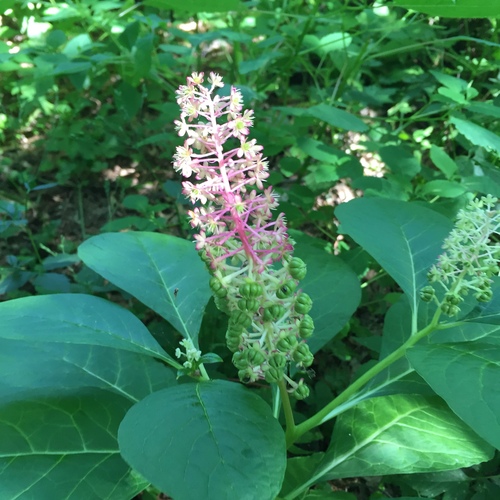
A herb. It grows to 4 m tall. The root is thick and cone shaped. The stems are erect. The leaf stalk is 1-4 cm long. The leaf blade is oval and 9-18 cm long by 5-10 cm wide. The base is wedge shaped and it tapers to a short tip. The flower racemes can be at the end of branches or on the side. They are 5-20 cm long. The flowers are white and slightly red. The fruiting stalk hangs down. The fruit is a berry which is oblong and purple black when mature. The seeds are kidney shaped and 3 mm across.
Edible Uses
Young leaves must be cooked — changing the water once during cooking is advisable. They are used like spinach, but only young leaves should be used as they become toxic with age. Young shoots are cooked as a delicious asparagus substitute; they are sometimes blanched beforehand, or forced in cellars for an early crop. The tender, clear inner portion of the stem can be rolled in cornmeal and fried. Although cultivated on a small scale in North America for its shoots, caution is advised. The fruit is a berry about 12mm in diameter and is used cooked in pies, but is poisonous raw, causing vomiting and diarrhoea — even cooked fruits should be viewed with caution. A red dye from the fruit is used as a food colouring. Nutritional analysis of shoots (dry weight): 274 calories per 100g; water 0%; protein 31g; fat 4.8g; carbohydrate 44g; fibre 0g; ash 20.2g; calcium 631mg; phosphorus 524mg; iron 20.2mg; vitamin A 62mg; thiamine (B1) 0.95mg; riboflavin (B2) 3.93mg; niacin 14.3mg; vitamin C 1619mg.
Traditional Uses
The young shoots and tender tops are boiled to make "poke salad". They can be pickled. CAUTION: The root is poisonous. The seeds are also toxic. The flesh of the fruit is eaten or used for food colouring. It is often made into juice.
Medicinal Uses
Pokeweed has a long history of medicinal use, traditionally employed to treat diseases linked to a compromised immune system. As of 1995, it was being investigated as a potential anti-AIDS drug, containing potent anti-inflammatory agents, antiviral proteins and substances that affect cell division — compounds toxic to many disease-causing organisms, including the water snails that cause schistosomiasis. All parts of the plant are toxic; excess causes diarrhoea and vomiting. This remedy should be used with caution and preferably under the supervision of a qualified practitioner, and should not be prescribed for pregnant women. The root is alterative, anodyne, anti-inflammatory, cathartic, expectorant, hypnotic, narcotic and purgative. Dried root is used as an anodyne and anti-inflammatory. Internally, the root treats auto-immune diseases (especially rheumatoid arthritis), tonsillitis, mumps, glandular fever and other complaints involving swollen glands, chronic catarrh and bronchitis. Fresh root is applied as a poultice for bruises and rheumatic pains, and a wash made from the roots is applied to swellings and sprains. Roots are best harvested in autumn and can be dried for later use. The fruit has a similar but milder action to the roots. The juice treats cancer, haemorrhoids and tremors. A poultice of the fruit is applied to sore breasts, and a tea made from the fruit treats rheumatism and dysentery. The plant has an unusually high potassium content; its ashes contain over 45% caustic potash and have been used as a salve for ulcers and cancerous growths. The leaves are cathartic, emetic and expectorant. A homeopathic remedy made from the fresh root acts primarily on the throat, breast, muscular tissues and joints.
Known Hazards
All parts of the plant can be toxic and pose risks to human and mammalian health. Toxins are found in highest concentration in the rootstock, then leaves and stems, then the ripe fruit. The plant generally gets more toxic with maturity, with the exception of the berries, which are dangerous even while green. Children may be attracted by clusters of berries. Ohio Agricultural Research and Development Center (OARDC) notes: Children are most frequently poisoned by eating raw berries. Infants are especially sensitive and have died from eating only a few raw berries. Adults have been poisoned, sometimes fatally, by eating improperly prepared leaves and shoots, especially if part of the root is harvested with the shoot, and by mistaking the root for an edible tuber. Research with humans has also shown that common pokeweed can cause mutations (possibly leading to cancer) and birth defects. Since the juice of pokeweed can be absorbed through the skin, contact of plant parts with bare skin should be avoided. Pokeweed is to be avoided during pregnancy and children consuming even one berry may require emergency treatment. The plant sap can cause dermatitis in sensitive people. Most animals dislike the taste of the plant and avoid it unless it is the only food source or if it is mixed in their feed. The fresh leaves have poisoned livestock who have eaten the green leaves or roots. If death occurs, it is usually due to respiratory paralysis. Pokeweed poisoning was common in eastern North America during the 19th century, especially from the use of tinctures as antirheumatic preparations and from ingestion of berries and roots that were mistaken for parsnip, Jerusalem artichoke, or horseradish. Owen states: If taken internally, pokeweed is a slow acting but a violent emetic. Vomiting usually starts about two hours after the plant or parts of it have been eaten. Severe cases of poisoning result in purging, spasms, and sometimes convulsions. If death occurs, it is usually due to paralysis of the respiratory organs. Cases of animal or human poisoning should be handled by a veterinarian or a physician. The OARDC staff scientists note that symptoms of poisoning include "a burning sensation in the mouth, salivation, gastrointestinal cramps, and vomiting and bloody diarrhea", and that depending upon the amount consumed, more severe symptoms can occur, including "anemia, altered heart rate and respiration, convulsions and death from respiratory failure." If only small quantities are ingested, people and animals recover within one to two days.
Distribution
It is a temperate climate plant. It is cultivated in China. It suits hardiness zones 5-9. In Yunnan. In Sichuan.
Where It Grows
Argentina, Asia, Australia, Balkans, Belgium, Brazil, Canada, Cape Verde, Central America, China, Cuba, Eswatini, Europe, Georgia, Hungary, India, Indochina, Korea, Macedonia, Mediterranean, Mexico, Myanmar, North America, SE Asia, Slovenia, South Africa, Southern Africa, South America, Spain, Swaziland, Switzerland, Taiwan, Tasmania, Turkey, Türkiye, Uruguay, USA, Vietnam, West Indies,
Cultivation
An easily grown plant, succeeding in most soils, though preferring a moisture retentive soil in full sun or partial shade. Plants can be grown in quite coarse grass, which can be cut annually in the autumn. Succeeds in an open woodland garden, growing well under trees. Whilst the dormant plant is hardy in much of Britain, the young growth in spring can be damaged by late frosts. A very ornamental plant, it often self sows when in a suitable position. Cultivated as a dye plant and on a small scale for its edible young shoots, there is at least one named form. 'White Stem' has white stems and the berries yield a golden-peach dye instead of purple. It is not yet known (1992) if it will breed true from seed. This plant is an alternative host to a number of viral diseases that affect members of the Amaryllidaceae, Liliaceae (broad view, including plants recently moved into separate families) and Solanaceae. Plants seem to be immune to the predations of rabbits.
Propagation
Sow seed in autumn or spring in a cold frame. Prick seedlings into individual pots when large enough to handle and grow on in a greenhouse for their first winter, then plant out in late spring or early summer after the last expected frosts. With sufficient seed, an outdoor sowing in a seedbed in early spring is worthwhile; grow plants on for their first year and transplant the following spring. Divide in March or October using a sharp spade or knife, ensuring each section has at least one growth bud. Larger divisions can go straight into permanent positions; smaller ones are better potted up and grown on in light shade in a cold frame until well established before planting out in late spring or early summer.
Other Uses
A red ink and dye are obtained from the fruit — a beautiful colour, though not very permanent. It makes a good body paint that washes off easily, though the mildly toxic nature of the berries should be kept in mind. The rootstock is rich in saponins and can be used as a soap substitute: cut the root into small pieces and simmer in boiling water to release the soap. The plant was being evaluated (as of 1980) for its snail-killing properties.
Other Information
It is a commercially cultivated vegetable.
Notes
There are 25 Phytolacca species. It is used in medicine.
Synonyms
Also Known As
Alkormos, Bledo, Capa-rosa, Chui xu shang lu, Gorget, Inkberry, Jabonera, Kusuzumu, Navadna barvilnica, Pigeon berry, Pocan, Poke, Pokeberry, Pokeroot, Red Ink Plant, Scoke, Sekerciboyast, Skoke, Thuongluc my, Uva-macaco
References (47)
- Beckstrom-Sternberg, Stephen M., and James A. Duke. "The Foodplant Database." http://probe.nalusda.gov:8300/cgi-bin/browse/foodplantdb.(ACEDB version 4.0 - data version July 1994)
- Blamey, M and Grey-Wilson, C., 2005, Wild flowers of the Mediterranean. A & C Black London. p 41 (As Phytolacca acinos)
- Bremness, L., 1994, Herbs. Collins Eyewitness Handbooks. Harper Collins. p 203
- Brickell, C. (Ed.), 1999, The Royal Horticultural Society A-Z Encyclopedia of Garden Plants. Convent Garden Books. p 793
- Burkill, I.H., 1966, A Dictionary of the Economic Products of the Malay Peninsula. Ministry of Agriculture and Cooperatives, Kuala Lumpur, Malaysia. Vol 2 (I-Z) p 1752 (As Phytolacca decandra)
Show all 47 references Hide references
- Bussman, R. W., et al, 2021, Unity in diversity—food plants and fungi of Sakartvelo (Republic of Georgia), Caucasus. Journal of Ethnobiology and Ethnomedicine (2021) 17:72 p 9
- Crawford, M., 2012, How to grow Perennial Vegetables. Green Books. p 150
- Cundall, P., (ed.), 2004, Gardening Australia: flora: the gardener's bible. ABC Books. p 1038
- Denes, A., et al, 2012, Wild plants used for food by Hungarian ethnic groups living in the Carpathian Basin. Acta Societatis Botanicorum Poloniae 81 (4): 381-396
- Duarte, M. C., et al, 2022, Diversity of Useful Plants in Cabo Verde Islands: A Biogeographic and Conservation Perspective. Plants 2022, 11, 1313 p 15
- Duke, J.A., 1992, Handbook of Edible Weeds. CRC Press. p 148
- Elias, T.S. & Dykeman P.A., 1990, Edible Wild Plants. A North American Field guide. Sterling, New York p 96
- Ertug, F, Yenen Bitkiler. Resimli Türkiye Florası -I- Flora of Turkey - Ethnobotany supplement
- Esperanca, M. J., 1988. Surviving in the wild. A glance at the wild plants and their uses. Vol. 2. p 152
- Facciola, S., 1998, Cornucopia 2: a Source Book of Edible Plants. Kampong Publications, p 168
- Flora of Australia, Volume 4, Phytolaccaceae to Chenopodiaceae, Australian Government Publishing Service, Canberra (1984) p 2
- Flora of China @ efloras.org Volume 5
- Hani Medicine of Xishuangbanna, 1999, p 343
- Hedrick, U.P., 1919, (Ed.), Sturtevant's edible plants of the world. p 494 (As Phytolacca decandra)
- Heywood, V.H., Brummitt, R.K., Culham, A., and Seberg, O. 2007, Flowering Plant Families of the World. Royal Botanical Gardens, Kew. p 253
- Hibbert, M., 2002, The Aussie Plant Finder 2002, Florilegium. p 232
- http://www.botanic-gardens-ljubljana.com/en/plants
- Jackes, D. A., Edible Forest Gardens
- Jordan, J., et al, 2006, Vascular Plants Utilized by the Plains Apache in Southwestern Oklahoma, Publications of the Oklahoma Biological Survey. 2nd Series. Volume 7: 24-33, 2006
- Kays, S. J., and Dias, J. C. S., 1995, Common Names of Commercially Cultivated Vegetables of the World in 15 languages. Economic Botany, Vol. 49, No. 2, pp. 115-152
- Kermath, B. M., et al, 2014, Food Plants in the Americas: A survey of the domesticated, cultivated and wild plants used for Human food in North, Central and South America and the Caribbean. On line draft. p 654
- Kiple, K.F. & Ornelas, K.C., (eds), 2000, The Cambridge World History of Food. CUP p 1837
- Kizilarslan, C. & Ozhatay, N., 2012, An ethnobotanical study of the useful and edible plants of İzmit. Marmara Pharmaceutical Journal 16: 134-140, 2012.
- Lazarides, M. & Hince, B., 1993, Handbook of Economic Plants of Australia, CSIRO. p 189
- Loughmiller, C & L., 1985, Texas Wildflowers. A Field Guide. University of Texas, Austin. p 190
- MacKinnon, A., et al, 2009, Edible & Medicinal Plants of Canada. Lone Pine. p 175
- Martin, F.W. & Ruberte, R.M., 1979, Edible Leaves of the Tropics. Antillian College Press, Mayaguez, Puerto Rico. p 212 (As Phytolacca decandra)
- Miguel, E., et al, 1989, A checklist of the cultivated plants of Cuba. Kulturpflanze 37. 1989, 211-357
- Moerman, D. F., 2010, Native American Ethnobotany. Timber Press. p 397
- Morton,
- Pham-Hoang Ho, 1999, An Illustrated Flora of Vietnam. Nha Xuat Ban Tre. p 715
- Piedra-Malagón, E. M., et al, 2022, Edible native plants of the Gulf of Mexico Province. Biodiversity Data Journal 10: e80565 p 27
- Plants for a Future database, The Field, Penpol, Lostwithiel, Cornwall, PL22 0NG, UK. http://www.scs.leeds.ac.uk/pfaf/
- Ruiters-Welcome, A. K., 2019, Food plants of southern Africa. Ph.D. thesis. Univ. of Johannesburg p 86
- Saunders, C.F., 1948, Edible and Useful Wild Plants. Dover. New York. p 119 (As Phytolacca decandra)
- Sp. pl. 1:441. 1753
- Swaziland's Flora Database http://www.sntc.org.sz/flora
- Uphof,
- USDA, ARS, National Genetic Resources Program. Germplasm Resources Information Network - (GRIN). [Online Database] National Germplasm Resources Laboratory, Beltsville, Maryland. Available: www.ars-grin.gov/cgi-bin/npgs/html/econ.pl (10 April 2000)
- Welcome, A. K. & Van Wyk, B.-E., 2019, An inventory and analysis of the food plants of southern Africa. South African Journal of Botany 122 (2019) 136–179
- Wiersema, J. H. & Leon, B., 2013, World Economic Plants. A Standard Reference CRC Press. 2nd Ed. p 525
- World Checklist of Useful Plant Species 2020. Royal Botanic Gardens, Kew