Amyema quandang
(Lindl.) Teigh.
Grey Mistletoe
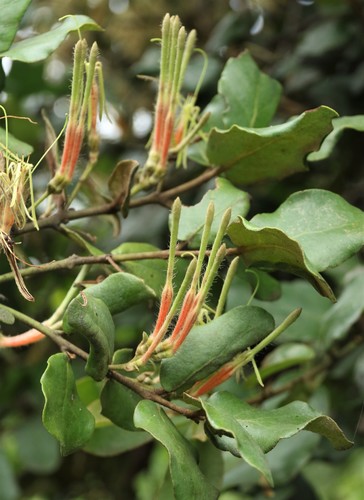
iNaturalist· cc-by-nc
(c) Reiner Richter, some rights reserved (CC BY-NC), uploaded by Reiner Richter
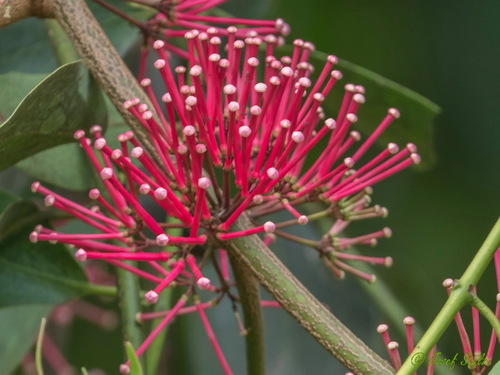
iNaturalist· cc-by-nc
(c) hardenbergiaviolacea, some rights reserved (CC BY-NC)
iNaturalist· cc0
no rights reserved, uploaded by Jean-Paul Boerekamps
Summary
Source: WikipediaAmyema quandang is a species of hemi-parasitic shrub which is widespread throughout the mainland of Australia, especially arid inland regions, sometimes referred to as the grey mistletoe.
Description
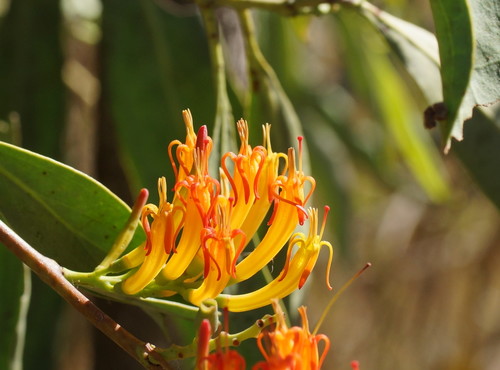
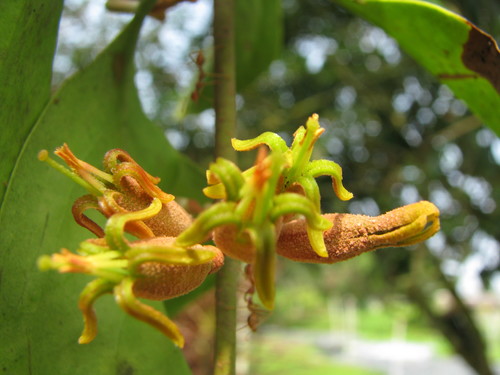
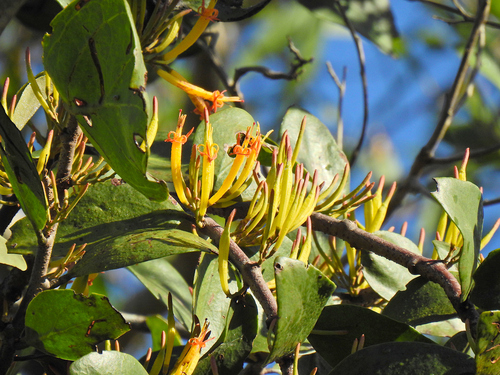
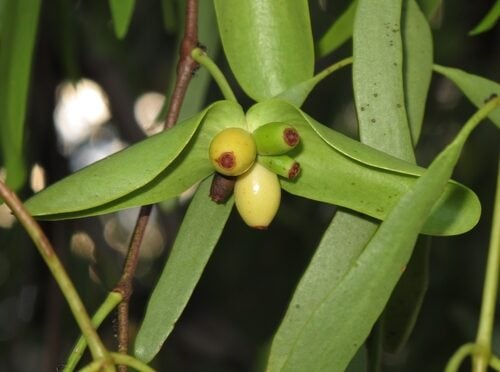
A shrub which grows attached to other plants. It hangs downwards. It has a white covering of soft hairs. The leaves are opposite and grey. They are usually curved and 3-12 cm long. The flowers occur in 2 groups of 3 flowers on a common stalk. The flowers are green outside and dark pink inside. They are 1.6-3 cm long. The fruit is slightly pear shaped and 6-10 mm long.
Edible Uses
The fruit are eaten.
Distribution
It grows on Acacia plants. It grows in subtropical places.
Where It Grows
Australia*,
Cultivation
It grows from seeds.
Notes
There are about 90-100 Amyema species.
Synonyms
References (8)
- Bodkin, F., 1991, Encyclopedia Botanica. Cornstalk publishing, p 77
- Gott, B & Conran, J., 1991, Victorian Koorie Plants. PO Box 666 Hamilton, Victoria 3300, Australia. p 29
- Lazarides, M. & Hince, B., 1993, Handbook of Economic Plants of Australia, CSIRO. p 19
- Milson, J., 2000, Trees and Shrubs of north-west Queensland. DPI p 93
- Paczkowska, G. & Chapman, A.R., 2000, The Western Australian Flora. A Descriptive Catalogue. Western Australian Herbarium. p 284
Show all 8 references Hide references
- Steenbeeke, Greg as part of the Plants Directory project. List of plant species from northern NSW that may be used as food plants p 6 (Also as var. bancroftii)
- Williams, K.A.W., 1999, Native Plants of Queensland Volume 4. Keith A.W. Williams North Ipswich, Australia. p 54
- World Checklist of Useful Plant Species 2020. Royal Botanic Gardens, Kew