Dendrophthoe vitellina
(F. Muell.) Tiegh.
Long-flowered mistletoe
iNaturalist· cc-by-nc
(c) Marie Tarrant, some rights reserved (CC BY-NC), uploaded by Marie Tarrant
iNaturalist· cc0
no rights reserved
iNaturalist· cc0
no rights reserved
Summary
Source: WikipediaDendrophthoe vitellina, commonly known as long-flowered- or apostle mistletoe, is a hemiparasitic plant of the mistletoe family Loranthaceae. The genus Dendrophthoe comprises about 31 species spread across tropical Africa, Asia, and Australia. Despite being collected by Joseph Banks and Daniel Solander in 1788, and depicted in Banks' Florilegium, it was not until 1860 that it was described by Ferdinand von Mueller as Loranthus vitellinus after being collected near Ipswich, and renamed by Philippe Édouard Léon Van Tieghem in 1895.
Description
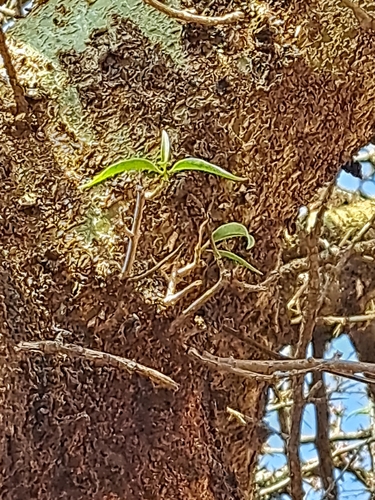
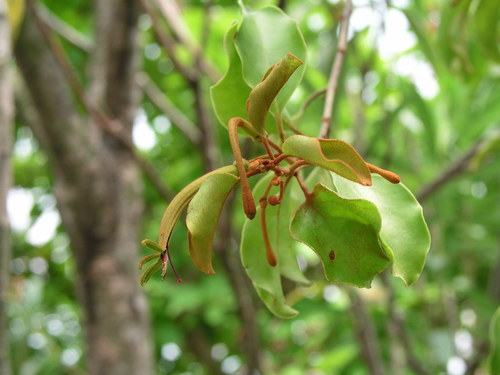
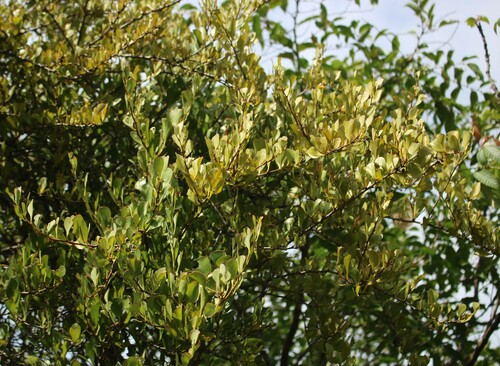
A mistletoe that hangs from trees. The leaves are oval or spear shaped and 4-16 cm long by 0.6-3 cm wide. The flowering shoot has 5-20 small flowers. They are usually yellow or orange with red tips. The fruit is egg-shaped and 1-1.5 cm long and yellow to red. It has one sticky seed.
Edible Uses
The fruit is eaten after removing the sticky seed.
Traditional Uses
The fruit is eaten. The sticky seed needs to be removed.
This uses section is brief — help expand it
Distribution
It is a temperate plant.
Where It Grows
Australia,
Cultivation
The seeds germinate and attach to trees.
Synonyms
References (2)
- Caton, J.M. & Hardwick, R. J., 2016, Field Guide to Useful Native Plants from Temperate Australia. Harbour Publishing House. p 350
- World Checklist of Useful Plant Species 2020. Royal Botanic Gardens, Kew