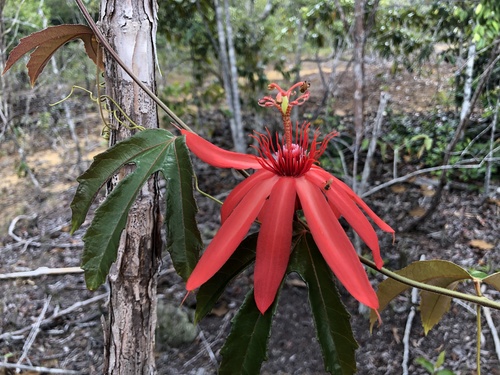
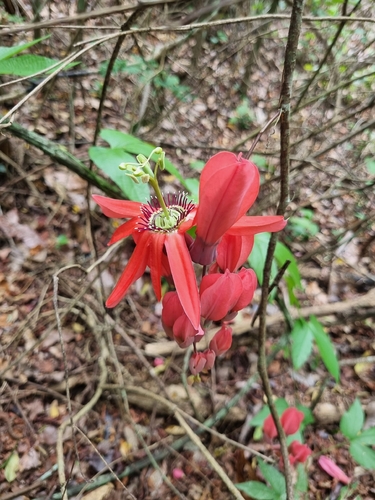
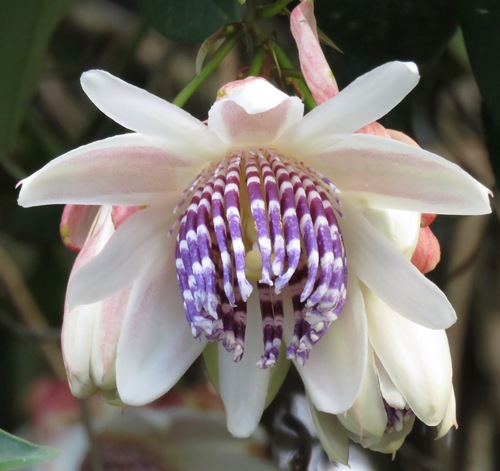
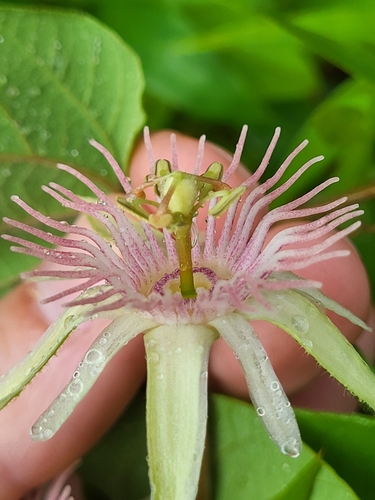
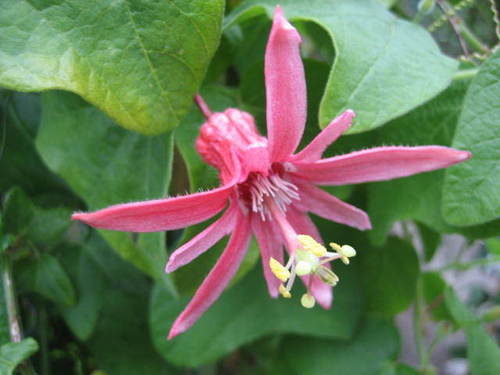
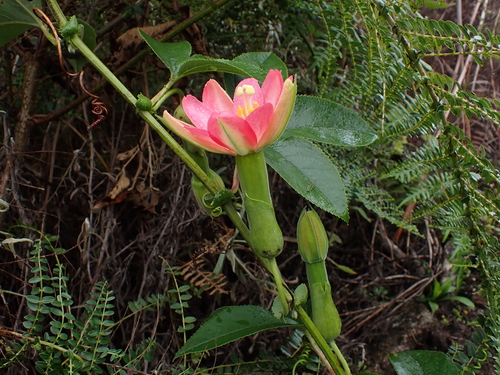
Passiflora edulis f. flavicarpa
O. Deg.
Yellow passionfruit
gbif· cc-by-nc
Franco Colnago
gbif· cc-by-nc
Franco Colnago
gbif· cc-by-nc
Maryse Neukomm
Summary
Source: WikipediaPassiflora edulis, commonly known as passion fruit, is a vine species of passion flower. The fruit is a pepo, a type of botanical berry, round to oval, either yellow or dark purple at maturity, with a soft to firm, juicy interior filled with numerous seeds. The plant is native to the region of southern Brazil through Paraguay to northern Argentina. It is cultivated commercially in tropical and subtropical areas for its sweet, seedy fruit. This is both eaten and juiced, with the juice often added to other fruit juices to enhance aroma.
Description
A vigorous climbing vine. This can be 7 m long. It has long tendrils which enable it to attach to supports. The tendrils are reddish-purple. The leaves are larger than purple passionfruit. The fruit are slightly larger than purple passionfruit and with a yellow skin. They can be 6-12 cm long by 4-7 cm wide. The seeds are brown. The flowers open in the afternoon.
Edible Uses
Passion fruit has a variety of uses related to its favored taste as a whole fruit and juice. In Australia and New Zealand, it is available commercially both fresh and tinned. It is added to fruit salads, and fresh fruit pulp or passion fruit sauce is commonly used in desserts, including as a topping for pavlova (a regional meringue cake) and ice cream, a flavouring for cheesecake, and in the icing of vanilla slices. A passion-fruit–flavored soft drink called Passiona has also been manufactured in Australia since the 1920s. It can be used in some alcoholic cocktails. In Brazil, the term maracujá applies to passion fruit (maracujá azedo, or "sour") and granadillo (maracujá doce, or "sweet"). Passion fruit mousse is a common dessert and passion fruit pulp is used to decorate the tops of cakes. Passion fruit juice, ice pops, and soft drinks are also consumed. When making a caipirinha, passion fruit may be used instead of lime. In Cambodia, the red and yellow passion fruit grown in the Mondulkiri Province are used to produce wine and liquor. In Colombia and Costa Rica, it is used for juices and desserts. In the Dominican Republic, where it is locally called chinola, it is used to make juice and fruit preserves. Passion-fruit-flavored syrup is used on shaved ice, and the fruit is also eaten raw, sprinkled with sugar. In East Africa, passion fruit is used to make juice, and is commonly eaten as a whole fruit. In Hawaii, where it is known as lilikoʻi, fresh passion fruit pulp is eaten. Lilikoi-flavored syrup is used as a topping for shave ice, soft drinks, a glaze, and to marinate meat and vegetables. It is used as a flavoring for malasadas, cheesecakes, cookies, dessert bars, ice cream and mochi. Passion fruit is also used in jam or jelly, as well as a fruit curd known as "lilikoi butter". In India, the government of Andhra Pradesh started growing passion fruit vines in the Chintapalli (Vizag) forests to make fruit available within the region. The fruit is eaten raw, sprinkled with sugar, and is used to make juice. In Indonesia, where it is known as markisa, both edulis and flavicarpa varieties are cultivated and consumed differently. The former is normally eaten as is, while the latter is more commonly strained to obtain its juice, which is cooked with sugar to make passion fruit syrup used in drinks and desserts. In Mexico, passion fruit is used to make juice or is eaten raw with chili powder and lime. In Paraguay, passion fruit is used principally for its juice, to prepare desserts such as passion fruit mousse, cheesecake, ice cream, and to flavor yogurts and cocktails. In Peru, passion fruit has long been a staple in homemade ice pops called "marciano" or "chupetes". Passion fruit is also used in several desserts, especially mousses and cheesecakes. Passion fruit juice is also drunk on its own and is used in ceviche variations and in cocktails, including the Maracuyá sour, a variation of the Pisco sour. Granadilla, or "sweet", can be eaten raw. In the Philippines, passion fruit is commonly sold in public markets and in public schools. Some vendors sell the fruit with a straw to enable sucking out the seeds and juices inside. In Portugal, especially the Azores and Madeira, passion fruit is used as a base for a variety of liqueurs and mousses. In Puerto Rico, where the fruit is known as "parcha", it is used in juices, ice cream or pastries. In South Africa, passion fruit, known locally as granadilla (the yellow variety as guavadilla), is used to flavor yogurt, soft drinks, such as Schweppes' "Sparkling Granadilla", and numerous cordial drinks (in cordial flavors, it is referred to as passion fruit). It is often eaten raw or used as a topping for cakes and tarts. Granadilla juice is commonly available in restaurants. The yellow variety is used for juice processing, while the purple variety is sold in fresh fruit markets. In Sri Lanka, passion fruit juice, along with faluda, is a common refreshment. Passion fruit cordial is manufactured both at home as well as industrially by mixing the pulp with sugar. In Suriname, where it is known as markoesa, there are three varieties. The red and orange varieties are sold by markets and eaten as a fruit because of their natural sweet flavor. The sour yellow variety, widely grown in the coastal region, is used to make jam and juices with added sugar, either uncooked for instant use or cooked into a thick syrup for refrigerated storage. The juice is also used to flavor cocktails.
Traditional Uses
The pulp of the fruit is eaten fresh. The seeds are edible. The fruit are used to flavour food and drinks.
This uses section is brief — help expand it
Distribution
A tropical plant. It grows in the tropical lowlands. It benefits from sun except under very hot conditions (>38°C). Plants need good drainage and adequate water. They are very susceptible to frosts. They need temperatures above 12°C. It is like purple passionfruit but will grow in warmer locations. They commonly grow between sea level and 800 m in the tropics.
Where It Grows
Africa, Amazon, Australia, Brazil, Central Africa, Central America, Colombia, Congo DR, Costa Rica, Ecuador, Guiana, Guianas, Guyana, Hawaii, India, Mexico, Northeastern India, Pacific, Papua New Guinea, PNG, South Africa, Southern Africa, South America, Suriname, USA, Vanuatu, Venezuela,
Cultivation
Plants are commonly grown from seed. They can be grown from cuttings. The vine needs to be pruned regularly. This reduces less vigorous growth and promotes flowering. Bottom heating the seeds at 20-26°C can result in germination at 1-2 weeks, at lower temperatures seeds can take up to 10 weeks to germinate.
Production
Flowering can continue year round under suitable conditions. Individual flowers bloom for 12-24 hours. Flowers need to be hand pollinated or pollinated by bees. They will not self pollinate. Fruit ripen from flowering in 80 days. Plants continue their productive life for 4-6 years. Fruit are harvested when they fall. Fruit are considered fully ripe and ready for eating when the skin starts to wrinkle.
Other Information
It is widely cultivated.
Notes
There are about 400 Passiflora species. It can become self sown and a problem in some Pacific Islands regions. Fruit are high in folates 271μg/100.
Also Known As
Goki dimputu, Golden passion fruit, Guavadilla, Karora chi, Lilikoi, Maracuya amarillo, Maracuja peroba, Saptheilempa
References (29)
- Bourke, R. M., Altitudinal limits of 230 economic crop species in Papua New Guinea. Terra australis 32.
- Chin, H.F., & Yong, H.S., 1996, Malaysian Fruits in Colour. Tropical press, Kuala Lumpur p 39
- Cull, B.W., 1995, Fruit Growing in Warm Climates. Reed. p 141
- Cundall, P., (ed.), 2004, Gardening Australia: flora: the gardener's bible. ABC Books. p 991
- Darley, J.J., 1993, Know and Enjoy Tropical Fruit. P & S Publishers. p 96
Show all 29 references Hide references
- Facciola, S., 1998, Cornucopia 2: a Source Book of Edible Plants. Kampong Publications, p 166
- Fl. Haw. Fam. 250. 1946
- Latham, P., 2004, Useful Plants of Bas-Congo province. Salvation Army & DFID p 213
- Lyle, S., 2006, Discovering fruit and nuts. Land Links. p 312
- Martin, F. W., et al, 1987, Perennial Edible Fruits of the Tropics. USDA Handbook 642 p 50
- Medhi, P. & Borthakur, S. K., 2012, Phytoresources from North Cachur Hills of Assam -3: Edible plants sold at Hflong market. Indian Journal or Natural Products and Resources. 3(1) pp 84-109
- Medhi, P. & Borthakur, S. K., 2013, Wild edible plants sold by the Zeme Nagas at the makeshift market of Mahur, Dima Hasao district of Assam. Pleione 7(1): 84 - 93. 2013
- Penafield Anchundia, D. D., 2017, Traditional food consumption and its nutritional contribution in Guasaganda, Central Ecuador. PhD Ghent University p 72
- Roa, J. A. G. & Boada, D. S. G., 2018, Fundación para el Fortalecimiento de la Fruticultura y Plantas Alimenticias no Convencionales en Colombia.
- Segura, S., et al, 2018, The edible fruit species in Mexico. Genet Resour Crop Evol (2018) 65:1767–1793
- Omawale, 1973, Guyana's edible plants. Guyana University, Georgetown p 33
- Paz, F. S., et al, 2021, Edible Fruit Plant Species in the Amazon Forest Rely Mostly on Bees and Beetles as Pollinators. Journal of Economic Entomology, XX(XX), 2021, 1–13
- PROSEA (Plant Resources of South East Asia) handbook, Volume 2, 1991, Edible fruits and nut. p 244
- Recher, P, 2001, Fruit Spirit Botanical Gardens Plant Index. www.nrg.com.au/~recher/ seedlist.html p 3
- Sharma, B.B., 2005, Growing fruits and vegetables. Publications Division. Ministry of Information and broadcasting. India. p 104
- Staples, G.W. and Herbst, D.R., 2005, A tropical Garden Flora. Bishop Museum Press, Honolulu, Hawaii. p 450
- Striegel, L., et al, 2019, Promising Tropical Fruits High in Folates. Foods 2019, 8, 363; doi:10.3390/foods8090363. www.mdpi.com/journal/foods
- Torre, de la, L., et al, 2008, Enciclopedia de las Plantas Útiles del Ecuador. Herbario QCA. Pontificia Universidad Católica del Ecuador. p 485
- USDA, ARS, National Genetic Resources Program. Germplasm Resources Information Network - (GRIN). [Online Database] National Germplasm Resources Laboratory, Beltsville, Maryland. Available: www.ars-grin.gov/cgi-bin/npgs/html/econ.pl (10 April 2000)
- van Wyk, B., 2005, Food Plants of the World. An illustrated guide. Timber press. p 279
- van Wyk, Be., & Gericke, N., 2007, People's plants. A Guide to Useful Plants of Southern Africa. Briza. p 52
- Walter, A. & Lebot, V., 2007, Gardens of Oceania. ACIAR Monograph No. 122. p 209
- Wiersema, J. H. & Leon, B., 2013, World Economic Plants. A Standard Reference CRC Press. 2nd Ed. p 500
- Zuchowski W., 2007, Tropical Plants of Costa Rica. A Zona Tropical Publication, Comstock Publishing. p 189