Adenia ellenbeckii
Harms
wikimedia· cc-by-sa
Wikimedia Commons - Joachim Beyenbach
Description
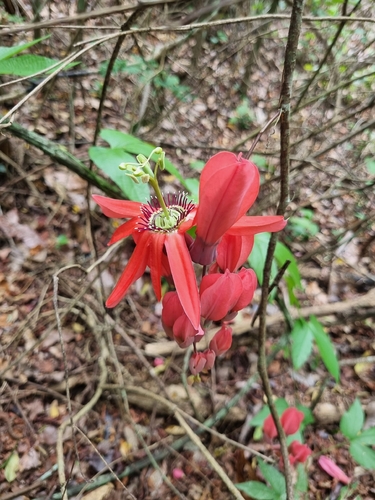
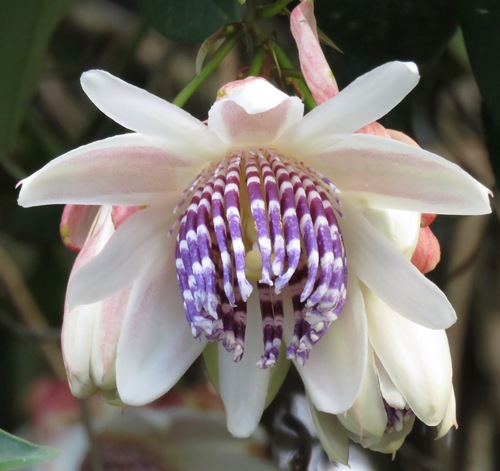
A herb or shrub. It grows 1.5 m tall. It can be climbing or lie along the ground. It grows from succulent stems 30 cm tall. The leaves can be entire of deeply divided into finger like lobes. There are 3-5 lobes. The leaves are 2-17 cm long. Male flowers occur in groups of 1-10. Female flowers in groups of 1-3. The male flowers are tube shaped. The flowers are pale yellow. The fruit are round and 2-5 cm across. They are leathery. The seeds are 7-8 mm long.
Edible Uses
The leaves are eaten as a vegetable.
Distribution
It is a tropical plant. It grows between 30 and 1,050 m above sea level.
Where It Grows
Africa, East Africa, Ethiopia, Kenya, Somalia, Tanzania, Uganda,
Cultivation
It can be grown from seeds or less easily from cuttings.
Nutrition
| Part | Moisture | kJ | kcal | Protein | Vit A | Vit C | Iron | Zinc |
|---|---|---|---|---|---|---|---|---|
| Leaves | 83.6 | — | 28.6 | 4.7 | — | — | 2.7 | 0.5 |
Also Known As
Armulo, Kaguto, Qaqula
References (9)
- Addis, G., et al, 2013, Dietary values of wild and semi-wild edible plants in Southern Ethiopia. African Journal of Food, Agriculture, Nutrition and Development. 13(2)
- Addis. G., et al, 2013, The Role of Wild and Semi-wild Edible Plants in Household Food Sovereignty in Hamer and Konso Communities, South Ethiopia. Ethnobotany Research & Applications. 11:251-271
- Addis, G., Asfaw, Z & Woldu, Z., 2013, Ethnobotany of Wild and Semi-wild Edible Plants of Konso Ethnic Community, South Ethiopia. Ethnobotany Research and Applications. 11:121-141
- Duguma, H. T., 2020, Wild Edible Plant Nutritional Contribution and Consumer Perception in Ethiopia. Hindawi International Journal of Food Science Volume 2020, Article ID 2958623, 16 pages
- Grubben, G. J. H. and Denton, O. A. (eds), 2004, Plant Resources of Tropical Africa 2. Vegetables. PROTA, Wageningen, Netherlands. p 559
Show all 9 references Hide references
- Lulekal, E., et al, 2011, Wild edible plants in Ethiopia: a review on their potential to combat food insecurity. Afrika Focus - Vol. 24, No 2. pp 71-121
- Mutie, F. M., et al, 2023, Important Medicinal and Food Taxa (Orders and Families) in Kenya, Based on Three Quantitative Approaches. Plants 2023, 12, 1145
- Ocho, D. L., et al, 2012, Assessing the levels of food shortage using the traffic light metaphor by analyzing the gathering and consumption of wild food plants, crop parts and crop residues in Konso, Ethiopia. Journal of Ethnobiology and Ethnomedicine 8:30
- World Checklist of Useful Plant Species 2020. Royal Botanic Gardens, Kew