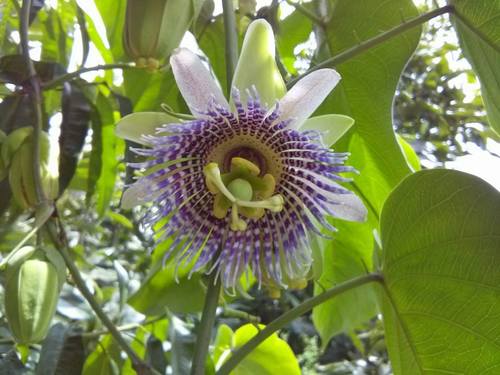
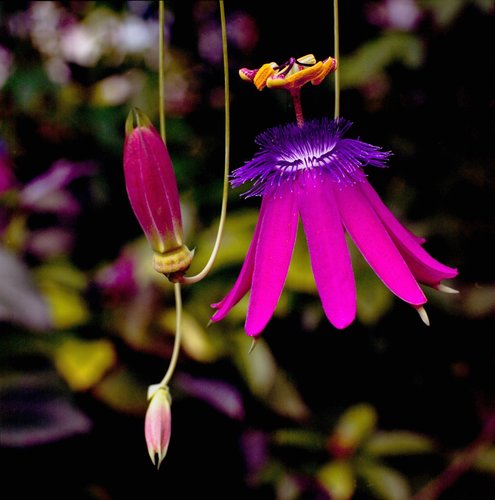
Adenia digitata
(Harvey) Engl.
Wild granadilla, Finger-leaved adenia
iNaturalist· cc-by-nc
(c) Troos van der Merwe, some rights reserved (CC BY-NC), uploaded by Troos van der Merwe
iNaturalist· cc0
no rights reserved, uploaded by Andrew Deacon
iNaturalist· cc-by-nc
(c) Richard Gill, some rights reserved (CC BY-NC), uploaded by Richard Gill
Summary
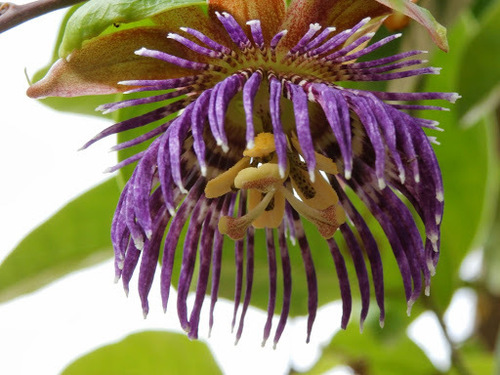
Source: WikipediaAdenia digitata is a species of flowering plant in the passionflower family, Passifloraceae. It is a climbing geophyte, from 0.2 to 3 meters long, which grows from a tuber. It is native to southern and eastern Africa, from Tanzania and Angola to the Northern Provinces and KwaZulu-Natal in South Africa.
Description
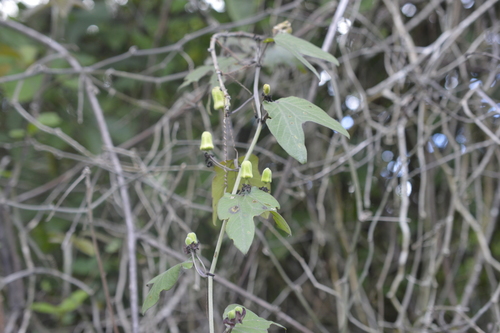
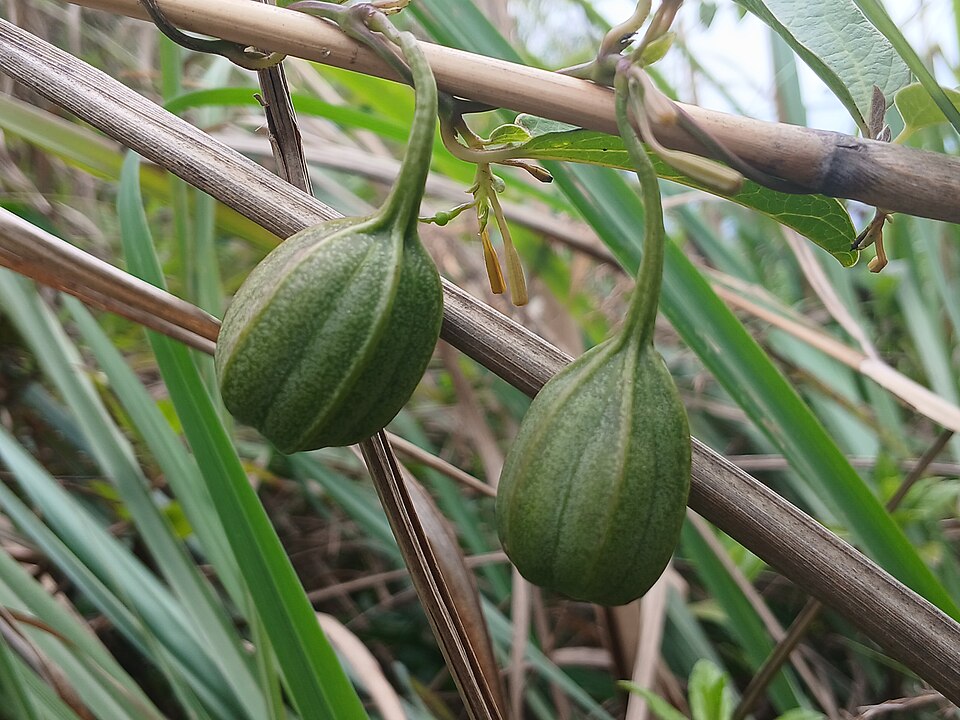
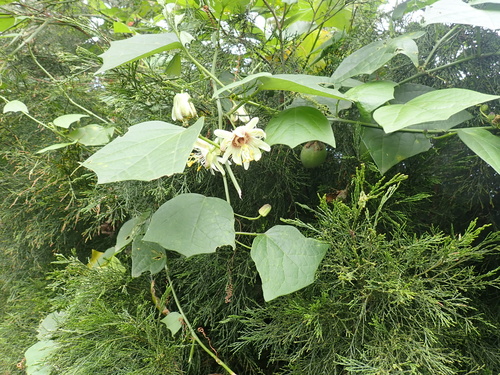
A climber. It grows from a tuber and can be 3 m tall. The tuber is 10 cm long by 6 cm wide. The stems usually grow annually. The leaf blade is 4-18 cm long by 3-17 cm wide. They are deeply divided. They are greenish-yellow above and more grey underneath. The leaflets vary in shape. The fruit is a capsule. It can be 5 cm long by 4 cm wide and oval. It can contain 20-60 seeds. The seeds are 5-8 mm long by 5 mm wide and 3 mm thick. They are oval.
Edible Uses
Young leaves are cooked and eaten as a vegetable.
Traditional Uses
The young leaves are cooked and eaten as a vegetable. Caution: The fruit and tubers are poisonous.
This uses section is brief — help expand it
Medicinal Uses
The whole plant is very poisonous, but it is sometimes used medicinally, mainly being applied externally, though there are reports of the root being taken internally. The root, which can be raw, cooked, or in the form of a decoction, is applied externally onto swellings, various skin ailments, leprosy or ulcers. It is sometimes applied externally and also drunk to treat swollen legs.
Known Hazards
The whole plant is deadly poisonous. The tuber contains cyanogenic glycosides, mainly tetraphyllin B (barterioside), and the very potent toxin modeccin, a toxalbumin, which inhibits protein synthesis in vitro. The fruit has been used for committing homicide; it is also eaten or a root extract is drunk as a suicide poison. Accidental poisoning mainly occurs when the root is mistaken for edible tubers, particularly those of Coccinia species. Children are often poisoned as a result of eating the attractive fruit.
Distribution
It is a tropical and subtropical plant. It grows in savannahs and woodlands and can be on sand or clayey soils. It grows between 390-1,800 m above sea level. It can grow in arid places.
Where It Grows
Africa, Angola, Botswana, Central Africa, East Africa, Eswatini, Malawi, Mozambique, South Africa, Southern Africa, Swaziland, Tanzania, Zambia, Zimbabwe,
Cultivation
A plant of drier areas in the tropics, where it can be found at elevations up to 1,850 metres. The plant is not frost tolerant, being damaged at temperatures below 4°c. Succeeds in a sunny to lightly shaded position and a well-drained soil. A dioecious species, both male and female forms need to be grown if fruit and seed are required.
Notes
There are 95 Adenia species. They are common in the semiarid regions of Africa.
Synonyms
Also Known As
Bobbejaangif, Borok-gothlolo, Boshielie, Dundu, Golobaje, Lawawa, Liphobobo, Marakabele, Mojaja, Muhow, Muzembo, Tshikutu, Utshwala benyoni
References (11)
- Flora Zambesiaca. http://apps.kew.org/efloras
- Fowler, D. G., 2007, Zambian Plants: Their Vernacular Names and Uses. Kew. p 52
- Fox, F. W. & Young, M. E. N., 1982, Food from the Veld. Delta Books. p 287
- Long, C., 2005, Swaziland's Flora - siSwati names and Uses http://www.sntc.org.sz/flora/
- Magwede, K., van Wyk, B.-E., & van Wyk, A. E., 2019, An inventory of Vhavenḓa useful plants. South African Journal of Botany 122 (2019) 57–89
Show all 11 references Hide references
- Pickering, H., & Roe, E., 2009, Wild Flowers of the Victoria Falls Area. Helen Pickering, London. p 90
- Plowes, N. J. & Taylor, F. W., 1997, The Processing of Indigenous Fruits and other Wildfoods of Southern Africa. in Smartt, L. & Haq. (Eds) Domestication, Production and Utilization of New Crops. ICUC p 184
- Royal Botanic Gardens, Kew (1999). Survey of Economic Plants for Arid and Semi-Arid Lands (SEPASAL) database. Published on the Internet; http://www.rbgkew.org.uk/ceb/sepasal/internet [Accessed 5th May 2011]
- Ruiters-Welcome, A. K., 2019, Food plants of southern Africa. Ph.D. thesis. Univ. of Johannesburg p 84
- Welcome, A. K. & Van Wyk, B.-E., 2019, An inventory and analysis of the food plants of southern Africa. South African Journal of Botany 122 (2019) 136–179
- World Checklist of Useful Plant Species 2020. Royal Botanic Gardens, Kew