Adenia gummifera
(Harvey) Harms
Snake climber, Green stem
iNaturalist· cc-by-nc
(c) Mark Hyde, Bart Wursten and Petra Ballings, some rights reserved (CC BY-NC)
iNaturalist· cc-by-nc
(c) Sharon Louw, some rights reserved (CC BY-NC)
iNaturalist· cc-by-nc
(c) Sharon Louw, some rights reserved (CC BY-NC)
Description
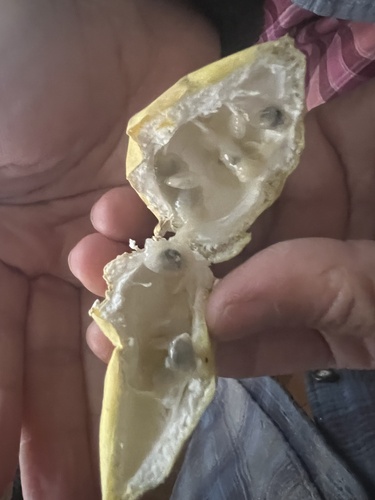
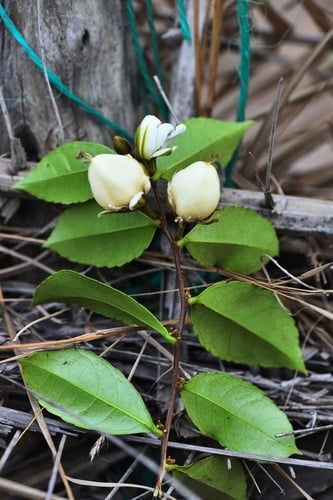
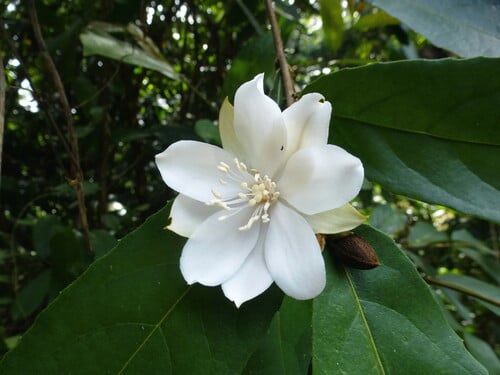
A climber. It is a succulent plant with a swollen base. It is a creeper with tendrils. The stems are grey. The leaf stalks are slender and 3 cm long. There is a small gland at the top. The leaf blades are 4 cm long. They have 3 broad blunt lobes. The edges are slightly wavy. The flowering shoots are in the axils of the leaves. These stalks are slender. The flowers are greenish-yellow. The fruit are oval and 2.5 cm long. The seeds are white with a netted surface.
Edible Uses
Young leaves are cooked and eaten as a vegetable, and very ripe fruit are eaten fresh as a dessert fruit.
Traditional Uses
CAUTION: Most Adenia are poisonous. The young leaves are cooked and eaten as a vegetable. The very ripe fruit are eaten as a dessert fruit.
This uses section is brief — help expand it
Medicinal Uses
It is a commonly used leaf vegetable in Mozambique.
Known Hazards
Most Adenia species are poisonous; caution should be exercised.
Distribution
It is a tropical plant. It is widespread in hilly country in Malawi. In grows in rainforest and along rivers. It suits humid locations. It grows below 1,700 m above sea level. In Tanzania it grows between 1 and 500 m above sea level. It grows in rocky and stony dry soils. It can grow in arid places. It can grow on termite mounds.
Where It Grows
Africa, Central Africa, Congo, East Africa, Eswatini, Ethiopia, Kenya, Malawi, Mozambique, Seychelles, Somalia, South Africa, Southern Africa, Swaziland, Tanzania, Uganda, Zambia, Zimbabwe,
Cultivation
It can be grown by seeds or cuttings.
Propagation
Seed - Cuttings
Other Uses
An exudate obtained by heating the stems is used to glue knives on to their handles.
Other Information
It is a commonly used leaf in Mozambique.
Notes
There are 95 Adenia species. They are common in the semiarid regions of Africa.
Nutrition
| Part | Moisture | kJ | kcal | Protein | Vit A | Vit C | Iron | Zinc |
|---|---|---|---|---|---|---|---|---|
| Leaves cooked | 81 | 247 | 59 | 3.6 | — | — | 4.2 | — |
Synonyms
Also Known As
Alfakunso, Beleha, Bopa, Bopa-vhafy, Bopha, Cimboyi, Deveramvumi, Dovosha, Dovoza, Gole, Imfulo, Impinda, Infulwa, Kimboyi, Kinboyi, Komboponoke, Kungu-mti, Lukenda, Mandali, Mdozi, Mkengeti, Mkuta, Mlozi, Monkey rope, Msambafumu, Muboori, Mulozi, Munua-nyoka, Murride, Nancuta, Slangklimop, Wore
References (21)
- Campbell, B. (Ed.), 1996, The Miombo in Transition: Woodlands and Welfare in Africa. CIFOR p 105
- Food Composition Tables for use in Africa FAO http://www.fao.org/infoods/directory No. 489
- Fowler, D. G., 2007, Zambian Plants: Their Vernacular Names and Uses. Kew. p 52
- Fox, F. W. & Young, M. E. N., 1982, Food from the Veld. Delta Books. p 287
- Kidane, B., et al, 2014, Wild and semi-wild leafy vegetables used by the Maale and Ari ethnic communities in southern Ethiopia. Genetic Resour Crop Evol. Springer. p 8
Show all 21 references Hide references
- Long, C., 2005, Swaziland's Flora - siSwati names and Uses http://www.sntc.org.sz/flora/
- Magwede, K., van Wyk, B.-E., & van Wyk, A. E., 2019, An inventory of Vhavenḓa useful plants. South African Journal of Botany 122 (2019) 57–89
- Malaisse, F., 2010, Se nourrir en floret claire africaine. Approche ecologique et nutritionnelle. CTA., p 57
- Malaisse, F., 2010, How to live and survive in Zambezian open forest (Miombo Ecoregion). Les Presses Agronomiques de Gembloux.
- Peters, C. R., O'Brien, E. M., and Drummond, R.B., 1992, Edible Wild plants of Sub-saharan Africa. Kew. p 159
- Plowes, N. J. & Taylor, F. W., 1997, The Processing of Indigenous Fruits and other Wildfoods of Southern Africa. in Smartt, L. & Haq. (Eds) Domestication, Production and Utilization of New Crops. ICUC p 184
- Royal Botanic Gardens, Kew (1999). Survey of Economic Plants for Arid and Semi-Arid Lands (SEPASAL) database. Published on the Internet; http://www.rbgkew.org.uk/ceb/sepasal/internet [Accessed 5th May 2011]
- Ruffo, C. K., Birnie, A. & Tengnas, B., 2002, Edible Wild Plants of Tanzania. RELMA p 106
- Ruiters-Welcome, A. K., 2019, Food plants of southern Africa. Ph.D. thesis. Univ. of Johannesburg p 85
- Swaziland's Flora Database http://www.sntc.org.sz/flora
- Tredgold, M.H., 1986, Food Plants of Zimbabwe. Mambo Press. p 1
- Welcome, A. K. & Van Wyk, B.-E., 2019, An inventory and analysis of the food plants of southern Africa. South African Journal of Botany 122 (2019) 136–179
- White, F., Dowsett-Lemaire, F. and Chapman, J. D., 2001, Evergreen Forest Flora of Malawi. Kew. p 427
- Williamson, J., 2005, Useful Plants of Malawi. 3rd. Edition. Mdadzi Book Trust. p 14
- World Checklist of Useful Plant Species 2020. Royal Botanic Gardens, Kew
- www.zimbabweflora.co.zw 2011