Panax ginseng
C. A. Mey.
Ginseng, Chinese ginseng
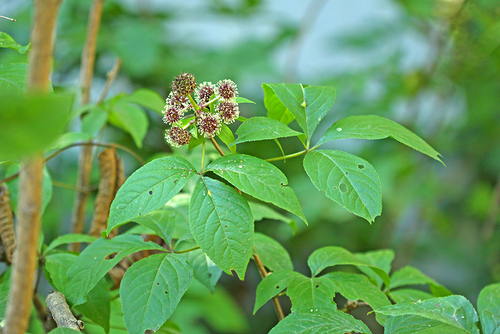
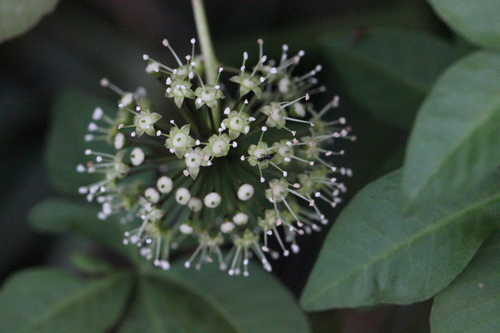
iNaturalist· cc-by-nc
(c) onidiras-iNaturalist, some rights reserved (CC BY-NC), uploaded by onidiras-iNaturalist
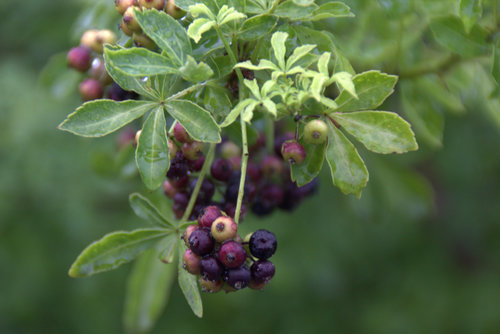
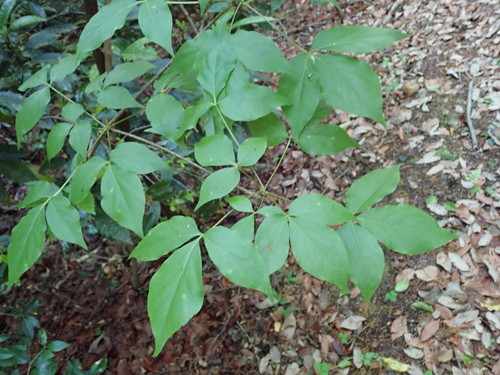
iNaturalist· cc-by-nc
(c) Leicester Library, some rights reserved (CC BY-NC), uploaded by Leicester Library
Summary
Source: WikipediaPanax ginseng, ginseng, also known as Asian ginseng, Chinese ginseng or Korean ginseng, is a species of plant whose root is the original source of ginseng. It is a perennial plant that grows in the mountains of East Asia. It is mainly cultivated in China, Korea, Russia, and Japan. P. ginseng is an herbaceous perennial plant, 30–60 cm tall, with palmately compound leaves, serrated leaflets, a terminal umbel of 30–50 flowers, red round fruits, and kidney-shaped seeds. P. ginseng is primarily cultivated in Korea. While all South Korean ginseng is P. ginseng, ginseng production in China encompasses both P. ginseng and South China ginseng (Panax notoginseng). There is little evidence that using P. ginseng provides any health effect. It may cause side effects or interact with various medications and conditions.
Description
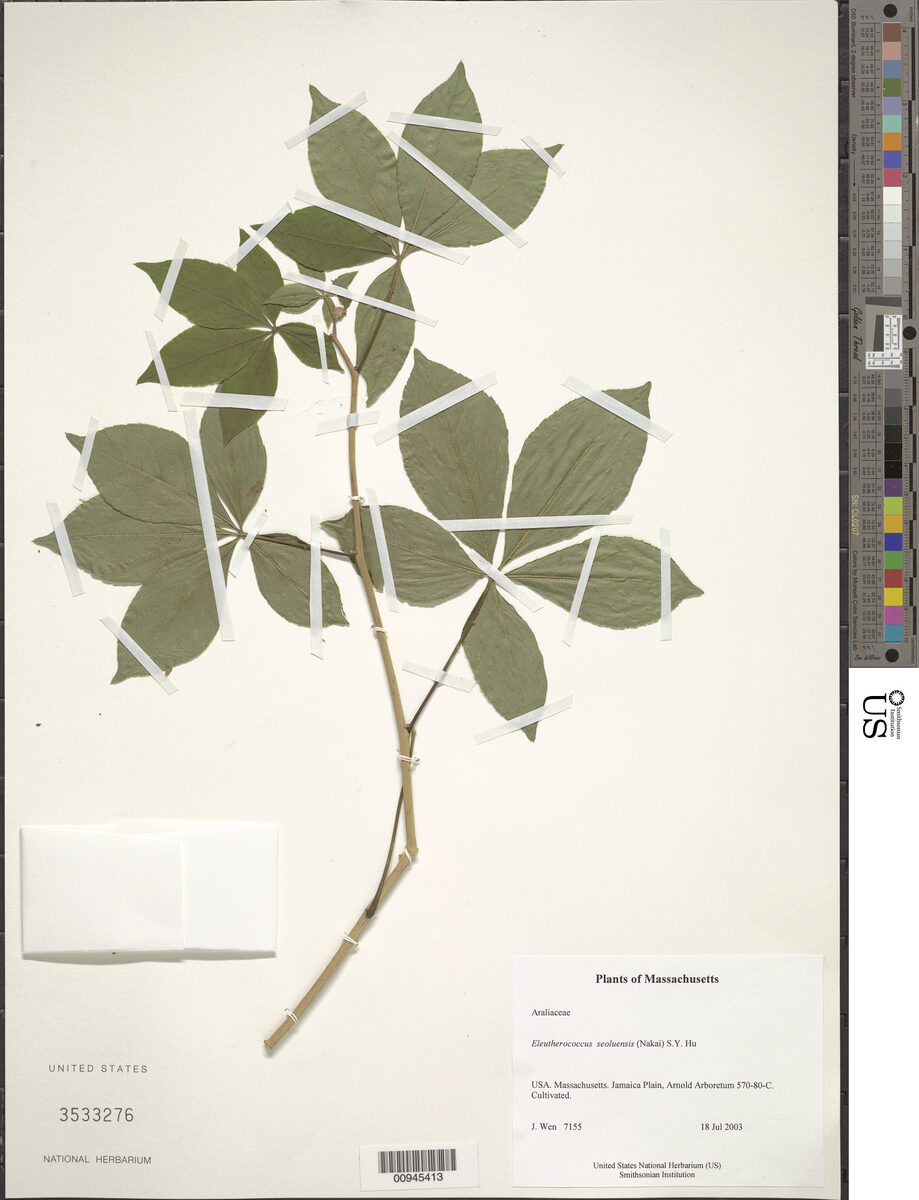
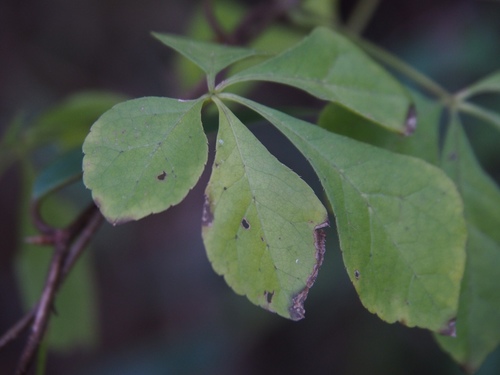
A perennial herb. It grows up to 80 cm high. It spreads to about 70 cm across. It has a carrot shaped root. These can have branches. The stems are upright with rings of 2-5 leaves. These have long stalks. The leaves are compound. They have 5 oval leaflets. These have teeth along the edge. The flowers are small and greenish-white. The fruit is red and like a berry.
Edible Uses
The root is chewed, though this likely refers primarily to its medicinal application. A tea is also made from the root.
Traditional Uses
A tea is made from the ground dried root. The sliced young root is also eaten raw or fried or candied. It can be used in stuffings, soft drinks and soups.
Medicinal Uses
Ginseng has a documented history of herbal use spanning over 5,000 years and is among the most highly regarded medicinal plants in the Orient, where it has long been associated with promoting health, general vigour, and longevity. The root is adaptogen, alterative, carminative, demulcent, emetic, expectorant, stimulant, and tonic. It both stimulates and relaxes the nervous system, encourages hormone secretion, improves stamina, lowers blood sugar and cholesterol levels, and increases resistance to disease. It is used internally for debility associated with old age or illness, lack of appetite, insomnia, stress, shock, and chronic illness. Ginseng is not normally prescribed for pregnant women, patients under 40, or those with depression, acute anxiety, or acute inflammatory disease, and is typically taken for no longer than 3 weeks at a time. Excess use can cause headaches, restlessness, raised blood pressure, and other side effects, particularly when taken alongside caffeine, alcohol, turnips, or bitter and spicy foods. Roots are harvested in autumn, preferably from plants that are 6–7 years old, and can be used fresh or dried. A dose of 10 µg/ml of ginseng saponins has been shown to be significantly radio-protective when administered prior to gamma-irradiation. The leaf is emetic and expectorant. The German Commission E Monographs approve Panax ginseng for lack of stamina.
Known Hazards
Use of Panax ginseng during pregnancy and breastfeeding is potentially unsafe. It may have adverse effects in people with immune disorders, bleeding conditions, cardiovascular diseases or cancer. It should not be used by children. Common side effects include headache, an increase in blood pressure, diarrhea, insomnia, skin rash, and vaginal bleeding.
Distribution
It is a temperate plant. It is native to northern China. It grows naturally in mountain forest. It requires a moist humus rich soil. It is hardy to frost. It suits hardiness zones 4-8.
Where It Grows
Asia, Australia, Britain, China*, Europe, France, India, Indochina, Japan, Korea*, Manchuria, Myanmar, North America, Russia, SE Asia, Tasmania, Thailand, USA,
Cultivation
It can be sown from seed. Seed can be erratic to germinate. Plants can also be grown by division of plants.
Propagation
Seed — sow in a shady position in a cold frame, preferably as soon as it is ripe, otherwise as soon as the seed becomes available. Germination can be very slow and erratic. Prick seedlings into individual pots once large enough to handle and grow on in a shady position in the greenhouse or frame through at least their first winter, ensuring pots are deep enough to accommodate the roots. Plant out into permanent positions in late summer. Division can be carried out in spring.
Other Uses
No other uses are known. The plant is suited to food forest cultivation.
Other Information
It is cultivated.
Notes
There are 3-6 Panax species. Some people divide the species into several. It has medicinal uses. It has anticancer properties.
Synonyms
Also Known As
Asian ginseng, Asiatic Ginseng, Jen Shen, Jen Shen Chiu, Kauli-thein, Korean Ginseng, Sang, Ren shen, Yakuyou ninjin, Som
References (21)
- Ambasta, S.P. (Ed.), 2000, The Useful Plants of India. CSIR India. p 422
- Arora, R. K., 2014, Diversity in Underutilized Plant Species - An Asia-Pacific Perspective. Bioversity International. p 106
- Bodkin, F., 1991, Encyclopedia Botanica. Cornstalk publishing, p 757
- Bremness, L., 1994, Herbs. Collins Eyewitness Handbooks. Harper Collins. p 199
- Cheifetz, A., (ed), 1999, 500 popular vegetables, herbs, fruits and nuts for Australian Gardeners. Random House p 146
Show all 21 references Hide references
- Cundall, P., (ed.), 2004, Gardening Australia: flora: the gardener's bible. ABC Books. p 978
- Facciola, S., 1998, Cornucopia 2: a Source Book of Edible Plants. Kampong Publications, p 25
- Gouldstone, S., 1983, Growing your own Food-bearing Plants in Australia. Macmillan p 169
- Hu, Shiu-ying, 2005, Food Plants of China. The Chinese University Press. p 586
- Kintzios, S. E., 2006, Terrestrial Plant-Derived Anticancer Agents and Plant Species Used in Anticancer research Critical Reviews in Plant Sciences. 25: pp 79-113
- Kiple, K.F. & Ornelas, K.C., (eds), 2000, The Cambridge World History of Food. CUP p 1778 (As Panax schinseng)
- Lim, T. K., 2015, Edible Medicinal and Non Medicinal Plants. Volume 9, Modified Stems, Roots, Bulbs. Springer p 63
- Macmillan, H.F. (Revised Barlow, H.S., et al), 1991, Tropical Planting and Gardening. Sixth edition. Malayan Nature Society. Kuala Lumpur. p 364
- Plants for a Future database, The Field, Penpol, Lostwithiel, Cornwall, PL22 0NG, UK. http://www.scs.leeds.ac.uk/pfaf/
- Rep. Pharm. Prakt. Chem. Russ. 7:524. 1842 (Bull. Cl. Phys.-Math. Acad. Imp. Sci. Saint-Petersbourg 1:340. 1843)
- Shikov, A. N. et al, 2017, Traditional and Current Food Use of Wild Plants Listed in the Russian Pharmacopoeia. Frontiers in Pharmacology. Vol. 8 Article 841
- van Wyk, B., 2005, Food Plants of the World. An illustrated guide. Timber press. p 274
- Wiersema, J. H. & Leon, B., 2013, World Economic Plants. A Standard Reference CRC Press. 2nd Ed. p 490
- Yasukawa, K., Medicinal and Edible Plants as Cancer Preventive Agents. Drug Discovery Research in Pharmacognosy. p185 www.intechopen.com
- Zeng, Y., et al, 2014, Evaluation of antioxidant activities of extracts from 19 Chinese edible flowers. SpringerPlus 2014, 3:315
- Zeven, A. C. & de West, J. M. J., 1982, Dictionary of cultivated plants and their regions of diversity. Wageningen. p 32