Tetrapanax papyrifer
(Hook.) K. Koch
Rice paper, Chinese ricepaper plant
iNaturalist· cc-by-nc
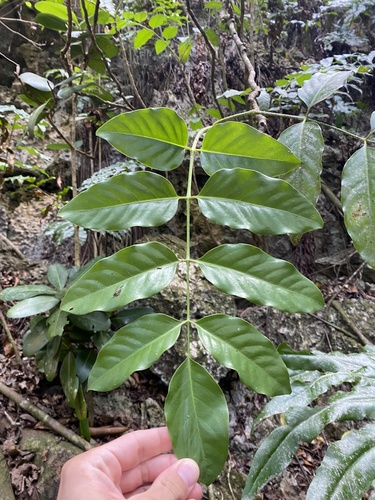
(c) 戴勝, some rights reserved (CC BY-NC), uploaded by 戴勝
iNaturalist· cc-by-nc
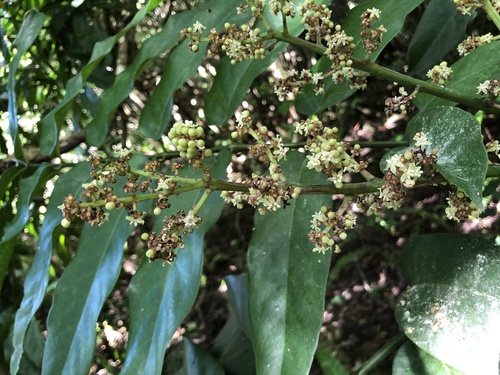
(c) Abi, some rights reserved (CC BY-NC), uploaded by Abi
iNaturalist· cc-by-nc
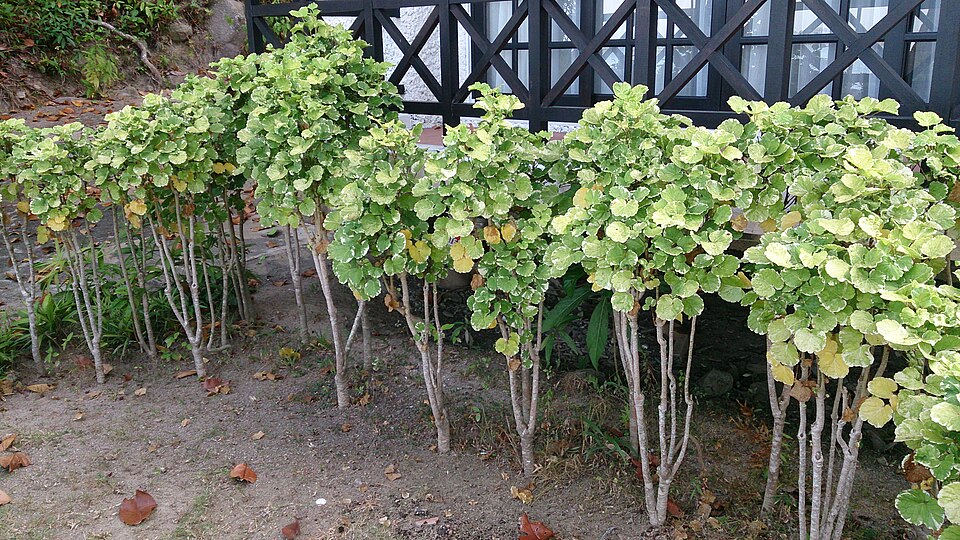
(c) 莊燿鴻, some rights reserved (CC BY-NC), uploaded by 莊燿鴻
Summary
Source: WikipediaAn evergreen shrub reaching 5 m tall with 5 m spread, growing at a fast rate. Hardy to UK zone 8 but frost tender. Year-round foliage; flowers in August with seeds ripening October to December. Hermaphroditic, bee-pollinated. Tolerates light sandy, medium loamy, and heavy clay soils at mildly acid to mildly alkaline pH. Grows in semi-shade or full light and prefers moist soil.
Description
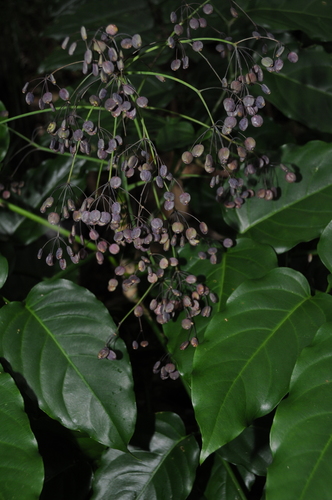
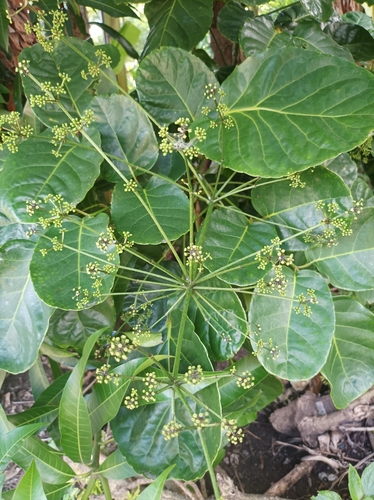
A small tree up to 3-6 m tall. It spreads 4.5 m wide. It has stolons or runners. It has a dense woolly or hairy covering. The leaf blade is almost round and with 7-12 lobes. This extend about halfway to the centre. The leaves are 15-30 cm long and densely hairy underneath. The lobes taper. The leafy structures or stipules are 5-12 cm long. They join to the base of the leaf stalk. The male flowers are on stalks 3-5 mm long. These are 6-8 mm long in female flower heads. The petals are triangle shaped and 2 mm long. The fruit is round and flattened. It is about 2 mm long. It is purplish-black.
Edible Uses
The inner pith of the stems is used to make 'rice paper'. Rice paper can be used to wrap foods, and can be eaten with the food. Root. No more details are given.
Traditional Uses
The pith of the plant is used to produce rice paper.
This uses section is brief — help expand it
Medicinal Uses
The pith is deobstruent, diuretic, febrifuge, galactagogue, sedative, and vermifuge. In Korea it is used in the treatment of oedema.
Distribution
It is a warm temperate and subtropical plant. It grows between 100 and 2,800 m altitude in China. It grows best in damp sites. It suits hardiness zones 8-11. In Brisbane Botanical Gardens. In Sichuan and Yunnan.
Where It Grows
Asia, Australia, China, Hawaii, India, Korea, Norfolk Island, Pacific, St Helena, Taiwan*, USA,
Cultivation
Tetrapanax papyrifer is a plant of mainly subtropical areas, it is cultivated as an ornamental in the tropics. Plants can tolerate temperatures down to about -5°c. They are often cut back to ground level in cold winters but will normally regrow from the rootstock in the spring. Succeeds in any fertile soil and in most situations. Prefers a moist but well-drained humus-rich soil in full sun or semi-shade. The plant requires a sheltered position in order to prevent damage to its large leaves. A very ornamental plant.
Propagation
Sow seed in autumn in a greenhouse, then prick out seedlings into individual pots when large enough to handle and grow on for at least their first year under glass. Plant out in late spring or early summer after the last expected frosts, and consider providing winter protection for the first few years outdoors. Suckers can be divided in early spring, though they can be difficult to establish. It is best to pot up divisions and grow them on in light shade in a greenhouse until well established, overwintering them under glass and planting out the following late spring or early summer after the last expected frosts.
Other Uses
The inner pith of the stems is used to make 'rice paper', as well as for crafting toys and flowers, for surgical dressings, and as a surface for painting. The paper is produced by cutting thin slivers from long sections of the pith.
Notes
There is only one Tetrapanax species. A form of rice paper is made from the pith of the stem.
Synonyms
References (15)
- Ambasta, S.P. (Ed.), 2000, The Useful Plants of India. CSIR India. p 631
- Arora, R. K., 2014, Diversity in Underutilized Plant Species - An Asia-Pacific Perspective. Bioversity International. p 109
- Cundall, P., (ed.), 2004, Gardening Australia: flora: the gardener's bible. ABC Books. p 1407
- Flora of Australia Volume 49, Oceanic Islands 1, Australian Government Publishing Service, Canberra. (1994) p 265
- Heywood, V.H., Brummitt, R.K., Culham, A., and Seberg, O. 2007, Flowering Plant Families of the World. Royal Botanical Gardens, Kew. p 44
Show all 15 references Hide references
- Hibbert, M., 2002, The Aussie Plant Finder 2002, Florilegium. p 297
- Lord, E.E., & Willis, J.H., 1999, Shrubs and Trees for Australian gardens. Lothian. p 267
- Lim, T. K., 2015, Edible Medicinal and Non Medicinal Plants. Volume 9, Modified Stems, Roots, Bulbs. Springer p 81
- Plants for a Future database, The Field, Penpol, Lostwithiel, Cornwall, PL22 0NG, UK. http://www.scs.leeds.ac.uk/pfaf/
- Purseglove, J.W., 1972, Tropical Crops. Monocotyledons. Longmans p 164
- Solomon, C., 2001, Encyclopedia of Asian Food. New Holland. p 315
- Staples, G.W. and Herbst, D.R., 2005, A tropical Garden Flora. Bishop Museum Press, Honolulu, Hawaii. p 138
- Wochenschr. Gartnerei Planzenk. 2:371. 1859 [As Tetrapanax papyrifer]
- World Checklist of Useful Plant Species 2020. Royal Botanic Gardens, Kew
- Xiang Chi-bai (Shang Chih-bei); Porter P. Lowry II, ARALIACEAE [Draft], Flora of China