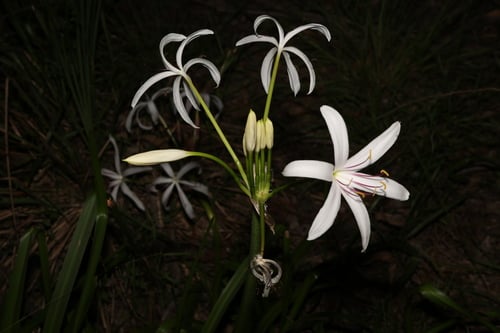
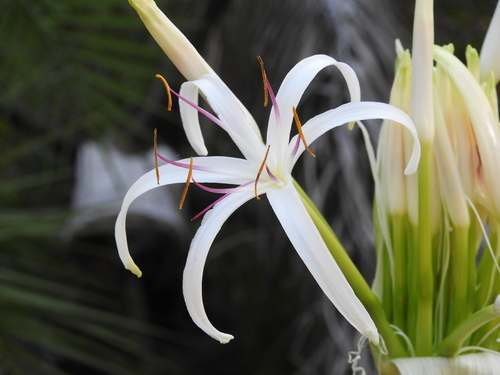
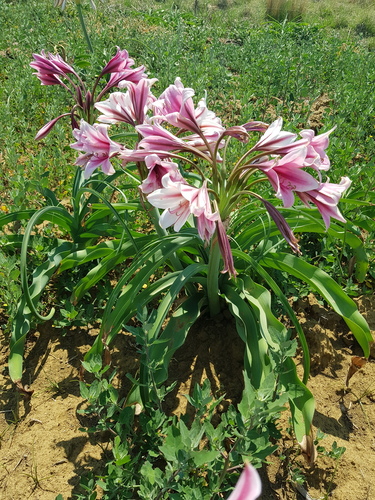
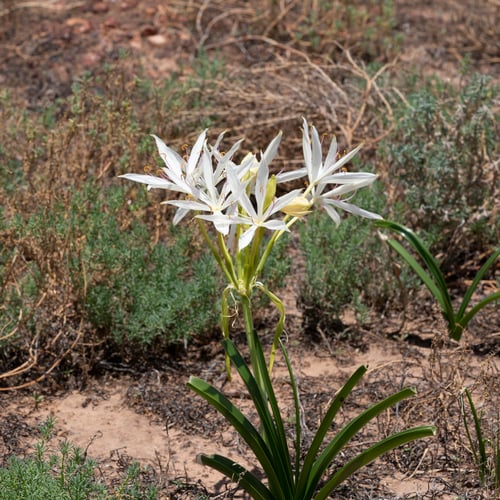
Allium subhirsutum
L.
Hairy garlic
iNaturalist· cc-by-nc
(c) Franck Le Driant, some rights reserved (CC BY-NC), uploaded by Franck Le Driant
iNaturalist· cc-by
(c) Daniel Cahen, some rights reserved (CC BY), uploaded by Daniel Cahen
iNaturalist· cc-by-nc
(c) David Renoult, some rights reserved (CC BY-NC), uploaded by David Renoult
Summary
Source: WikipediaAllium subhirsutum, the hairy garlic, is a plant species widespread around the Mediterranean region from Spain and the Canary Islands to Turkey and Palestine. Allium subhirsutum is a perennial herb up to 50 cm tall. Leaves are long, up to 15 mm across, tapering toward the tip, with hairs along the margins (hence the name "hairy garlic"). The umbel contains only a few flowers, white with thin pink midveins.
Description
An onion family plant. It is a bulb plant. It grows 20-30 cm high and spreads 20-40 cm wide. The leaves are grass like but fairly broad and flat. They have fine hairs on the edge. The leaves are 25-50 cm long. There are 2-3 leaves on each bulb. The flowers are white and in loose heads. These heads are 3-6 cm across.
Edible Uses
The bulb, roughly 15mm in diameter, can be eaten raw or cooked and is used like garlic as a flavouring in salads and cooked foods. The flavour is somewhat milder and slightly sweet, allowing it to be used in greater quantities than garlic. Bulbs are harvested in mid-summer after the plant dies down and will store for at least six months. The leaves are available raw or cooked, have a pleasant texture, are slightly sweet with a mild garlic flavour, and can be harvested throughout winter. The flowers are eaten raw in spring as a garnish on salads, offering a mild garlic flavour with a delicate sweetness that is attractive both visually and in taste.
Traditional Uses
The leaves are fried with egg. The flowers can be eaten raw or used as a garnish in salads. The bulbs are eaten raw or cooked.
This uses section is brief — help expand it
Medicinal Uses
No specific medicinal uses have been recorded for this species, but members of this genus are generally considered healthy additions to the diet. They contain sulphur compounds responsible for their onion flavour, and eaten regularly they help reduce blood cholesterol levels, act as a digestive tonic, and support the circulatory system.
Known Hazards
Although no individual reports regarding this species have been seen, there have been cases of poisoning caused by the consumption, in very large quantities and by some mammals, of certain members of this genus. Dogs seem to be particularly susceptible.
Distribution
It is a warm temperate plant. It grows in rocky and sandy habitats. It is often close to the sea. It suits hardiness zones 9-10.
Where It Grows
Africa, Albania, Australia, Balkans, Crete, Croatia, Europe, France, Greece, Italy, Mediterranean, North Africa, Portugal, Sicily, Spain, Turkey, Türkiye,
Cultivation
Easily grown in a warm sunny position. The plants require a period of summer rest when they are best kept dry but they do succeed in a well-drained sunny position in the open garden. Prefers a rich moist but well-drained soil. Closely related to A. neopolitanum and A. trifoliatum, this species comes into new growth in the autumn and flowers in the spring, dying down in the summer. It is a potential winter salad crop but is less hardy than A. neopolitanum so is only suitable for the mildest areas of Britain. The plant is thriving at Kew and so is hardier than the books say. The plants can flower within 12 months of germination, the bulbs are also producing offsets by this time. The bulbs should be planted fairly deeply. Most members of this genus are intolerant of competition from other growing plants. Grows well with most plants, especially roses, carrots, beet and chamomile, but it inhibits the growth of legumes. This plant is a bad companion for alfalfa, each species negatively affecting the other. Members of this genus are rarely if ever troubled by browsing deer.
Propagation
Seed is best sown as soon as it is ripe in a greenhouse, where it germinates quickly. Grow plants on under glass for the first year, then plant out the dormant bulbs in late summer of the following year if sufficiently developed, or continue in pots for another year. Stored seed can be sown in spring in a greenhouse. Divide plants in summer after they have died down — the bulbs divide freely and can be planted directly into permanent positions.
Other Uses
The plant's juice works as a moth repellent. The whole plant is also said to repel insects and moles.
Notes
There are about 300-700 Allium species. Most species of Allium are edible (Flora of China). All alliums are edible but they may not all be worth eating! They have also been put in the family Alliaceae.
Synonyms
Also Known As
Agghiu sarvaggiu, Azu, Koremen, Kormen
References (17)
- Ahiskali, M., Ari, C. & Selvi, S., Edible wild plants and their consumption during winterin a rural village of Kazdagi (Mount Ida)
- Biscotti, N. et al, 2018, The traditional food use of wild vegetables in Apulia (Italy) in the light of Italian ethnobotanical literature. Italian Botanist 5:1-24
- Blamey, M and Grey-Wilson, C., 2005, Wild flowers of the Mediterranean. A & C Black London. p 485
- Cundall, P., (ed.), 2004, Gardening Australia: flora: the gardener's bible. ABC Books. p 128
- Dogan, Y., 2012, Traditionally used wild edible greens in the Aegean Region of Turkey. Acta Societatis Botanicorum Poloniae 81(4): 329-342
Show all 17 references Hide references
- Dogan, Y. et al, 2013, Wild Edible Plants sold in the Local Markets of Izmir, Turkey Pak. J. Bot. 45(S1): 177-184
- Dolina, K. & Luczaj, L., 2014, Wild food plants used on the Dubrovnik coast (south-eastern Croatia) Acta Soc Bot Pol 83(3):175–181
- Ertug, F., 2004, Wild Edible Plants of the Bodrum Area. (Mugla, Turkey). Turk. J. Bot. 28 (2004): 161-174
- Ertug, F, Yenen Bitkiler. Resimli Türkiye Florası -I- Flora of Turkey - Ethnobotany supplement
- Geraci, A., et al, 2018, The wild taxa utilized as vegetables in Sicily (Italy): a traditional component of the Mediterranean diet. Journal of Ethnobiology and Ethnomedicine (2018) 14:14
- Gurdal, B. & Kultur, S., 2014, The edible and miscellaneous useful plants in Marmaris (Southwest Turkey). İstanbul Ecz. Fak. Derg. / J. Fac. Pharm. Istanbul 44(1) 2014 pp.69-78
- Licata, M., et al, 2016, A survey of wild plant species for food use in Sicily (Italy) – results of a 3-year study in four Regional Parks. Journal of Ethnobiology and Ethnomedicine 12:12
- Luczaj et al, 2013, Wild vegetable mixes sold in the markets of Dalmatia (southern Croatia). Journal of Ethnobiology and Ethnomedicine. 8:2
- Pasta, S., et al, 2020, An Updated Checklist of the Sicilian Native Edible Plants: Preserving the Traditional Ecological Knowledge of Century-Old Agro-Pastoral Landscapes. Frontiers in Plant Science. Volume 11|Article 388
- Plants for a Future database, The Field, Penpol, Lostwithiel, Cornwall, PL22 0NG, UK. http://www.scs.leeds.ac.uk/pfaf/
- Signorini, M. A., et al, 2009, Plants and traditional knowledge: An ethnobotanical investigation on Monte Ortobene (Nuoro, Sardinia). Journal or Ethnobiology and Ethnomedicine, 5:6
- Sp. pl. 1:295. 1753