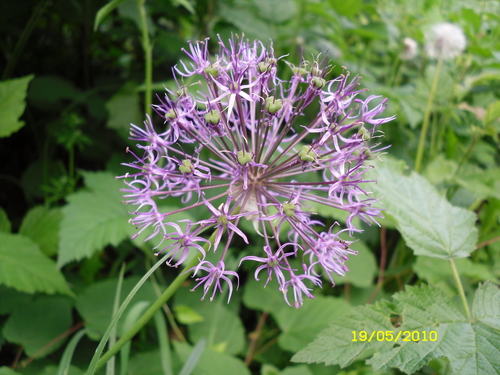
Allium victorialis
L.
Alpine leek
iNaturalist· cc-by-nc
(c) Luca Boscain, some rights reserved (CC BY-NC), uploaded by Luca Boscain
iNaturalist· cc-by
(c) Wolfgang Jauch, some rights reserved (CC BY), uploaded by Wolfgang Jauch
iNaturalist· cc-by-nc
(c) René Stalder, some rights reserved (CC BY-NC), uploaded by René Stalder
Summary
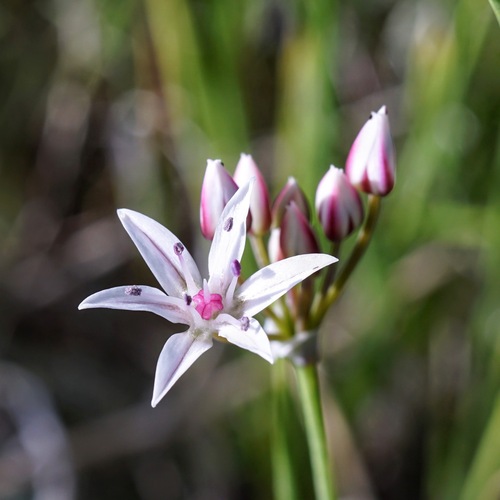
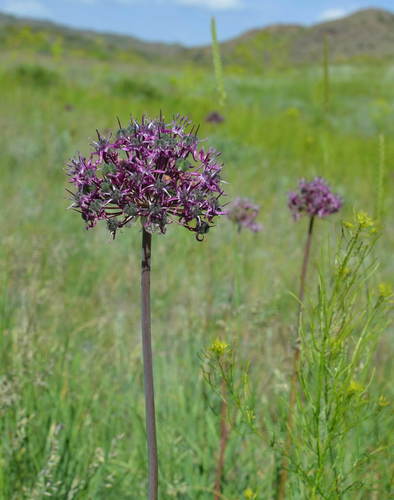
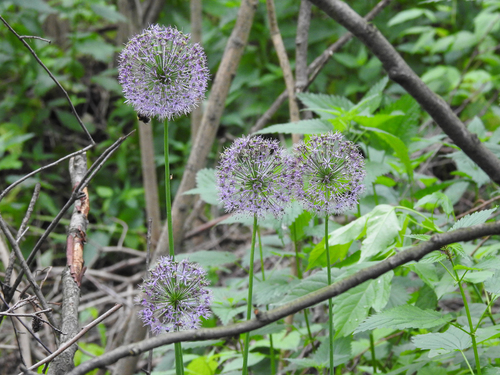
Source: WikipediaAllium victorialis, commonly known as victory onion, Alpine leek, and Alpine broad-leaf allium is a broad-leaved Eurasian species of wild onion. It is a perennial of the Amaryllis family that occurs widely in mountainous regions of Europe (including Caucasus) and parts of Asia (Himalayas). Some authors consider certain East Asian and Alaskan populations as constituting subspecies platyphyllum within the species Allium victorialis. Recent sources recognize this group as a distinct species, called Allium ochotense.
Description
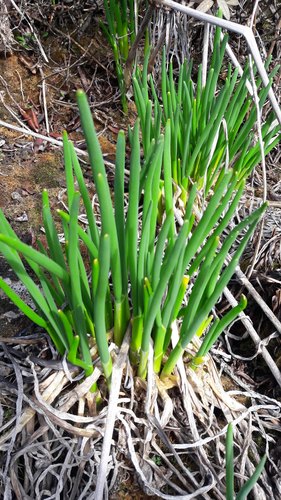
An onion family plant. It is a bulb plant. There can be one bulb or a cluster. The covering is greyish-brown. There are 2-3 leaves. The leaf stalk is 2-10 cm long and the leaf blade is 8-12 cm long by 3-9.5 cm wide. The base is wedge shaped narrowing into the leaf stalk. It tapers to the tip.
Edible Uses
The bulbs can be eaten raw or cooked as an onion substitute, and are roughly as pungent as garlic. They are small — around 10–20mm in diameter — and grow in clusters on a short rhizome. The stems and leaves are also eaten raw or cooked and are particularly popular in Japan. Flowers can be eaten raw or cooked as well.
Traditional Uses
The leaves and bulbs are eaten fresh in salads. They are also pickled. They are also dried. The flowers can be eaten raw and used as a garnish in salads.
Medicinal Uses
The root is antiscorbutic, carminative, diuretic, and vermifuge. It is used in the treatment of profuse menstruation.
Known Hazards
Although no individual reports regarding this species have been seen, there have been cases of poisoning caused by the consumption, in very large quantities and by some mammals, of certain members of this genus. Dogs seem to be particularly susceptible.
Distribution
It is a temperate plant. It grows in forests and shady moist places near streams between 600-2500 m altitude in N China. In Sichuan.
Where It Grows
Africa, Albania, Armenia, Asia, Balkans, Bosnia, Bulgaria, Caucasus, Central Asia, China, Egypt, Europe, France, Georgia, Germany, Himalayas, Hungary, India, Japan, Kazakhstan, Korea, Mongolia, North Africa, North America, Norway, Russia, Scandinavia, Slovenia, Tibet,
Cultivation
Requires a sunny position in a light well-drained soil. The bulbs should be planted fairly deeply. Most members of this genus are intolerant of competition from other growing plants. Grows well with most plants, especially roses, carrots, beet and chamomile, but it inhibits the growth of legumes. This plant is a bad companion for alfalfa, each species negatively affecting the other. Members of this genus are rarely if ever troubled by browsing deer.
Propagation
Seed is best sown as soon as it is ripe in a greenhouse or cold frame, where it germinates quickly. Seedlings can be grown on in the greenhouse for the first year, then dormant bulbs planted out in late summer of the following year if sufficiently developed — otherwise continue growing in pots for another year. Stored seed can be sown in spring under glass. Division can be done in summer after the plants have died down. This is fairly straightforward, though it is best to pot up the divisions until they are growing strongly before planting them out into their permanent positions.
Other Uses
The juice of the plant can be used as a moth repellent. The whole plant is also said to repel insects and moles.
Other Information
It is a commercially cultivated vegetable. It is sold in local markets.
Notes
There are about 300-700 Allium species. Most species of Allium are edible (Flora of China). All alliums are edible but they may not all be worth eating! They have also been put in the family Alliaceae.
Synonyms
Also Known As
Ainu negi, Cesan, Cheremsha, Div luk, Farn, Ge cong, Ghandzil, Gyozedelmes hagyma, Gyouja niniku, Hamas, Happu, Long-root garlic, Pukusa, S:ls:upi, Soghik, Soi, Vanež, Victory onion
References (25)
- Altschul, S.V.R., 1973, Drugs and Foods from Little-known Plants. Notes in Harvard University Herbaria. Harvard Univ. Press. Massachusetts. no. 258
- Bussman, R. W., et al, 2016, A comparative ethnobotany of Khevsureti, Samtskhe-Javakheti, Tusheti, Svaneti, and Racha-Lechkhumi, Republic of Georgia (Sakartvelo), Caucasus. Journal of Ethnobiology and Ethnomedicine (2016) 12:43
- Denes, A., et al, 2012, Wild plants used for food by Hungarian ethnic groups living in the Carpathian Basin. Acta Societatis Botanicorum Poloniae 81 (4): 381-396
- Dutt, B., et al, 2011, Ethnobotanical Survey of Plants used by Gaddi Tribe of Bharmour Area in Himachal Pradesh. ENVIS Bulletin: Himalayan Ecology 19, 2011
- https://en.wikipedia.org/wiki/List of wild edible plants in Mongolian cuisine
Show all 25 references Hide references
- Hu, Shiu-ying, 2005, Food Plants of China. The Chinese University Press. p 315
- Kaliszewska, I & Kolodziejska-Degorska, I, 2015, The social context of wild leafy vegetables uses in Shiri, Daghestan. Journal of Ethnobiology and Ethnomedicine, 11:63
- Kang, Y., et al, 2014, Wild food plants used by the Tibetans of Gongba Valley (Zouqu country, Gansu, China) Journal of Ethnobiology and Ethnomedicine 10:20
- Kays, S. J., and Dias, J. C. S., 1995, Common Names of Commercially Cultivated Vegetables of the World in 15 languages. Economic Botany, Vol. 49, No. 2, pp. 115-152
- Khasbagan, Hu-Yin Huai, and Sheng-Ji pei, 2000, Wild Plants in the Diet of Athorchin Mongol Herdsmen in Inner Mongolia. Economic Botany 54(4): 528-536
- Kuhnlein, H. V., et al, 2009, Indigenous Peoples' food systems. FAO Rome p 148
- Lim, T. K., 2015, Edible Medicinal and Non Medicinal Plants. Volume 9, Modified Stems, Roots, Bulbs. Springer p 6
- Nanagulyan, S., et al, 2020, Wild plants and fungi sold in the markets of Yerevan (Armenia). Journal of Ethnobiology and Ethnomedicine 16:26
- Negi, K. S., and Pant, K. C., 1992, Less-Known Wild Species of Allium L. (Amaryllidaceae) from Mountainous Regions of India. Economic Botany, Vol. 46, No. 1, pp. 112-114
- Nedelcheva A., 2013, An ethnobotanical study of wild edible plants in Bulgaria. EurAsian Journal of BioSciences 7, 77-94
- Pieroni, A., et al, 2020, Wild food plants traditionally gathered in central Armenia: archaic ingredients or future sustainable foods? Environment, Development and Sustainability. Springer p 6
- Plants for a Future database, The Field, Penpol, Lostwithiel, Cornwall, PL22 0NG, UK. http://www.scs.leeds.ac.uk/pfaf/
- Redzic, S. J., 2006, Wild Edible Plants and their Traditional Use in the Human Nutrition in Bosnia-Herzegovina. Ecology of Food and Nutrition, 45:189-232
- Seidemann J., 2005, World Spice Plants. Economic Usage, Botany, Taxonomy. Springer. p 27
- Sp. pl. 1:295. 1753
- Turner, N. J. et al, 2011, Edible and Tended Wild Plants, Traditional Ecological Knowledge and Agroecology. Critical Reviews in Plant Sciences, 30:198-225
- Wiersema, J. H. & Leon, B., 2013, World Economic Plants. A Standard Reference CRC Press. 2nd Ed. p 36
- Wild edible plants of Himachal Pradesh
- World Checklist of Useful Plant Species 2020. Royal Botanic Gardens, Kew
- Zhang, Y., et al, Yunatov’s Records of Wild Edible Plant Used by the Mongols in Mongolia During 1940- 1951: Ethnobotanical Arrangements and Discussions. Inner Mongolia Normal University. p 9