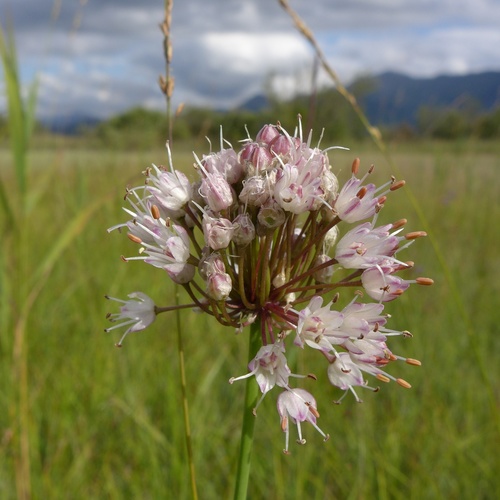
Allium wallichii
Kunth
Himalaya onion
iNaturalist· cc-by-nc
(c) Asim Giri, some rights reserved (CC BY-NC), uploaded by Asim Giri
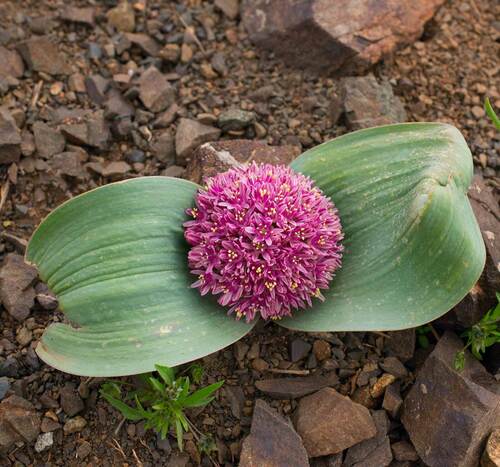
iNaturalist· cc-by-nc
(c) Elizabeth Byers, some rights reserved (CC BY-NC), uploaded by Elizabeth Byers
iNaturalist· cc-by-nc
(c) Suresh Ghimire, some rights reserved (CC BY-NC), uploaded by Suresh Ghimire
Summary
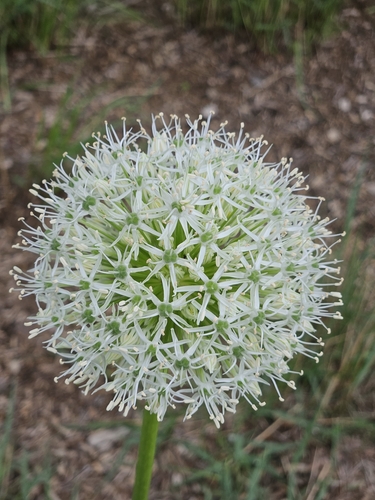
Source: WikipediaAllium wallichii is a plant species native to India, Nepal, Sikkim, Bhutan, Myanmar, and parts of China (Guangxi, Guizhou, Hunan, Sichuan, Tibet, Xizang, Yunnan). It grows at elevations of 2300–4800 m. Allium wallichii has elongate roots and clusters of narrow bulbs. Scapes are up to 110 cm tall, triangular in cross-section. Leaves are flat, up to 20 mm across, usually shorter than the scape. Flowers are white, pink, red, dark purple (sometimes almost black).
Description
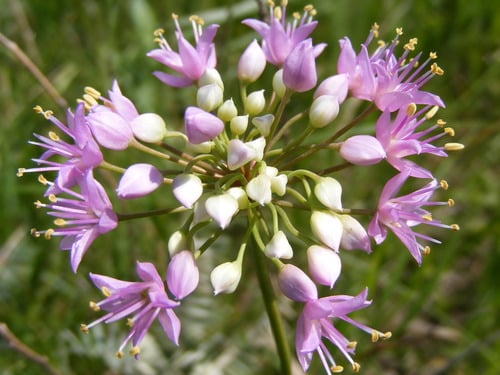
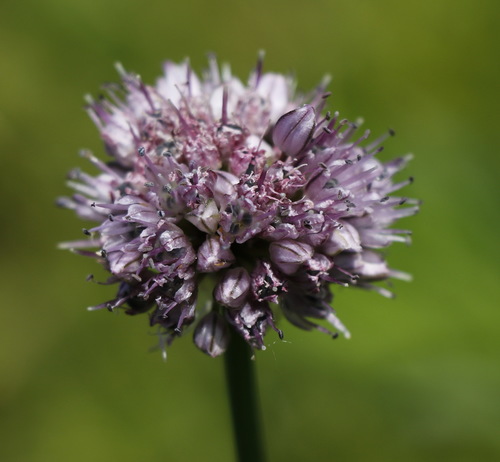
An onion family plant. It is a herb which produces a bulb. It grows to about 65 cm high. The bulbs are small and clustered. The roots are long and thick. The stem base is covered with the leaf sheath. The leaves are narrow and flat. They have a garlic like smell when squeezed. The flowers are purple. They occur in clusters at the top of the plant. Some varieties have been described.
Edible Uses
Young leaves can be cooked as a vegetable, and the dried leaves are used as a condiment in curries and pickles. The bulbs, though poorly developed and quite small, can be eaten raw or cooked — the cloves serve as a garlic substitute. Flowers can be eaten raw and used as a garnish on salads.
Traditional Uses
The young leaves are eaten as a vegetable. Dried leaves are used for flavouring. The cloves are used as a garlic substitute. The flowers are eaten raw and used as a garnish in salads. The plant is used for soup.
Medicinal Uses
Bulbs boiled and then fried in ghee are eaten in the treatment of cholera and dysentery. Chewing the raw bulb is used to treat coughs and colds, and eating the bulbs is said to help ease symptoms of altitude sickness. As with other members of this genus, the plant contains sulphur compounds that, when included regularly in the diet, may help reduce blood cholesterol levels, support the digestive system, and tonify the circulatory system.
Known Hazards
Although no individual reports regarding this species have been seen, there have been cases of poisoning caused by the consumption, in very large quantities and by some mammals, of certain members of this genus. Dogs seem to be particularly susceptible.
Distribution
It is a temperate plant. In Nepal it grows at 2400-4500 m altitude. It grows in moist, rocky places. In China it grows in forest margins and stream banks between 2300-4800 m altitude in S China. In Sichuan and Yunnan.
Where It Grows
Asia, Bangladesh, Bhutan, China, Himalayas, India, Indochina, Myanmar, Nepal, Northeastern India, Pakistan, SE Asia, Sikkim, Sri Lanka, Tibet,
Cultivation
An easily grown plant, it prefers a sunny position in a light well-drained soil. This species is not hardy in the colder areas of Britain, it tolerates temperatures down to between -5 and -10°c. It succeeds outdoors in N.W. England where it sets seed. The bulbs should be planted fairly deeply. Most members of this genus are intolerant of competition from other growing plants. Grows well with most plants, especially roses, carrots, beet and chamomile, but it inhibits the growth of legumes. This plant is a bad companion for alfalfa, each species negatively affecting the other. Members of this genus are rarely if ever troubled by browsing deer.
Propagation
Seed can be sown in spring in a cold frame. Prick out seedlings into individual pots once large enough to handle — placing three plants per pot will produce clumps more quickly. Grow them on under glass for at least their first winter, then plant out in spring once they are vigorous and of sufficient size. Division can be done in spring, and plants can be divided successfully at any point during the growing season. Pot up the divisions in a cold frame or greenhouse until growing well before planting out into permanent positions.
Other Uses
The juice of the plant can be used as a moth repellent, and the whole plant is said to repel insects and moles.
Other Information
Plants are sold in markets.
Notes
There are about 300-700 Allium species. Most species of Allium are edible (Flora of China). All alliums are edible but they may not all be worth eating! They have also been put in the family Alliaceae.
Synonyms
Also Known As
Ban lasun, Ban lasun, Ban nhoo, Bathatuva, Dundu sag, Dung-dunge, Duo xing jiu, Dzimbu, Ge zi, Gobka, Gokpa, Guo guo, Jimbur, Jungli piyaj, Koje, Laadu, Lainka, Lathum, Palengu, Oang-rko-spa, Sekkwa, Sekuwa, Zimbu nagpo, Zim nak
References (26)
- Altschul, S.V.R., 1973, Drugs and Foods from Little-known Plants. Notes in Harvard University Herbaria. Harvard Univ. Press. Massachusetts. no. 273
- Aryal, K. P., et al, 2018, Diversity and use of wild and non-cultivated edible plants in the Western Himalaya. Journal of Ethnobiology and Ethnomedicine (2018) 14:10
- Brickell, C. (Ed.), 1999, The Royal Horticultural Society A-Z Encyclopedia of Garden Plants. Convent Garden Books. p 98
- Chen Xinqi, Liang Songyun, Xu Jiemei, Tamura M.N., Liliaceae. Flora of China. p 106
- Cheng, Z., et al, 2022, Ethnobotanical study on wild edible plants used by Dulong people in northwestern Yunnan, China. Journal of Ethnobiology and Ethnomedicine (2022) 18:3
Show all 26 references Hide references
- Chettri, N. & Sharma, E., Non-timber Forest Produce: Utilization, Distribution and Status in the Khangchendzonga Biosphere Reserve, Sikkim, India.
- Dangol, D. R. et al, 2017, Wild Edible Plants in Nepal. Proceedings of 2nd National Workshop on CUAOGR, 2017.
- Davis, S.D., Heywood, V.H., & Hamilton, A.C. (eds), 1994, Centres of plant Diversity. WWF. Vol 1 or 2. p 99
- Ding, X., 2021, Collection calendar: the diversity and local knowledge of wild edible plants used by Chenthang Sherpa people to treat seasonal food shortages in Tibet, China. Journal of Ethnobiology and Ethnomedicine 17:40
- Enum. pl. 4:443. 1843
- Facciola, S., 1998, Cornucopia 2: a Source Book of Edible Plants. Kampong Publications, p 7
- Gautam, R. S., et al, 2022, Ethnobotanical Review of Wild Edible Plants of Nepal. Journal of Natural History Museum Volume 32, 2021-22 p 101
- Ghimire, S. K., et al, 2008, Non-Timber Forest Products of Nepal Himalaya. WWF Nepal p 20
- Global Plants JSTOR
- Guo, C., et al, 2022, An Ethnobotany Survey of Wild Plants Used by the Tibetan People of the Yadong River Valley, Tibet, China. Journal of Ethnobiology and Ethnomedicine
- Joshi, N., et al, 2007, Traditional neglected vegetables of Nepal: Their sustainable utilization for meeting human needs. Tropentag 2007. Conference on International Agricultural Research for Development.
- Joshi, N. & Siwakoti, M., 2012, Wild Vegetables Used by Local Community of Makawanpur District and Their Contribution to Food Security and Income Generation. Nepal Journal of Science and Technology Vol. 13, No. 1 (2012) 59-66
- Khakurel, D., et al, 2021, Foods from the wild: Local knowledge, use pattern and distribution in Western Nepal. PLOS ONE.
- Manandhar, N.P., 2002, Plants and People of Nepal. Timber Press. Portland, Oregon. p 81
- Misra, S. et al, 2008, Wild leafy vegetables: A study of their subsistence dietetic support to the inhabitants of Nanda Devi Biosphere reserve, India. Journal or Ethnobiology and Ethnomedicine. 4:15
- Negi, K.S., 1988, Some little known wild edible plants of U.P. Hills. J. Econ. Tax. Bot. Vol. 12 No. 2 pp 345-360
- Plants for a Future database, The Field, Penpol, Lostwithiel, Cornwall, PL22 0NG, UK. http://www.scs.leeds.ac.uk/pfaf/
- Rawat, G.S., & Pangtey, Y.P.S., 1987, A Contribution to the Ethnobotany of Alpine Regions of Kumaon. J. Econ. Tax. Bot. Vol. 11 No. 1 pp 139-147
- Sundrayal, M., et al, 2004, Dietary Use of Wild Plant Resources in the Sikkim Himalaya, India. Economic Botany 58(4) pp 626-638
- Uprety, Y., et al, 2016, Traditional use and management of NTFPs in Kangchenjunga Landscape: implications for conservation and livelihoods. Journal of Ethnobiology and Ethnomedicine (2016) 12:19
- Wild edible plants of Himachal Pradesh