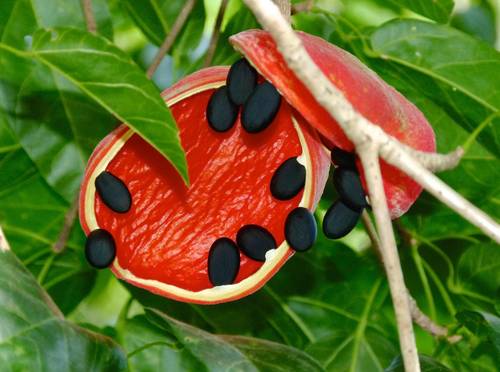
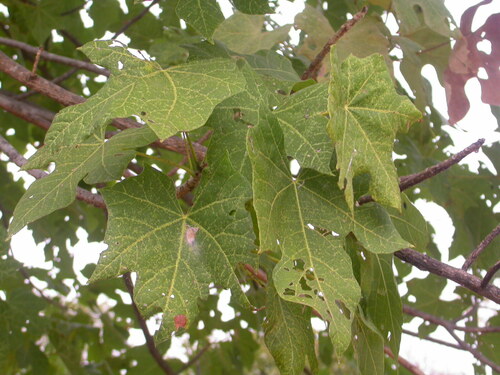
Hibiscus panduriformis
Burm. f.
Yellow Hibiscus
iNaturalist· cc-by-nc
(c) Himanshu Pandav, some rights reserved (CC BY-NC), uploaded by Himanshu Pandav
iNaturalist· cc-by
(c) Brendan Costello, some rights reserved (CC BY), uploaded by Brendan Costello
iNaturalist· cc-by-sa
(c) J.M.Garg, some rights reserved (CC BY-SA)
Summary
Source: WikipediaHibiscus panduriformis, the yellow hibiscus, is a species of flowering plant in the family Malvaceae, native to much of Tropical Africa, Madagascar, Yemen, the Indian Subcontinent, and Myanmar. An erect shrub reaching 2.5 m (8 ft), it is a minor weed of cotton.
Description
A small shrub. It has a woody rootstock. It often only has a few erect stems. It grows 2.7 m tall. The branches are densely hairy. Young growth is greyish. The leaves are 4-10 cm long by 3-8 cm wide. They are broadly oval to heart shaped. The leaf stalks are 3-7 cm long. They are dull green and have hairs on both surfaces. There are teeth along the edges. The flowers are 6-9 cm across and bright yellow. They have a dark red blotch at the centre. The flowers occur singly in the axils of the upper leaves. The fruit is a capsule 1.2-1.7 cm long and 1-1.2 cm wide. It is densely hairy. The seeds have short hairs.
Edible Uses
The seeds are mixed with millet and ground into flour. Flowers and leaves are also used as vegetables.
Traditional Uses
The seeds are mixed with millet and ground into flour.
This uses section is brief — help expand it
Known Hazards
The plant is thickly hairy and often has urticating (stinging) bristles.
Distribution
A tropical plant. It suits tropical places. It grows in northern and central Australia. It grows in woodland on heavy soils along stream banks. It needs an open sunny position and well drained soil. It is not very frost tolerant. It grows in savannah areas in West Africa. Bombay.
Where It Grows
Africa, Asia, Australia, Botswana, Burkina Faso, East Africa, India, Madagascar, Malawi, Mali, Mozambique, Myanmar, Nigeria, SE Asia, Senegal, West Africa, Zambia, Zimbabwe,
Cultivation
Plants can be grown from seed or cuttings.
Propagation
Seed - sow in situ or in containers. Germination is usually fairly rapid and no special pretreatment is needed, although germination will be faster if the seed is abraded or soaked prior to sowing. Prick out container-grown seedlings into individual pots when they are large enough to handle and plant them out into their permanent positions when they are 10cm or more tall. Cuttings of half-ripe wood in a frame. They generally strike readily, particularly if cuttings are taken on an angle through a node and rooting hormone is applied to their ends. Division of the rootstock.
Other Uses
A fibre obtained from the stems is used for making twine, bags etc.
Production
Plants grow rapidly in the wet season.
Notes
There are about 220 Hibiscus species.
Synonyms
Also Known As
Da orignan, Kasli, Kere da ka, Taw-yon-padi
References (14)
- Bindon, P., 1996, Useful Bush Plants. Western Australian Museum. p 159
- Bodkin, F., 1991, Encyclopedia Botanica. Cornstalk publishing, p 558
- Burkill, H. M., 1985, The useful plants of west tropical Africa, Vol. 4. Kew.
- Elliot, W.R., & Jones, D.L., 1990, Encyclopedia of Australian Plants suitable for cultivation. Vol 5. Lothian. p 360
- Fl. indica 151, t. 47, fig. 2. 1768 "panduraeformis"
Show all 14 references Hide references
- GAMMIE,
- Grubben, G. J. H. and Denton, O. A. (eds), 2004, Plant Resources of Tropical Africa 2. Vegetables. PROTA, Wageningen, Netherlands. p 562
- Kenneally, K.E., Edinger, D. C., and Willing T., 1996, Broome and Beyond, Plants and People of the Dampier Peninsula, Kimberley, Western Australia. Department of Conservation and Land Management. p 122
- Lord, E.E., & Willis, J.H., 1999, Shrubs and Trees for Australian gardens. Lothian. p 175
- Norrington, L., & Campbell, C., 2001, Tropical Food Gardens. Bloomings Books. p 65
- Paczkowska, G. & Chapman, A.R., 2000, The Western Australian Flora. A Descriptive Catalogue. Western Australian Herbarium. p 290
- Petheram, R.J. and Kok, B., 2003, Plants of the Kimberley Region of Western Australia. UWA Press p 335
- Townsend, K., 1994, Across the Top. Gardening with Australian Plants in the tropics. Society for Growing Australian Plants, Townsville Branch Inc. p 256
- Wheeler, J.R.(ed.), 1992, Flora of the Kimberley Region. CALM, Western Australian Herbarium, p 218