Sterculia villosa
Roxb. ex Smith
Elephant rope tree, Hairy kepuh tree
iNaturalist· cc-by-sa
(c) Dinesh Valke, some rights reserved (CC BY-SA)
iNaturalist· cc-by-sa
(c) Dinesh Valke, some rights reserved (CC BY-SA)
iNaturalist· cc-by-sa
(c) Dinesh Valke, some rights reserved (CC BY-SA)
Summary
Source: WikipediaSterculia villosa, the hairy sterculia, or elephant rope tree, known vernacularly as Sardol, Udal, or Udar in Northeast India, is a medium-sized, monoecious tree. A leaf from this plant is characterized by a petiole about 25–40 cm long and by a lamina composed of 5-7-lobes, approximately 20–40 cm long and wide. The leaves are glabrescent on the top but tomentose on the bottom. The elephant rope tree's panicles are about 15–30 cm long, rusty in color and pendulous. Its flowers are unisexual and have pedicels about 4–8 mm long and thread-like bracteoles; the flowers are easily detached and tend to be shed at an early stage. Its seeds are oblong, smooth, and black. It is distributed throughout India and Bangladesh, although it is cultivated elsewhere due to its fast-spreading nature. Sterculia villosa possesses certain paper-making characteristics. In Northeast India and Bangladesh, the plant's pulp is generally used for making tea boxes and light-weight packing cases, apart from use as fire-wood in certain rural areas.
Description
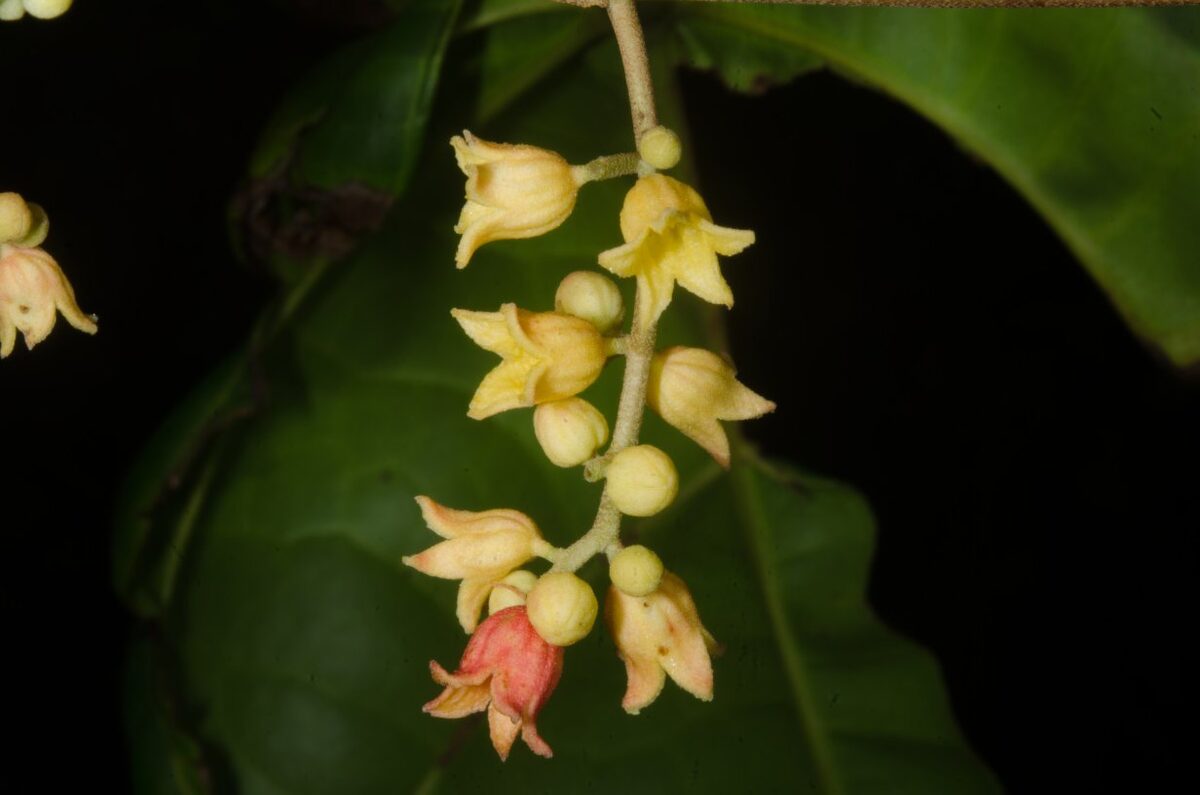
A tree that loses its leaves. It grows to 10 m high. The leaves have long stalks. The leaves are 30-48 cm long. They are heart shaped with 5-7 deep lobes. Young leaves are red and leaves are crowded near the top of the tree. There are star like hairs above and straight hairs underneath. The flowers are stalked. They are yellow in rusty hairy flower arrangements.
Edible Uses
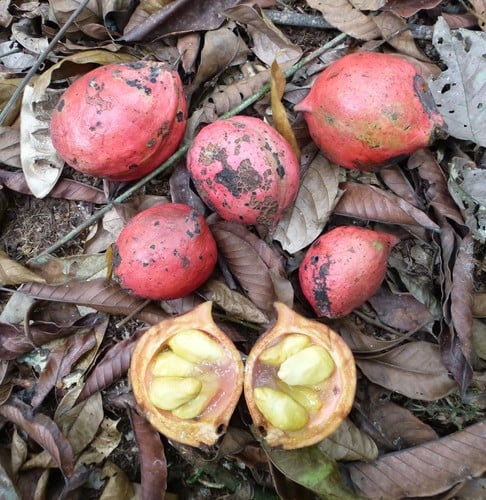
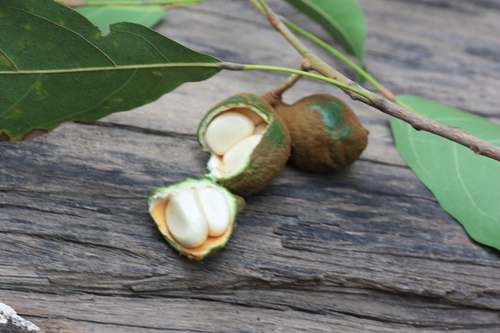
The seeds are roasted or baked and eaten. The ripe fruit is eaten raw. The powdered root is mixed with rice flour to make bread soft and tasty. The root also serves as a famine food.
Traditional Uses
The powdered root in mixed with rice flour to make bread soft and tasty. The seeds are roasted or baked and eaten. The bark exudes a gum used as a substitute for gum tragacanth. The ripe fruit is eaten.
Medicinal Uses
The bark exudes a gum used as a substitute for gum tragacanth.
Distribution
It is a tropical plant. In Nepal it grows between 300-600 m altitude. It grows in open places. In XTBG Yunnan.
Where It Grows
Andamans, Asia, Bangladesh, Bhutan, Cambodia, China, Himalayas, India, Indochina, Indonesia, Laos, Myanmar, Nepal, Northeastern India, Pakistan, SE Asia, Sikkim, Thailand,
Cultivation
Plants are grown from seed.
Propagation
A physical dormancy caused by the hard seed coat of the mature seeds of many species in this genus can be overcome by scarifying the seed. This is carried out by cutting away or abrading some of the seed coat to allow the ingress of water, though great care must be taken not to damage the embryo. The aril surrounding the seed should also be removed - this is easiest when it has been softened through soaking in water. The seeds germinate optimally at temperatures between 20 - 30°c. They can be sown in a nursery seedbed or in containers. A germination rate of about 95%, occurring within about 2 weeks can be expected if the seed has been properly treated.
Other Uses
A coarse but very strong fibre is obtained from the bark. It is made into ropes, hats and bags. The bast, or rather all the layers of the bark, can be stripped from the bottom to the top of the tree with the greatest facility. A fine, pliable rope is made from the inner layers, while the outer ones yield a coarse rope, which is strong and durable and little injured by water. The rope is said to become stronger for a time from being frequently wetted, and if constantly exposed to moisture it seldom lasts more than eighteen months. A good paper is said to have been made from it in India, but the samples of fibre sent to Europe were not favourably reported on as paper-making materials. A white gum is obtained from the bark. It exudes freely from scars on the bark. It is only slightly soluble and has no adhesive properties. The wood is soft. It is used for paper pulp.
Production
In NE India fruit are available May to June.
Other Information
The root is a famine food.
Notes
Also put in the family Sterculiaceae.
Synonyms
Also Known As
Arni vakenar, Bilidale, Chahrao, Chauri, Chekong, Dieng-star, Ganjher, Gulbodla, Gulkandar, Hta-gahta-kahta, Jintekong, Kanhlyem, Khau-pui, Khaw-wen, Kodalo, Kumbhi, Kummaripoliki, Kuthada, Murattham, Narila, Nemja, Odal, Odol, Paw-leng, Pohon kepuh bulu, Pohon kepuh udal, Sarda, Sardal, Sargik esing, Sargog, Savaya, Shaw-haw, Shaw-ni, Sheydey, Ubak, Udal, Udar, Vakka
References (32)
- Ambasta, S.P. (Ed.), 2000, The Useful Plants of India. CSIR India. p 601
- Baishya, S. Kr., et al, 2013, Survey of Wild Edible Fruits of Dhubri District, Assam, India. Plant Archives Vol 13 (1): 155-158
- Bajpai, O., et al, 2015, Tree species of the Himalayan Terai region of Uttar Pradesh, India: a checklist. Check List 11(4): 1718
- Bandyopadhyay, S. et al, 2009, Wild edible plants of Koch Bihar district, West Bengal. Natural Products Radiance 8(1) 64-72
- Brahma, S., et al, 2013, Wild edible fruits of Kokrajhar district of Assam, North-East India, Asian Journal of Plant Science and Research 3(6):95-100
Show all 32 references Hide references
- Burkill, I.H., 1966, A Dictionary of the Economic Products of the Malay Peninsula. Ministry of Agriculture and Cooperatives, Kuala Lumpur, Malaysia. Vol 2 (I-Z) p 2115
- Dobriyal, M. J. R. & Dobriyal, R., 2014, Non Wood Forest Produce an Option for Ethnic Food and Nutritional Security in India. Int. J. of Usuf. Mngt. 15(1):17-37
- Ethnobotany of Karbis. Chapter 4 in p 106
- Facciola, S., 1998, Cornucopia 2: a Source Book of Edible Plants. Kampong Publications, p 239
- Gautam, R. S., et al, 2020, Wild Edible Fruits of Nepal. Int. J. Appl. Sci. Biotechnol. Vol 8(3): 289-304
- Lim, T. K., 2015, Edible Medicinal and Non Medicinal Plants. Volume 9, Modified Stems, Roots, Bulbs. Springer p 80
- Lungphi, P., Wangpan, T. & Tangjang, S., 2018, Wild edible plants and their additional uses by the Tangsa community living in the Changlang district of Arunachal Pradesh, India. Pleione 12(2): 151 - 164. 2018.
- Mukhia, P.K., et al, 2013, Wild plants as Non Wood Forest Products used by the rural community of Dagana, a southern foothill district of Bhutan, SAARC Journal, 27 pages
- Pegu, R., et al, 2013, Ethnobotanical study of Wild Edible Plants in Poba Reserved Forest, Assam, India. Research Journal of Agriculture and Forestry Sciences 1(3):1-10
- Fl. ind. ed. 1832, 3:153. 1832 (Hort. bengal. 50. 1814, nom. nudum)
- Flora of Pakistan. www.eFloras.org
- Gardner, S., et al, 2000, A Field Guide to Forest Trees of Northern Thailand, Kobfai Publishing Project. p 79
- Janaki, B. & R. B. Sashidhar, 1998, Physico-chemical analysis of gum kondagogu (Cochlospermum gossypium): a potential food additive. Food Chemistry, Vol. 61, No. 1/2, pp. 231-236
- Kar, A., et al, 2013, Wild Edible Plant Resources used by the Mizos of Mizoram, India. Kathmandu University Journal of Science, Engineering and Technology. Vol. 9, No. 1, July, 2013, 106-126
- Manandhar, N.P., 2002, Plants and People of Nepal. Timber Press. Portland, Oregon. p 442
- Mozhui, R., et al, 2011, Wild edible fruits used by the tribals of Dimapur district of Nagaland, India. Pleione 5(1): 56 - 64
- Patiri, B. & Borah, A., 2007, Wild Edible Plants of Assam. Geethaki Publishers. p 17
- Sawian, J. T., et al, 2007, Wild edible plants of Meghalaya, North-east India. Natural Product Radiance Vol. 6(5): p 422
- Singh, H.B., Arora R.K.,1978, Wild edible Plants of India. Indian Council of Agricultural Research, New Delhi. p 83
- Sukarya, D. G., (Ed.) 2013, 3,500 Plant Species of the Botanic Gardens of Indonesia. LIPI p 526
- Tanaka,
- Teron, R. & Borthakur, S. K., 2016, Edible Medicines: An Exploration of Medicinal Plants in Dietary Practices of Karbi Tribal Population of Assam, Northeast India. In Mondal, N. & Sen, J.(Ed.) Nutrition and Health among tribal populations of India. p 156
- Thai Forestry Bulletin 23:62-108, 1995
- Toppo, P. et al, 2016, Wild edible plants of Dhamtari district of Chhattisgarh, India. Van Sangyan Vol. 3, No. 4
- Uprety, Y., et al, 2012, Diversity of use and local knowledge of wild edible plant resources in Nepal. Journal of Ethnobotany and Ethnomedicine 8:16
- Watt,
- World Checklist of Useful Plant Species 2020. Royal Botanic Gardens, Kew