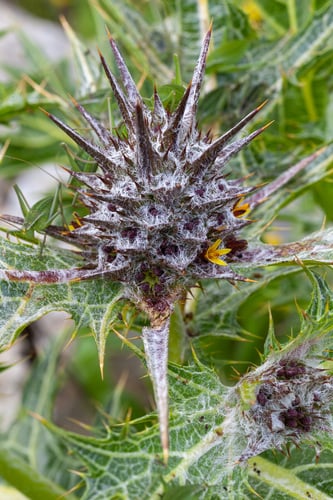
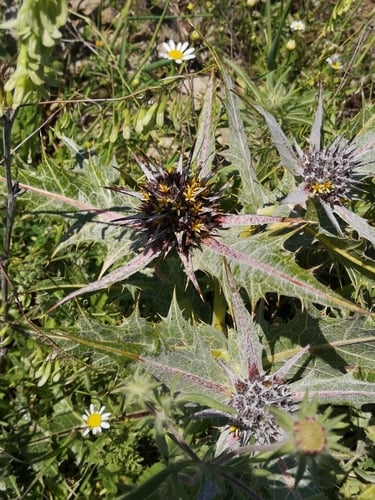
Helichrysum italicum
(Roth) G. Don
Curry plant
iNaturalist· cc-by-nc
(c) Jakob Fahr, some rights reserved (CC BY-NC), uploaded by Jakob Fahr
iNaturalist· cc-by-nc
(c) Martinho, some rights reserved (CC BY-NC)
Summary
Source: WikipediaHelichrysum italicum is a species of flowering plant in the family Asteraceae. It is sometimes called the curry plant because of the strong fragrance of its leaves. Other common names include Italian strawflower and immortelle. It grows on dry, rocky or sandy ground around the Mediterranean. The stems are woody at the base and can reach 60 centimetres (24 in) or more in height. The clusters of yellow flowers are produced in summer, retain their colour after picking, and are used in dried flower arrangements. This plant is sometimes used as a spice. Although called "curry plant" and smelling like curry powder, it is not related to this mixture of spices, nor the curry tree (Murraya koenigii), and is not used as masala for curry dishes either. Rather, it has a resinous, somewhat bitter aroma reminiscent of sage or wormwood. Its young shoots and leaves are used in a stew of Mediterranean meat, fish, or vegetable dishes until they have imparted their flavour and removed before serving.
Description
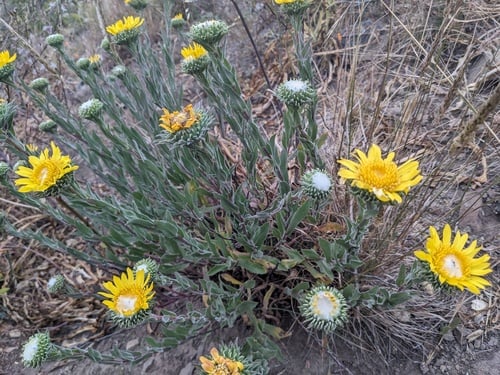
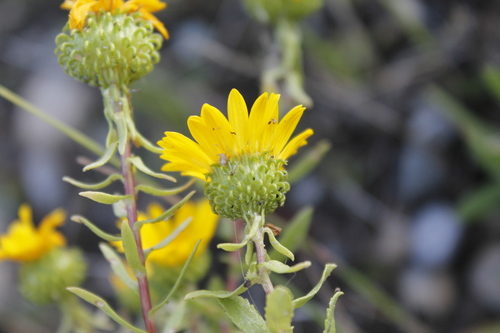
A plant which keeps growing from year to year. It grows to 45 cm high. It can spread 50 cm wide. The leaves are silver-grey in colour. They are narrow and have a few hairs. The leaves are 30 mm long. The flowers are small and white to yellow. They occur in heads in small clusters. These are 15-80 mm across. The involucre of the bracts is dull yellow and oblong.
Edible Uses
The leaves are used as a flavouring in salads and cooked foods, carrying a slight curry flavour, though this does not transfer very strongly to other foods. An essential oil — derived from the leaves — is used as a flavouring to enhance fruit flavours in sweets, ice cream, baked goods, soft drinks, and chewing gum. A tea is made from the flower heads.
Traditional Uses
The leaves have a curry flavour. They are finely chopped and added to scrambled eggs. They are used to season meat, fish and potatoes. Flower heads are used for tea. An essential oil extract is used to enhance fruit flavours in ice cream, candies and soft drinks.
Medicinal Uses
None known.
Distribution
It is a warm temperate plant. It does well on a sandy soil. It needs a sunny soil. It can stand coastal exposure. In Hobart Botanical gardens. It suits hardiness zones 8-10.
Where It Grows
Africa, Australia, Balkans, Croatia, Europe, France, Greece, Hawaii, Italy, Mediterranean, North Africa, Pacific, Portugal, Slovenia, Spain, Tasmania, USA,
Cultivation
Plants can be grown from seed. The temperature needs to be at least 13-16°C. It can be grown by basal cuttings. The plant can be pruned back.
Propagation
Sow seed in February or March in a greenhouse. Germination usually occurs within 2–3 weeks at 20°C. When seedlings are large enough to handle, prick them out into individual pots and grow on in the greenhouse for at least their first winter. Plant out into permanent positions in late spring or early summer, after the last expected frosts. Alternatively, take half-ripe wood cuttings of 5cm with a heel in June or July and root in a frame; they root in about 4 weeks with a good success rate.
Other Uses
Plants can be grown as a low hedge; the subspecies H. italicum serotinum (Boiss.) P.Fourn. is normally used for this purpose and responds well to trimming.
Notes
There have been 500 Helichrysum species but these may be regrouped.
Synonyms
Also Known As
Laški smilj, Smilj
References (16)
- Blamey, M and Grey-Wilson, C., 2005, Wild flowers of the Mediterranean. A & C Black London. p 437
- Bremness, L., 1994, Herbs. Collins Eyewitness Handbooks. Harper Collins. p 106
- Brickell, C. (Ed.), 1999, The Royal Horticultural Society A-Z Encyclopedia of Garden Plants. Convent Garden Books. p 505
- Brown, D., 2002, The Royal Horticultural Society encyclopedia of Herbs and their uses. DK Books. p 232
- Cheifetz, A., (ed), 1999, 500 popular vegetables, herbs, fruits and nuts for Australian Gardeners. Random House p 128
Show all 16 references Hide references
- Cundall, P., (ed.), 2004, Gardening Australia: flora: the gardener's bible. ABC Books. p 685
- Dolina, K. & Luczaj, L., 2014, Wild food plants used on the Dubrovnik coast (south-eastern Croatia) Acta Soc Bot Pol 83(3):175–181
- Facciola, S., 1998, Cornucopia 2: a Source Book of Edible Plants. Kampong Publications, p 40
- Hibbert, M., 2002, The Aussie Plant Finder 2002, Florilegium. p 119
- J. C. Loudon, Hort. brit. ed. 1:342. 1830
- Lentini, F. and Venza, F., 2007, Wild food plants of popular use in Sicily. J Ethnobiol Ethnomedicine. 3: 15
- Morton, 1976,
- Seidemann J., 2005, World Spice Plants. Economic Usage, Botany, Taxonomy. Springer. p 173
- Staples, G.W. and Herbst, D.R., 2005, A tropical Garden Flora. Bishop Museum Press, Honolulu, Hawaii. p 162
- Tardio, J., et al, Ethnobotanical review of wild edible plants in Spain. Botanical J. Linnean Soc. 152 (2006), 27-71
- World Checklist of Useful Plant Species 2020. Royal Botanic Gardens, Kew