Geophila repens
(Linn.) I. M. Johnston
Caua-piri
iNaturalist· cc-by-nc
(c) everettdaugherty, some rights reserved (CC BY-NC)
iNaturalist· cc-by-nc-sa
(c) Rich Hoyer, some rights reserved (CC BY-NC-SA), uploaded by Rich Hoyer
iNaturalist· cc-by-nc
(c) Enrique, some rights reserved (CC BY-NC), uploaded by Enrique
Description
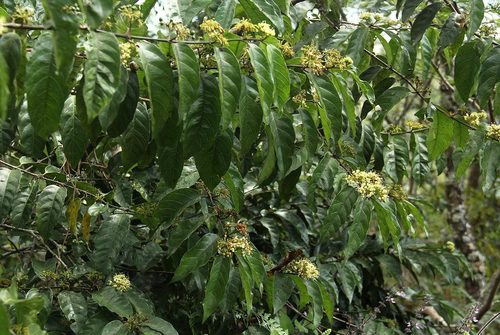
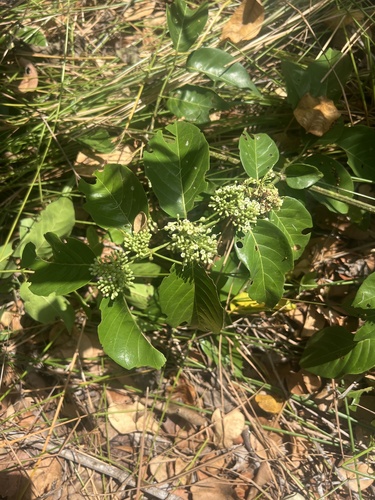
A herb. It creeps along the ground. It has underground stems or rhizomes. It forms roots at the nodes. The stems are 20-30 cm long. They have flattened hairs. The flowering shoots are 7.5 cm high. The leaves are kidney shaped with a round tip. They are 3.5 cm long by 5.5 cm wide. There can be some hairs underneath. The leaf stalk is 11.5 cm long. The flowers usually occur singly. They are white. The fruit is a berry. It is 5-12 mm across. It is shiny orange-red when ripe. It has the remains of the calyx at the top.
Edible Uses
The leaves are prepared as a drink.
Medicinal Uses
The leaves are sometimes chewed as a cough remedy. A decoction of the boiled plant is used as a treatment for coughs. The fruits are considered to be an effective antifungal agent. They are used in the treatment of skin fungi. They are crushed and rubbed on facial dermatitis that consists of white spots.
Distribution
A tropical plant. It grows in the forest in West Africa and many other tropical places. It grows in shady, wet forest floors. It grows between 300-1,140 m above sea level. In Argentina it grows below 500 m above sea level. In Yunnan. In Calicut Uni BG.
Where It Grows
Africa, American Samoa, Antilles, Asia, Angola, Argentina, Australia, Belize, Bolivia, Brazil, Burkina Faso, Central Africa, Central African Republic, CAR, Central America, China, Colombia, Congo, Costa Rica, Cuba, Dominican Republic, East Africa, Ecuador, El Salvador, Fiji, Gabon, Ghana, French Guiana, Guatemala, Guiana, Guianas, Guinea, Guinée, Guinea-Bissau, Guyana, Haiti, Honduras, India, Indochina, Jamaica, Laos, Madagascar, Malawi, Mexico, Mozambique, Nicaragua, Nigeria, Pacific, Panama, Paraguay, Peru, Puerto Rico, Rotuma, Sao Tome and Principe, SE Asia, Sierra Leone, South America*, Suriname, Taiwan, Trinidad-Tobago, Venezuela, Wallis and Futuna, West Africa, West Indies, Zimbabwe,
Cultivation
Grows best in the dappled shade of a woodland. Prefers a humus-rich soil. Succeeds in moist to wet soils. The plant has spread widely from its original range and is now naturalized through most of the tropics and subtropics. It is sometimes found as a weed of banana plantations.
Other Uses
The plant forms dense, close colonies in shady places and so can be used as a ground cover plant.
Other Information
It is cultivated.
Notes
There are about 20-30 Geophila species. Most are tropical.
Synonyms
Also Known As
Asaikyirisaem, Corrida yerba de guava, Ekoro, Jelen mudu ta'pe, Kiuka pahu panka, Oreja del diablo, Shikshi panka, Sigueme, Supay rinri, Tetana, Tetewa, Ti togo, Tono, Txiv quav yaj teb
References (10)
- Burkill, H. M., 1985, The useful plants of west tropical Africa, Vol. 4. Kew.
- Franklin, J., Keppel, G., & Whistler, W., 2008, The vegetation and flora of Lakeba, Nayau and Aiwa Islands, Central Lau Group, Fiji. Micronesica 40(1/2): 169–225, 2008
- Jardin, C., 1970, List of Foods Used In Africa, FAO Nutrition Information Document Series No 2.p 79
- Kew Plants of the World Online
- Martin, F.W. & Ruberte, R.M., 1979, Edible Leaves of the Tropics. Antillian College Press, Mayaguez, Puerto Rico. p 216
Show all 10 references Hide references
- Torre, de la, L., et al, 2008, Enciclopedia de las Plantas Útiles del Ecuador. Herbario QCA. Pontificia Universidad Católica del Ecuador. p 546
- von Katja Rembold, 2011, Conservation status of the vascular plants in East African rain forests. Dissertation Universitat Koblenz-Landau p 168
- Whitney, C. W., et al, 2014, Conservation and Ethnobotanical Knowledge of a Hmong Community in Long Lan, Luang Prabang, Lao People’s Democratic Republic. Ethnobotany Research and Applications 12:643-658
- World Checklist of Useful Plant Species 2020. Royal Botanic Gardens, Kew
- www.colecionandofrutas.org